B♭ baritone · treble clef · 31 notes
Baritone Fingering Chart (Treble Clef)
Tap any note to see which valves to press and hear the pitch. Treble-clef baritone parts read exactly like trumpet parts, an octave lower in sound. Reading bass clef? Use the euphonium chart — it is the same instrument.
Plays the real sound: written A3 sounds concert G2 on baritone (treble clef).
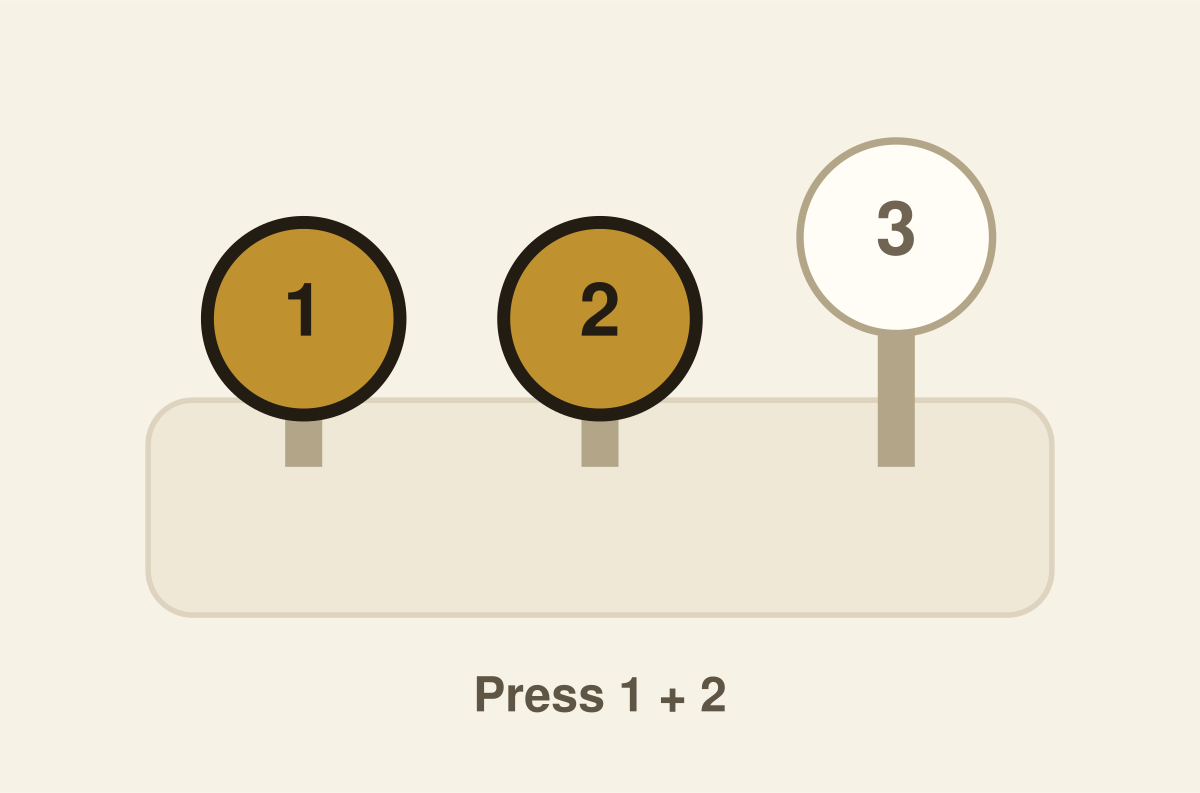
A3 is the 2nd partial with valves 1 and 2, 3 semitones below open C4. It sounds concert G2. With valves 1 and 2 down the tuning is honest, which makes it a useful note to tune against. Low baritone notes want a big, relaxed aperture and plenty of slow air; let the larger mouthpiece do the work.
Everything about A3 on baritone (treble clef) →How to read this chart
The three valves are numbered 1 for the one under your index finger, then 2 under the middle finger and 3 under the ring finger — on the baritone they are played with the right hand. A filled, dropped cap means press that valve; a pale, raised cap means leave it up. No caps down is an open note.
The same fingering appears at several pitches, and that is not a mistake. Valves only choose how long the tube is; which note of that tube sounds is set by the harmonic partial your air and lips find. Every note on this chart is tagged with its partial as well as its valves.
Treble clef or bass clef?
The baritone is one instrument with two ways of writing its music. Treble-clef baritone (often marked "baritone T.C.") is written in B♭ like a trumpet part, an octave and a whole step above where it sounds — so trumpet players can switch over without learning a new clef. Bass-clef baritone is written at concert pitch, like trombone and euphonium parts.
The valves you press for a given sound never change. On this treble-clef chart, written C4 is open and sounds concert B♭2; on the bass-clef chart that same open note is written B♭2. If your part is in bass clef, use the euphonium chart instead.
Written vs concert pitch
Treble-clef baritone sounds a major ninth (an octave plus a whole step) lower than written. Written C sounds concert B♭, so a concert B♭ scale is your written C scale — exactly as on trumpet, one octave down. The chart shows both pitches, and the play button sounds the concert pitch.
Full treble-clef baritone fingering chart — all notes
The written range from low F♯3 to high C6, chromatically. These are the trumpet's fingerings note for note; a baritone simply sounds them an octave lower.
Octave 3
6 notesF♯3
sounds E2
G3
sounds F2
A♭3
sounds G♭2
A3 (beginner note)
sounds G2
B♭3 (beginner note)
sounds A♭2
B3 (beginner note)
sounds A2
Octave 4
12 notesC4 (beginner note)
sounds B♭2
C♯4
sounds B2
D4 (beginner note)
sounds C3
E♭4 (beginner note)
sounds D♭3
E4 (beginner note)
sounds D3
F4 (beginner note)
sounds E♭3
F♯4 (beginner note)
sounds E3
G4 (beginner note)
sounds F3
A♭4 (beginner note)
sounds G♭3
A4 (beginner note)
sounds G3
B♭4 (beginner note)
sounds A♭3
B4 (beginner note)
sounds A3
Octave 5
12 notesC5 (beginner note)
sounds B♭3
C♯5
sounds B3
D5 (beginner note)
sounds C4
E♭5 (beginner note)
sounds D♭4
E5 (beginner note)
sounds D4
F5 (beginner note)
sounds E♭4
F♯5
sounds E4
G5
sounds F4
A♭5
sounds G♭4
A5
sounds G4
B♭5
sounds A♭4
B5
sounds A4
Octave 6
1 noteC6
sounds B♭4
Pressed or coveredOpenBeginner note
The same chart, written out
Every fingering in words — handy for copying into lesson notes, and it reads aloud properly on a screen reader.
| Written note | Sounds (concert) | Fingering | Beginner |
|---|---|---|---|
| F♯3 | E2 | Valves 1 + 2 + 3 | — |
| G3 | F2 | Valves 1 + 3 | — |
| A♭3 | G♭2 | Valves 2 + 3 | — |
| A3 | G2 | Valves 1 + 2 | Yes |
| B♭3 | A♭2 | Valves 1 | Yes |
| B3 | A2 | Valves 2 | Yes |
| C4 | B♭2 | Open (no valves) | Yes |
| C♯4 | B2 | Valves 1 + 2 + 3 | — |
| D4 | C3 | Valves 1 + 3 | Yes |
| E♭4 | D♭3 | Valves 2 + 3 | Yes |
| E4 | D3 | Valves 1 + 2 | Yes |
| F4 | E♭3 | Valves 1 | Yes |
| F♯4 | E3 | Valves 2 | Yes |
| G4 | F3 | Open (no valves) | Yes |
| A♭4 | G♭3 | Valves 2 + 3 | Yes |
| A4 | G3 | Valves 1 + 2 | Yes |
| B♭4 | A♭3 | Valves 1 | Yes |
| B4 | A3 | Valves 2 | Yes |
| C5 | B♭3 | Open (no valves) | Yes |
| C♯5 | B3 | Valves 1 + 2 | — |
| D5 | C4 | Valves 1 | Yes |
| E♭5 | D♭4 | Valves 2 | Yes |
| E5 | D4 | Open (no valves) | Yes |
| F5 | E♭4 | Valves 1 | Yes |
| F♯5 | E4 | Valves 2 | — |
| G5 | F4 | Open (no valves) | — |
| A♭5 | G♭4 | Valves 2 + 3 | — |
| A5 | G4 | Valves 1 + 2 | — |
| B♭5 | A♭4 | Valves 1 | — |
| B5 | A4 | Valves 2 | — |
| C6 | B♭4 | Open (no valves) | — |
Why the same valves play different notes
A three-valve baritone has seven valve combinations — open, 2, 1, 1-2 (or 3), 2-3, 1-3 and 1-2-3 — and each one is a complete harmonic series. With no valves down it plays written C4, G4, C5, E5, G5 and C6: one fingering, several notes, chosen by air speed and lip aperture.
From any open note, valve 2 lowers it a semitone, valve 1 a whole step, 1-2 or 3 a minor third, 2-3 a major third, 1-3 a fourth and 1-2-3 a tritone. The 5th partial sits flat on every valved brass instrument, and 1-3 and 1-2-3 run sharp because each valve's tubing is cut to be right on its own, not in combination.
So when a note will not come out, ask which is wrong: the valves, or the slot your lips are aiming for. It is usually the slot, and the fix is hearing the pitch before you play it — not pressing harder.
Alternate baritone (treble clef) fingerings
Alternates aren’t “better” fingerings — each one earns its place in a specific musical situation. Select any of these notes in the chart above and switch variants to compare them.
- A3 (A3) — 3: Valves 3. Valve 3 alone lowers the same minor third as 1-2 and often sits truer in tune this low.
- E4 (E4) — 3: Valves 3. Valve 3 alone is the standard substitute for 1-2 and is often smoother in a slurred line.
- F♯4 (F♯4) — 1-2-3: Valves 1 + 2 + 3. Reaches the same pitch from the 4th partial; much sharper, so it is kept for trills and awkward slurs.
- G4 (G4) — 1-3: Valves 1 + 3. A 4th-partial fingering for the same pitch, used for lip-flexibility work; it inherits the sharpness of 1-3.
- A4 (A4) — 3: Valves 3. The usual alternate — same minor third, same slot; it saves a finger move in a chromatic run.
- B♭4 (B♭4) — 1-2-3: Valves 1 + 2 + 3. Reaches the same pitch from the 5th partial; sharp and unwieldy, so a trill fingering only.
- B4 (B4) — 1-3: Valves 1 + 3. The same pitch off the 5th partial, used for trills; sharp like every 1-3 fingering.
- C5 (C5) — 2-3: Valves 2 + 3. A 5th-partial fingering for the same pitch, useful where an open note would break a slur.
- C♯5 (C♯5) — 3: Valves 3. The common substitute for 1-2 in this register; often easier to slur into and out of.
- D5 (D5) — 1-3: Valves 1 + 3. Reaches C3 from the 6th partial instead of the 5th; useful for avoiding a flat 5th-partial slot.
- E♭5 (E♭5) — 2-3: Valves 2 + 3. A 6th-partial fingering for the same note, a standard substitute when it is approached from above.
- E5 (E5) — 1-2: Valves 1 + 2. Places D3 on the 6th partial rather than the flat 5th — a trill and flexibility fingering.
- G5 (G5) — 1-3: Valves 1 + 3. The same pitch off the 8th partial; a flexibility fingering, sharp like all 1-3 combinations.
- A5 (A5) — 3: Valves 3. The standard 1-2 substitute; many players prefer its security this high.
Fingerings to avoid
These sound roughly the right note but badly out of tune. They are listed so you can recognize them, not so you can use them.
- B♭5 (B♭5) — Open (7th partial): Open (no valves). The open 7th partial sounds roughly this pitch but about a third of a semitone flat; listed for reference only, not as a usable fingering.
Common baritone fingering mistakes
- Mixing up the two clefs. A bass-clef B♭ and a treble-clef C are the same open note. If a fingering looks wrong, check which clef your part is in before changing it.
- Pinching the upper register. The baritone's wide bore punishes a tight embouchure: the tone thins and the pitch goes sharp. Lift with faster air instead.
- Not hearing the sharp low notes. Written low D (1-3) and C♯ (1-2-3) sit sharp on a three-valve baritone. Lip them down, or use a compensating instrument if your school has one.
Frequently asked questions
Is treble clef baritone the same fingering as trumpet?
Yes. Treble-clef baritone parts are written in B♭ exactly like trumpet parts, and every written note takes the trumpet's valve combination. The baritone just sounds an octave lower than the trumpet would.
What does baritone T.C. mean?
T.C. stands for treble clef. A "baritone T.C." part is written in treble clef and transposed for B♭, so it reads like a trumpet part. "Baritone B.C." means bass clef at concert pitch, which reads like a trombone part.
Is a baritone the same as a euphonium?
Not quite, but close enough for a fingering chart. The baritone horn has a narrower bore and usually three valves; the euphonium is wider and more conical, often with a fourth valve. Both are pitched in B♭, play the same notes and use the same fingerings.
Can I print this chart free?
Yes. The printable PDF (Letter and A4) is generated from the same data as this chart and downloads with one click — no email needed.
Baritone (treble clef) fingering data last updated . Every diagram here, in the printable PDF and in the chart image comes from one dataset, so the paper and the screen cannot disagree.