Soprano / descant in C · baroque fingering · 27 notes
Recorder Fingering Chart (Soprano)
Tap any note to see exactly which holes to cover, hear it and read it on the staff — the whole soprano recorder range, low C to high D, in baroque (English) fingering. Print the chart free below.
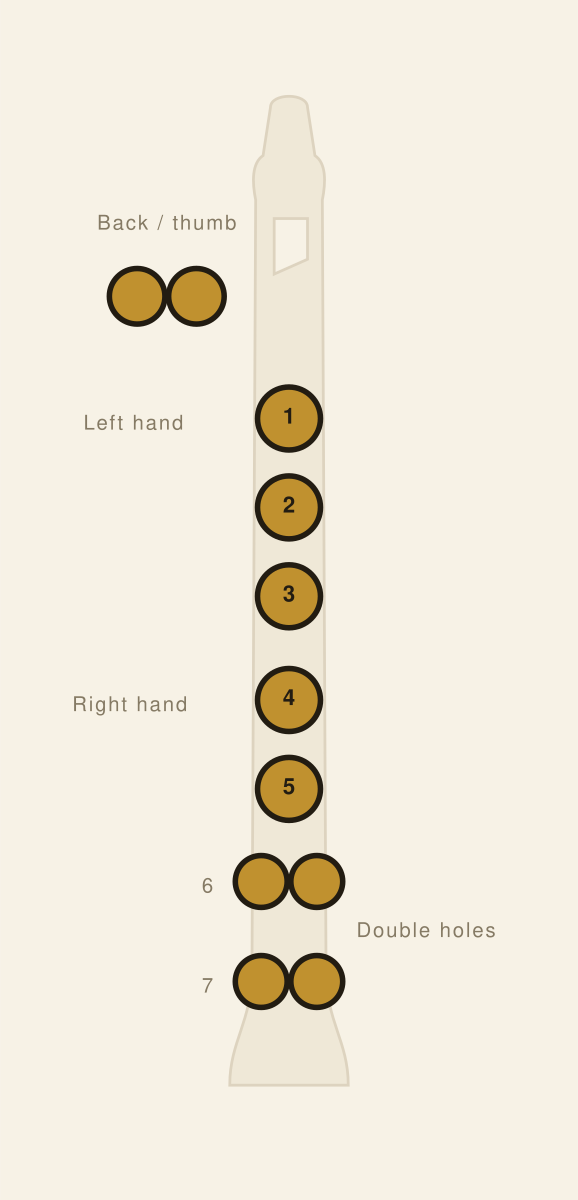
Every hole is sealed, including both pairs of double holes — the smallest leak turns low C into a squeak or into nothing at all. It also takes the gentlest breath of any note on the instrument. Lay the left thumb flat across its hole rather than pressing with the tip.
Everything about C4 on soprano recorder →How to read this chart
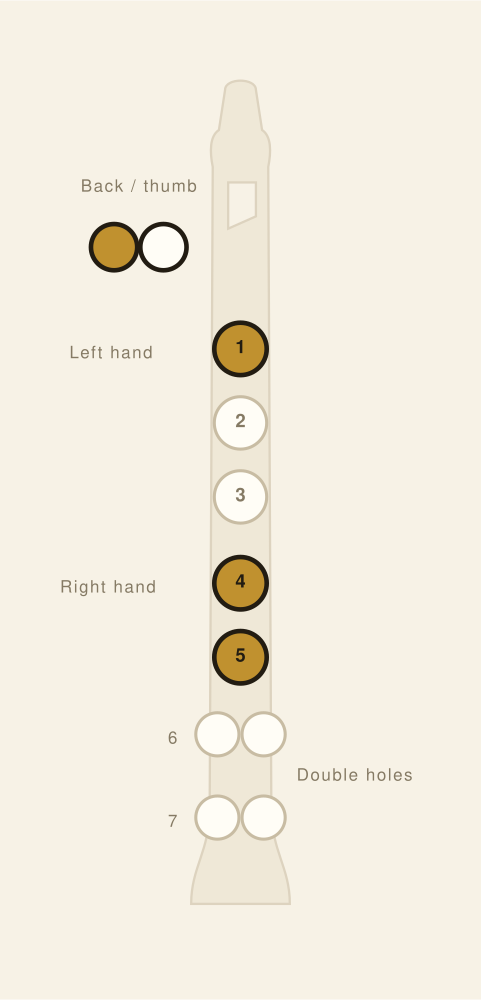
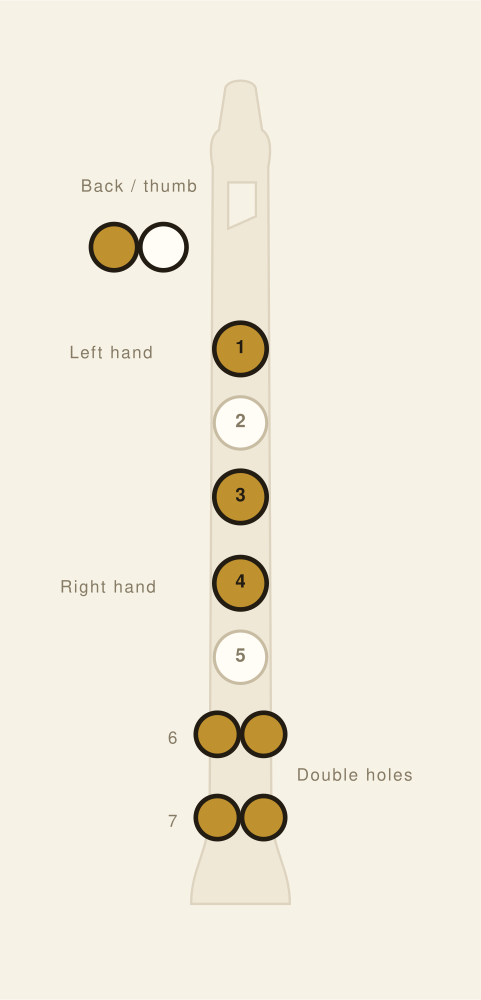
Filled circles are holes you cover; open circles you leave alone. The diagram is drawn with the beak at the top and the foot at the bottom, so it reads down the instrument the way you hold it. The hole shown at the top on its own is the thumb hole on the back — left thumb. Then come holes 1, 2 and 3 for the left index, middle and ring fingers, and 4, 5, 6 and 7 for the right hand.
Two things on the diagram need a word of explanation:
- Double holes 6 and 7. On a modern recorder these are drawn as pairs, because they are pairs. Covering both circles seals the hole; covering only one gives you the half-hole, which is exactly how you get E♭4 and C♯4 without the old bell-against-the-knee trick. On an older instrument with single holes you have to roll the finger to expose about half the opening instead.
- The pinched thumb. Every note from E5 upward needs the thumb hole roughly a quarter open rather than sealed. The chart shows that as a half-covered thumb hole, so a second-register note is visibly different from the lower-octave note that uses the same fingers.
One quirk of the notation: the soprano recorder sounds an octave higher than it is written, which is how school parts are printed. The chart shows both, so written C4 appears against a sounding C5.
Baroque vs German fingering — F is the tell
There are two fingering systems, and every chart has to pick one. This one is baroque (English) fingering, the system used by essentially every recorder sold today and by all standard repertoire.
F is how you tell them apart. On a baroque recorder F is a forked fingering: hole 5 opens while 6 and 7 close again below it. That fork makes F slightly stuffy but keeps it in tune, and the same idea returns for F♯, where hole 4 lifts while 5 and 6 stay down. A German recorder does the opposite trade: F is played the obvious way — hole 4 open, 5, 6 and 7 closed — which is easier for an absolute beginner but leaves F♯ and B♭ badly out of tune, which is why the system fell out of use.
So: play F from this chart. If it sounds right, you have a baroque instrument and everything here applies. If it is noticeably flat and thin, yours is German-fingered — check the fingering-system mark near the joint before you buy another one, because the two are not interchangeable.
The classic school order: B, A, G first
Almost every recorder method starts with B, then A, then G, and it is a good order for a reason. B is thumb plus the left index finger, A adds the middle finger, G adds the ring finger — three notes that build one on top of another so you can feel the grip without looking down.
They also teach breath control immediately. With so little of the tube closed, B is the easiest note on the instrument to overblow into the register above, so a squeak on your first note is a breath lesson, not a failure. Once B, A and G are steady, the method books go down to E and D (which expose leaks in holes 6 and 7) before tackling the forked F.
The second register and pinching
The second register starts at E5 and it works by pinching: you slide the left thumb so about a quarter of the thumb hole is uncovered, which lets the instrument sound the octave above. The fingers of the lower octave stay exactly where they were — E5 uses the fingers of low E, G5 the fingers of G4, A5 the fingers of A4. Only the thumb changes, which is why the chart draws the thumb hole half covered for all of them.
Getting the pinch right is the whole skill. Too wide and the note shrieks; too narrow and you drop back to the lower octave. F♯5 is a good place to find it, because its fork stabilises the pitch — set the pinch there, then keep the same thumb shape for E5 and F5. From B5 upward the notes want a narrower pinch and faster, more focused air, never more volume: loudness only makes the note split. The two notes at the very top, C♯6 and high D, genuinely differ between makers, so expect to try the alternates on your own instrument.
Full recorder fingering chart — all notes
The whole soprano range in baroque fingering, written C4 to D6 and fully chromatic, sounding an octave higher than written. The concert column is what a listener hears.
Octave 412 notes
C4 (beginner note)
sounds C5
C♯4
sounds C♯5
D4 (beginner note)
sounds D5
E♭4
sounds E♭5
E4 (beginner note)
sounds E5
F4 (beginner note)
sounds F5
F♯4 (beginner note)
sounds F♯5
G4 (beginner note)
sounds G5
A♭4
sounds A♭5
A4 (beginner note)
sounds A5
B♭4 (beginner note)
sounds B♭5
B4 (beginner note)
sounds B5
Octave 512 notes
C5 (beginner note)
sounds C6
C♯5
sounds C♯6
D5 (beginner note)
sounds D6
E♭5
sounds E♭6
E5 (beginner note)
sounds E6
F5 (beginner note)
sounds F6
F♯5
sounds F♯6
G5 (beginner note)
sounds G6
A♭5
sounds A♭6
A5 (beginner note)
sounds A6
B♭5
sounds B♭6
B5
sounds B6
Octave 63 notes
C6
sounds C7
C♯6
sounds C♯7
D6
sounds D7
Pressed or coveredOpenBeginner note
The same chart, written out
Every fingering in words — handy for copying into lesson notes, and it reads aloud properly on a screen reader.
| Written note | Sounds (concert) | Fingering | Beginner |
|---|---|---|---|
| Low C (C4) | C5 | Thumb hole + Hole 1 (left index) + Hole 2 (left middle) + Hole 3 (left ring) + Hole 4 (right index) + Hole 5 (right middle) + Double hole 6 + Double hole 7 | Yes |
| C♯4 | C♯5 | Thumb hole + Hole 1 (left index) + Hole 2 (left middle) + Hole 3 (left ring) + Hole 4 (right index) + Hole 5 (right middle) + Double hole 6 + Double hole 7 (half) | — |
| D4 | D5 | Thumb hole + Hole 1 (left index) + Hole 2 (left middle) + Hole 3 (left ring) + Hole 4 (right index) + Hole 5 (right middle) + Double hole 6 | Yes |
| E♭4 | E♭5 | Thumb hole + Hole 1 (left index) + Hole 2 (left middle) + Hole 3 (left ring) + Hole 4 (right index) + Hole 5 (right middle) + Double hole 6 (half) | — |
| E4 | E5 | Thumb hole + Hole 1 (left index) + Hole 2 (left middle) + Hole 3 (left ring) + Hole 4 (right index) + Hole 5 (right middle) | Yes |
| F4 | F5 | Thumb hole + Hole 1 (left index) + Hole 2 (left middle) + Hole 3 (left ring) + Hole 4 (right index) + Double hole 6 + Double hole 7 | Yes |
| F♯4 | F♯5 | Thumb hole + Hole 1 (left index) + Hole 2 (left middle) + Hole 3 (left ring) + Hole 5 (right middle) + Double hole 6 | Yes |
| G4 | G5 | Thumb hole + Hole 1 (left index) + Hole 2 (left middle) + Hole 3 (left ring) | Yes |
| A♭4 | A♭5 | Thumb hole + Hole 1 (left index) + Hole 2 (left middle) + Hole 4 (right index) + Hole 5 (right middle) + Double hole 6 (half) | — |
| A4 | A5 | Thumb hole + Hole 1 (left index) + Hole 2 (left middle) | Yes |
| B♭4 | B♭5 | Thumb hole + Hole 1 (left index) + Hole 3 (left ring) + Hole 4 (right index) | Yes |
| B4 | B5 | Thumb hole + Hole 1 (left index) | Yes |
| C5 | C6 | Thumb hole + Hole 2 (left middle) | Yes |
| C♯5 | C♯6 | Hole 1 (left index) + Hole 2 (left middle) | — |
| D5 | D6 | Hole 2 (left middle) | Yes |
| E♭5 | E♭6 | Hole 2 (left middle) + Hole 3 (left ring) + Hole 4 (right index) + Hole 5 (right middle) + Double hole 6 | — |
| E5 | E6 | Thumb hole (half) + Hole 1 (left index) + Hole 2 (left middle) + Hole 3 (left ring) + Hole 4 (right index) + Hole 5 (right middle) | Yes |
| F5 | F6 | Thumb hole (half) + Hole 1 (left index) + Hole 2 (left middle) + Hole 3 (left ring) + Hole 4 (right index) + Double hole 6 | Yes |
| F♯5 | F♯6 | Thumb hole (half) + Hole 1 (left index) + Hole 2 (left middle) + Hole 3 (left ring) + Hole 5 (right middle) | — |
| G5 | G6 | Thumb hole (half) + Hole 1 (left index) + Hole 2 (left middle) + Hole 3 (left ring) | Yes |
| A♭5 | A♭6 | Thumb hole (half) + Hole 1 (left index) + Hole 2 (left middle) + Hole 4 (right index) | — |
| A5 | A6 | Thumb hole (half) + Hole 1 (left index) + Hole 2 (left middle) | Yes |
| B♭5 | B♭6 | Thumb hole (half) + Hole 1 (left index) + Hole 2 (left middle) + Hole 4 (right index) + Hole 5 (right middle) + Double hole 6 | — |
| B5 | B6 | Thumb hole (half) + Hole 1 (left index) + Hole 2 (left middle) + Hole 4 (right index) + Hole 5 (right middle) | — |
| High C (C6) | C7 | Thumb hole (half) + Hole 1 (left index) + Hole 4 (right index) + Hole 5 (right middle) | — |
| C♯6 | C♯7 | Thumb hole (half) + Hole 1 (left index) + Hole 3 (left ring) + Hole 4 (right index) + Hole 5 (right middle) + Double hole 7 (half) | — |
| High D (D6) | D7 | Thumb hole (half) + Hole 1 (left index) + Hole 3 (left ring) + Hole 4 (right index) + Double hole 6 + Double hole 7 | — |
Alternate soprano recorder fingerings
Alternates aren’t “better” fingerings — each one earns its place in a specific musical situation. Select any of these notes in the chart above and switch variants to compare them.
- B4 (B4) — Thumb + holes 2 and 3: Thumb hole + Hole 2 (left middle) + Hole 3 (left ring). Yamaha's baroque chart lists this alongside the standard grip; it frees the index finger and can be smoother in a line that keeps returning to A or C.
- C♯5 (C♯5) — Thumb alone: Thumb hole. Yamaha's chart gives this as the alternate; it is easier to reach from B, but its tuning varies a lot between instruments, so check it against a drone before using it.
- B5 (B5) — Pinched thumb + holes 1, 5, 6 and 7: Thumb hole (half) + Hole 1 (left index) + Hole 5 (right middle) + Double hole 6 + Double hole 7. Yamaha's chart gives this as the alternate — stuffier, but steadier on some instruments; worth trying when B5 refuses to speak.
- High D (D6) — Pinched thumb + holes 1, 3, 4 and 6: Thumb hole (half) + Hole 1 (left index) + Hole 3 (left ring) + Hole 4 (right index) + Double hole 6. Yamaha's baroque chart leaves hole 7 open; top-register fingerings genuinely differ between makers, so try this if the note will not centre.
Common recorder mistakes
- Too much air. Squeaks are nearly always breath, not fingers. The bottom register takes the gentlest breath on the instrument, and low C in particular wants barely any — blow harder and it jumps a register or stops speaking altogether.
- Leaks. A hole that is 90% covered is an open hole as far as the recorder is concerned. Lay the flat pads of your fingers over the holes rather than pressing with the tips, and suspect holes 6 and 7 first when D and E will not sound.
- Half-covering hole 2 on B♭. B♭ is a forked fingering — hole 2 opens while 3 and 4 close below it. Lift that middle finger clearly, or the note sags towards A.
- Counting up instead of down. E♭5 has holes 2 to 6 closed with the thumb hole fully open — a shape that looks like a low-register fingering. Count down from hole 2, never up from hole 1.
Frequently asked questions
Is this a baroque or German fingering chart?
Baroque (also called English) fingering, which is what almost every recorder sold today uses. F is the quick way to tell: on a baroque recorder F is a forked fingering — hole 5 open with 6 and 7 closed below it — while a German recorder plays F the simple way, with hole 4 open and 5, 6 and 7 closed. If the forked F on this chart sounds badly out of tune on your instrument, you have a German-fingered recorder.
Soprano vs descant recorder — what's the difference?
Nothing: they are the same instrument. "Soprano" is the American name and "descant" the British one for the recorder in C that schools use. A tenor recorder is also in C an octave lower, so this same chart works for it too — only the sounding octave changes.
Why does my recorder squeak?
Almost always too much air. The recorder needs a gentle, steady breath — the low notes in particular take less air than any other note on the instrument, and blowing harder pushes them up into the next register as a squeak. The other cause is a leak: a fingertip covering 90% of a hole reads as an open hole, so lay the pads of your fingers flat rather than pressing with the tips, and check holes 6 and 7 first.
What recorder do schools use?
A plastic soprano (descant) recorder in C with baroque fingering and double holes for 6 and 7 — that is the instrument this chart is drawn for. Plastic is the sensible choice for a beginner: it is cheap, it survives being dropped, and it does not need the careful playing-in that a wooden recorder does.
Can I print this free?
Yes. The printable recorder chart comes as Letter and A4 PDFs generated from the same data as this interactive chart, and downloads in one click — no email address, no watermark.
Recorder fingering data last updated . Every diagram here, in the printable PDF and in the chart image comes from one dataset, so the paper and the screen cannot disagree.