Guitar · Standard tuning · 20 shapes
Easy guitar chords
Easy guitar chords are the open shapes that live in the first four frets. These 20 cover every basic major, minor and 7th you need — tap any chart to hear it strummed, then open a chord for finger-by-finger placement.
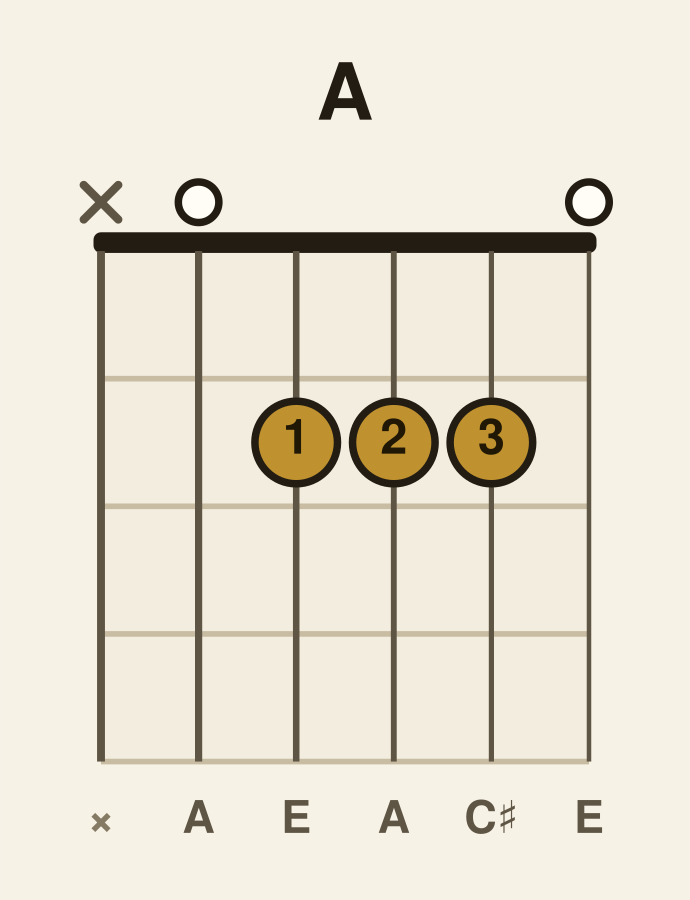
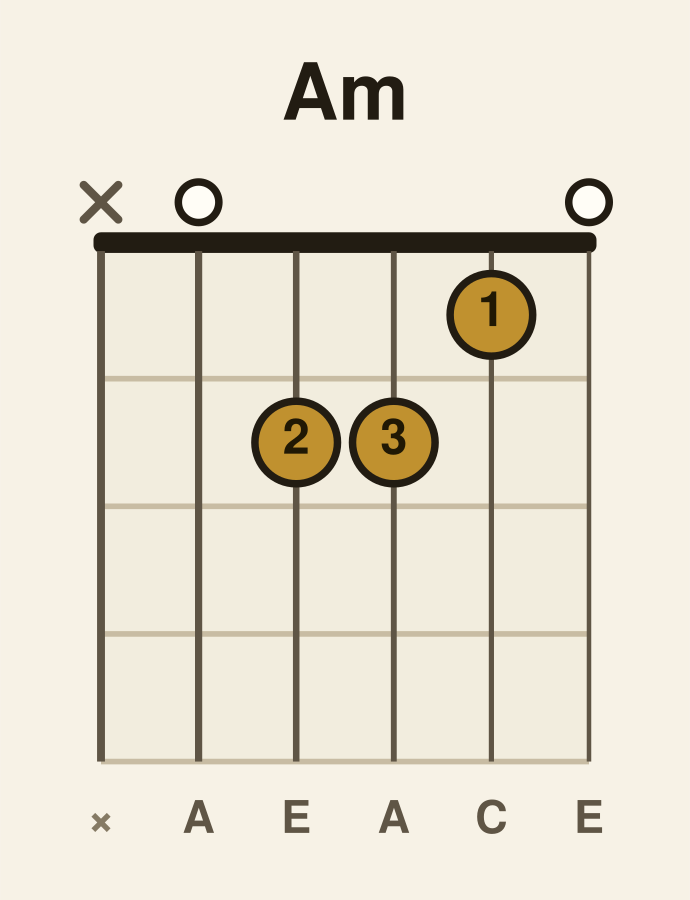
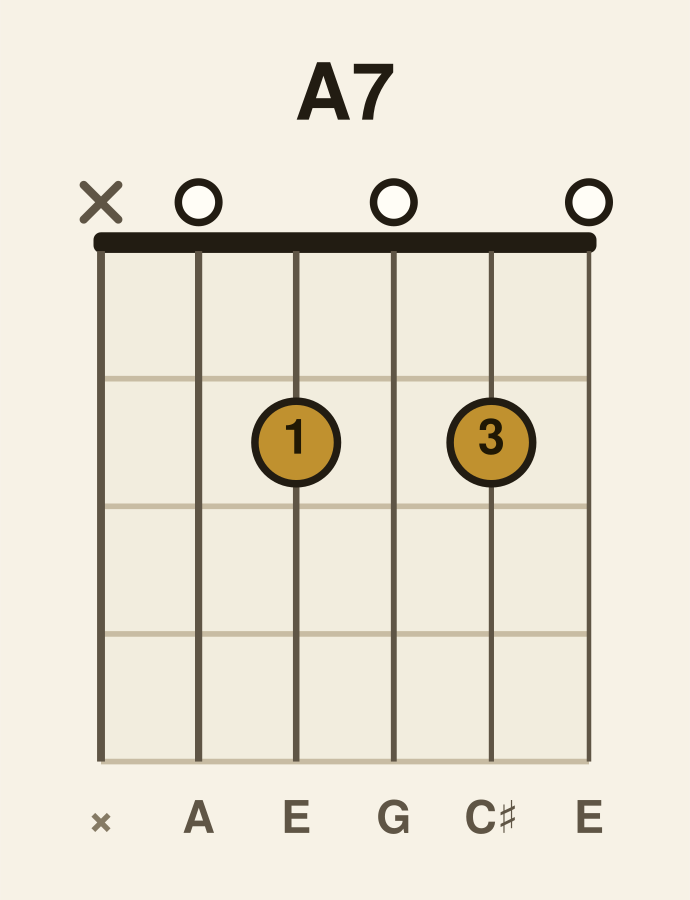
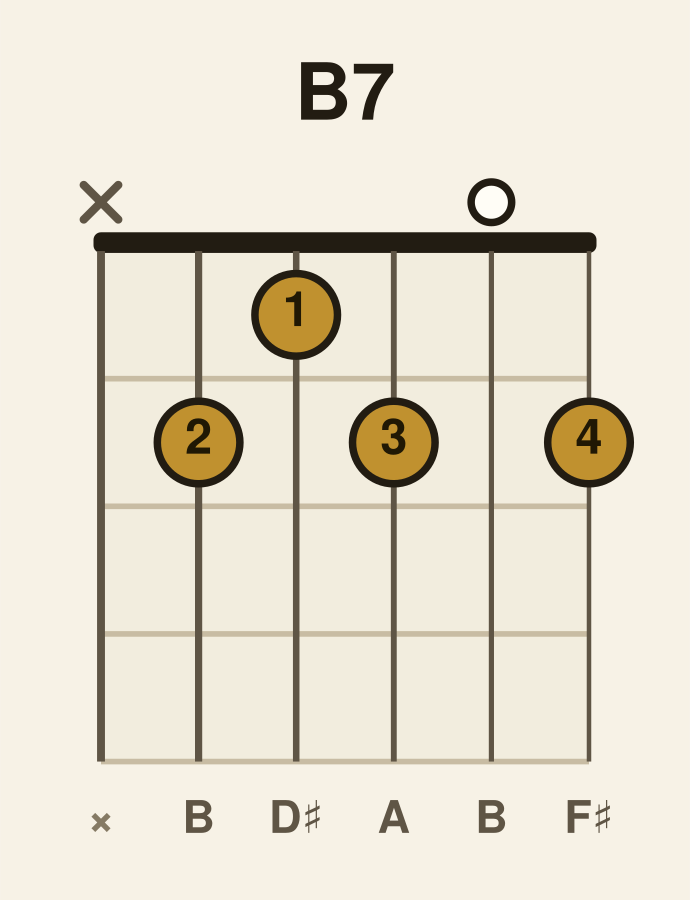
Each chart shows the nut at the top, the strings low E to high E left to right, the finger number inside every dot, and the note each string sounds underneath.
The 5 chords to learn first
You do not need twenty shapes to play something that sounds like music — you need five. G, C, D, E minor and A minor between them cover the keys of G and C, which is where most simple songs sit, and they combine into finished progressions on the first day.
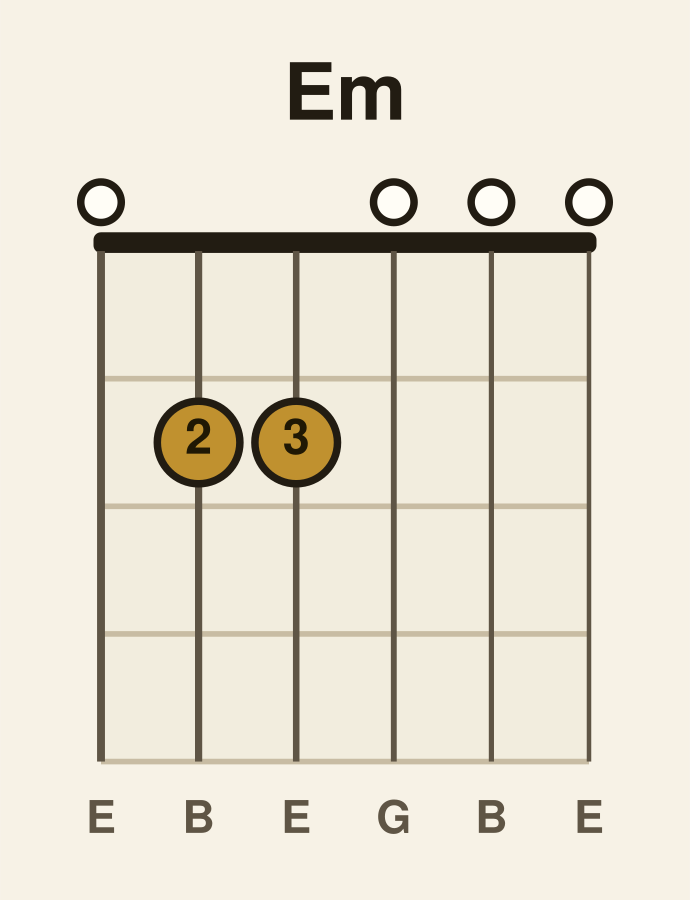
- Em 022000Two fingers, six ringing strings and no stretch at all. It is the shape that proves the guitar works before your hand has any strength in it.
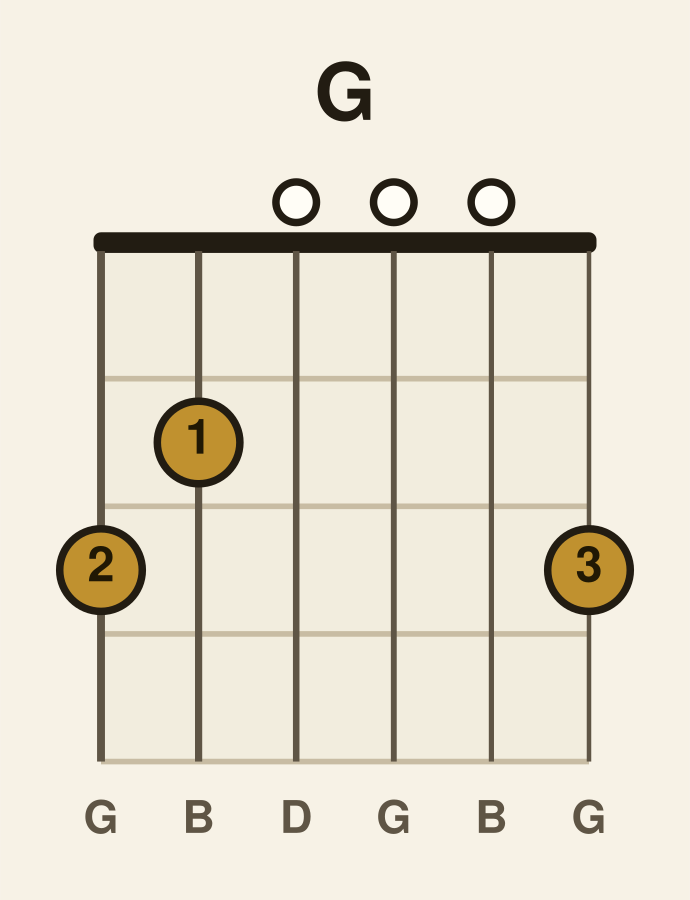
- G 320003The home chord of the key of G. It teaches the hand to spread to the outside strings, which every later shape depends on.
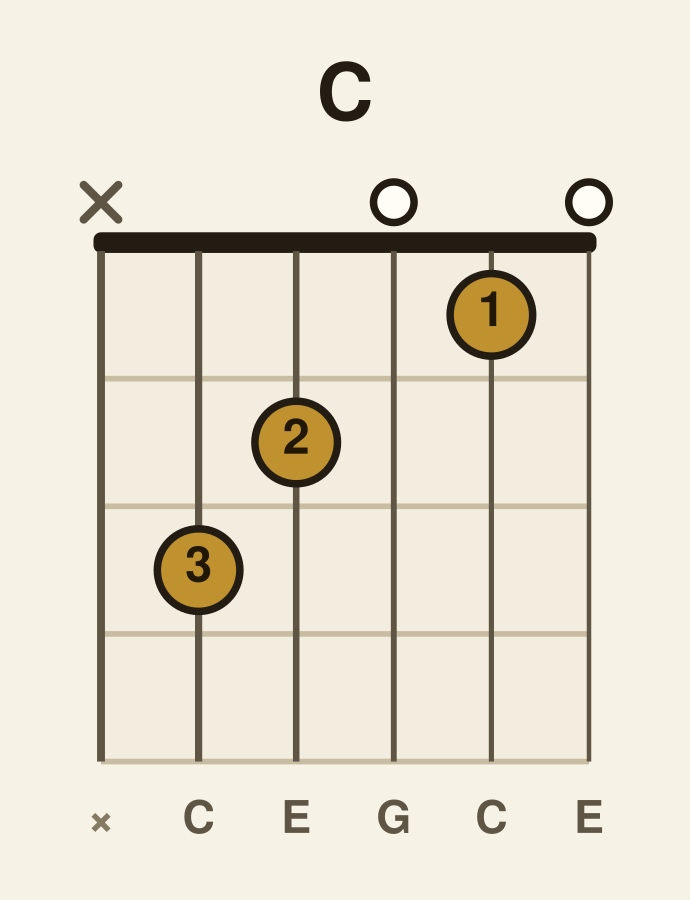
- C x32010The diagonal three-finger shape and the reference point for Cadd9, C7 and Am. Pairs with G and D immediately.
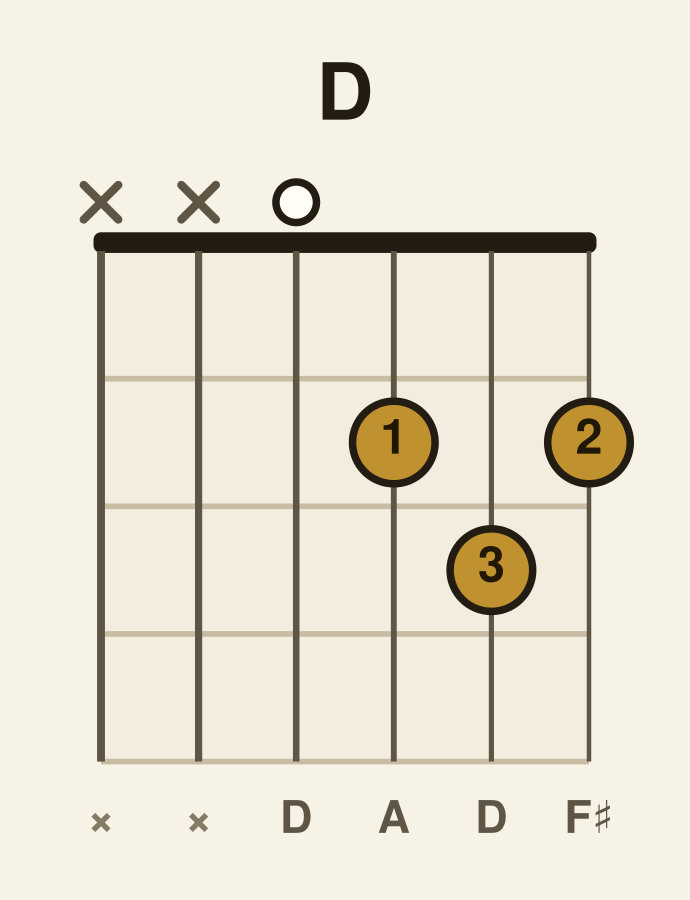
- D xx0232Only four strings, so it trains strum control as much as fingering. It completes the G–C–D trio that covers a huge amount of simple repertoire.
- Am x02210The minor colour that stops G, C and D sounding relentlessly cheerful, and one finger away from both C and E major.
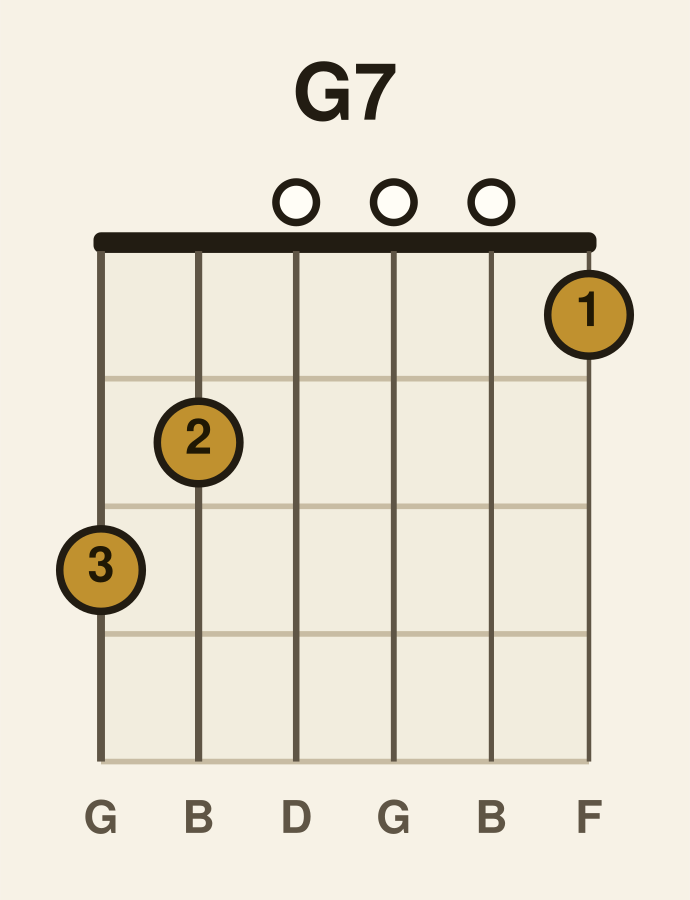
Play G → C → D → G, then Am → C → G → D. If those two loops sound steady, add the 7th chords next: G7 to get back to C, E7 and A7 for anything bluesy, D7 to land on G.
How to read a guitar chord chart
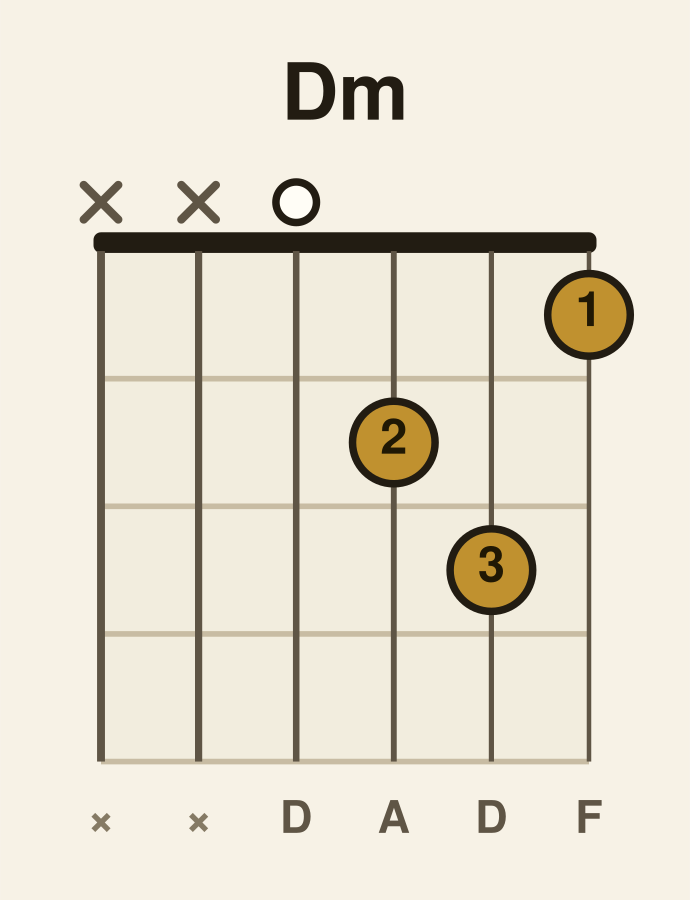
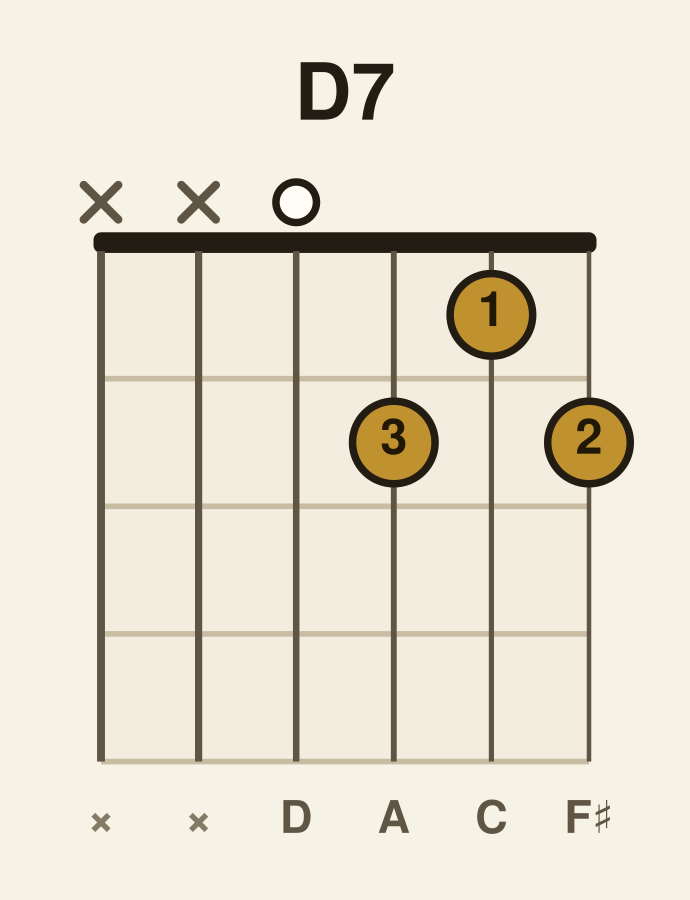
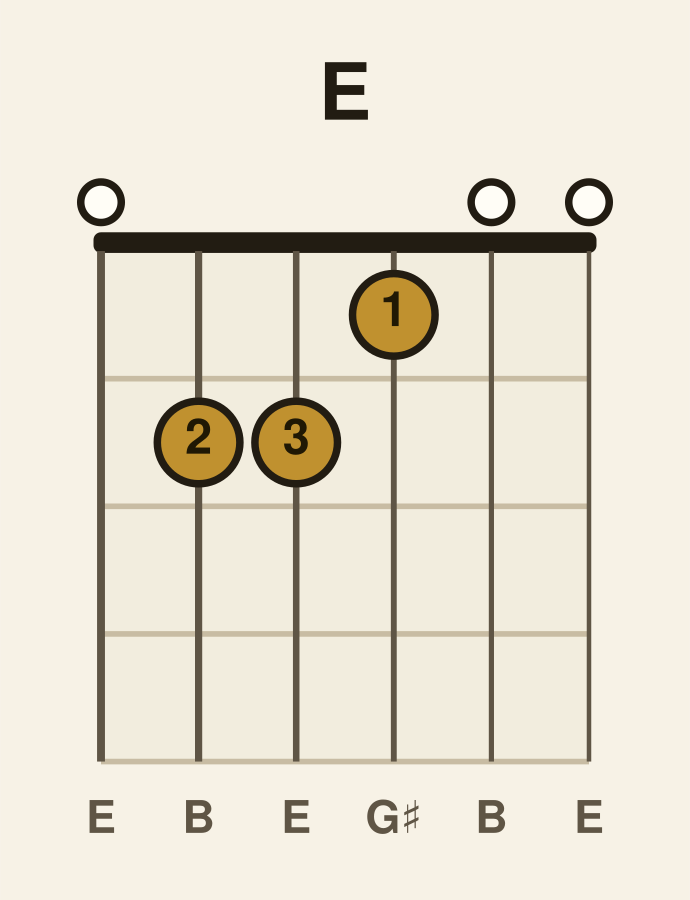
A chord chart — a chord box, or chord diagram — is a picture of the neck stood on end, as if the guitar were held up in front of you.
- Six vertical lines are the strings. Low E on the far left, high E on the far right. The line weight thins as the strings do.
- Horizontal lines are frets. The thick bar across the top is the nut, so the space directly under it is the 1st fret. When a shape sits higher up the neck, the nut is replaced by a plain line and a position label such as 5fr marks the top fret shown.
- Dots show where to press, and the number inside each dot is the finger: 1 index, 2 middle, 3 ring, 4 little.
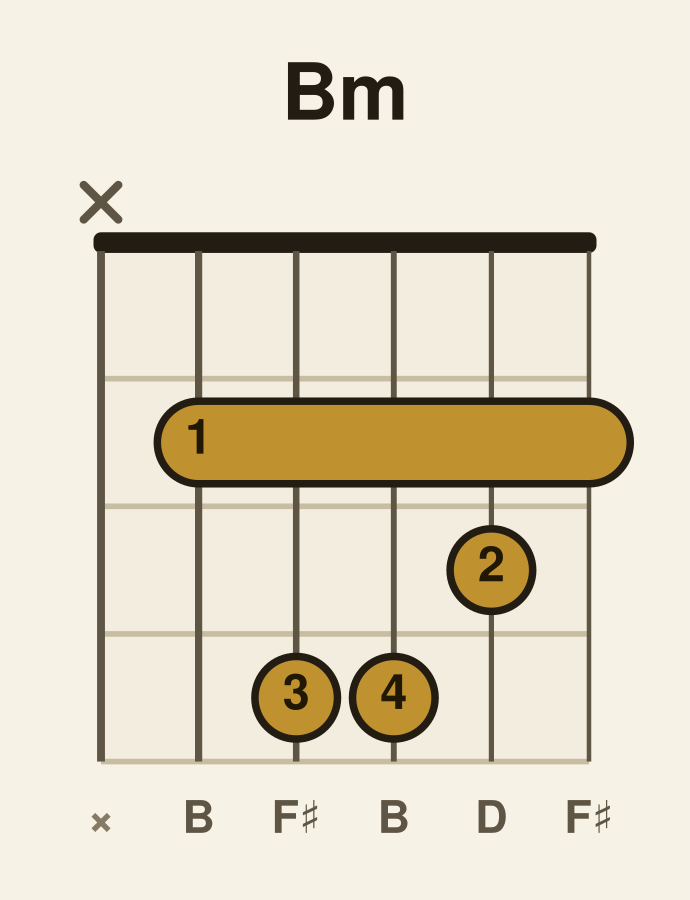
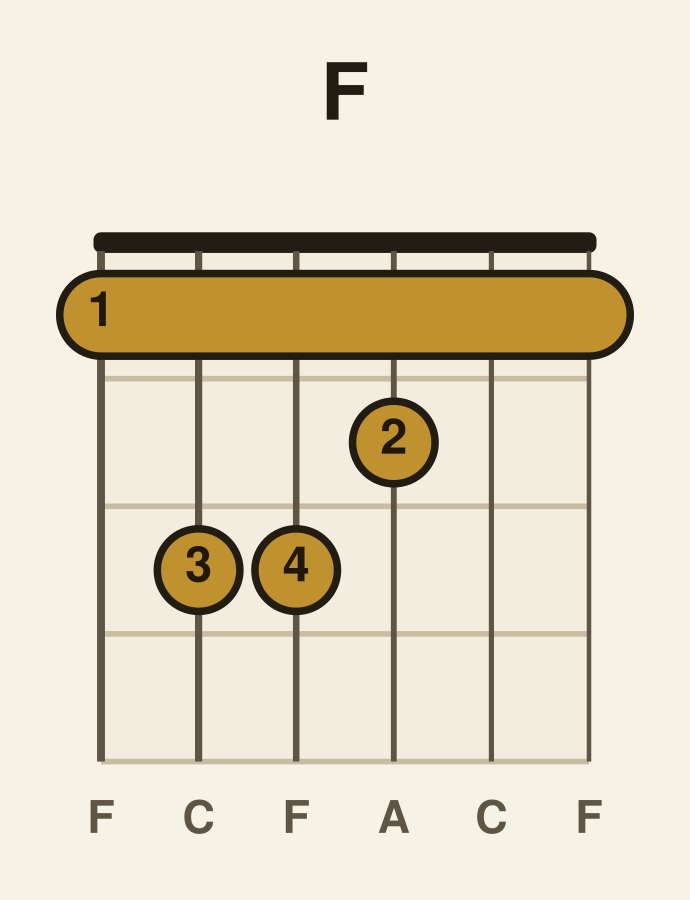
- A rounded bar is a barre — one finger flattened across several strings at the same fret, as in F and B minor.
- Above the nut, O means open (strum that string without fretting it) and X means muted (leave that string out of the strum entirely).
- The letters underneath are the note each string actually sounds in that shape, with × marking a muted string.
Charts on this page are also written in text as six characters, low E first: x32010 is C major — 5th string 3rd fret, 4th string 2nd fret, 3rd string open, 2nd string 1st fret, 1st string open, 6th string not played.
Finger placement that actually works
Nearly every buzzing, dead or muffled chord is a finger-placement problem rather than a strength problem. Four things fix most of it:
- Press just behind the fret wire, not in the middle of the fret. The string only has to be stopped against the wire. Sitting halfway back means you have to push far harder and the note still fizzes.
- Use the fingertips, not the pads. Curl each finger so it comes down vertically onto the string. A flat finger covers its own string and half-mutes the neighbour, which is why one string in the chord goes dead.
- Thumb behind the neck, roughly opposite the middle finger. That position lets the hand squeeze. A thumb hooked over the top of the neck pulls instead, and pulling is what makes barre chords impossible.
- Keep the knuckles up. If the big joint at the base of the fingers collapses toward the fingerboard, the fingers cannot arch and the open strings get smothered.
Test rather than guess: hold the shape and pick the strings one at a time from low to high. The dead string tells you exactly which finger to move — far quicker than strumming again and hoping.
Switching between chords
Holding a shape and changing to a shape are different skills, and the second one is what makes playing sound like music. Two ideas do most of the work.
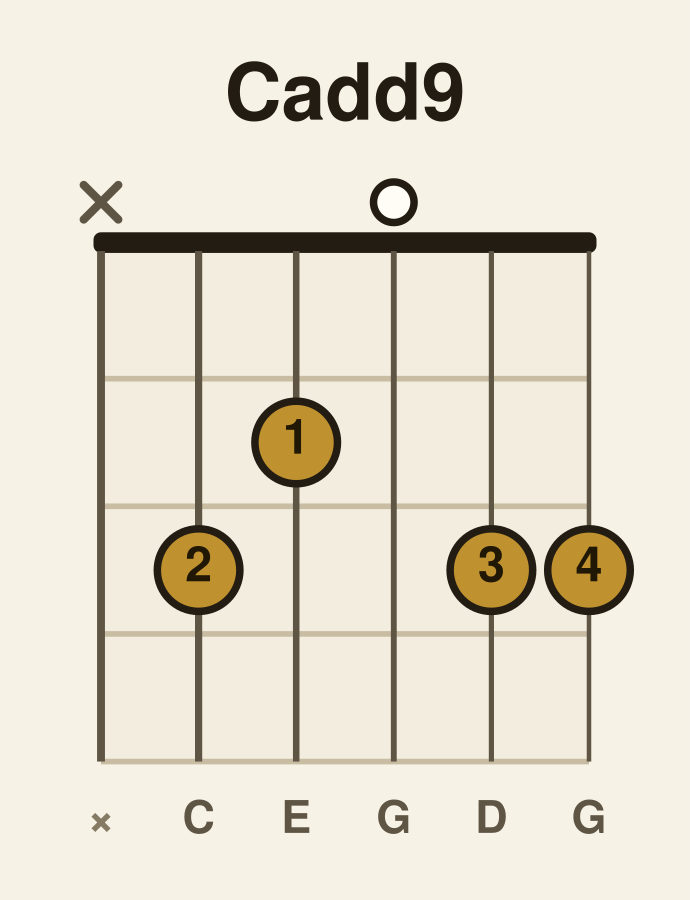
Anchor fingers. Look for a finger that is already in the right place in both chords and leave it down. C to Am keeps the index on the 1st fret of the B string. G to Cadd9 keeps the ring and little fingers at the 3rd fret of the top two strings — one reason Cadd9 is worth learning early. Em to E adds one finger and moves nothing.
Economy of motion. Move the fingers straight to their next fret rather than lifting the hand away from the neck, and move them together as a shape rather than one at a time. Practise slowly enough that the change happens in one motion — speed comes from that, not from hurrying.
The chord trainer calls out random chords at a tempo you set, which forces the change to become automatic instead of remembered.
The two hard ones: F and B minor
Eighteen of the twenty shapes here are genuinely easy. Two are not, and it is worth being honest about which: F major and B minor both need a barre, where the index finger flattens across several strings at once.
They are here because you cannot avoid them. F is the IV chord in C, and B minor is the ii in A and the vi in D — the moment you play in those keys, they arrive.
What actually helps: keep the barring finger straight and roll it slightly onto its bony outside edge, so the strings do not fall into the soft crease of the joint. Put the thumb behind the middle of the neck and bring the elbow in toward your body, so the hand squeezes rather than the arm pulls. Then place the other fingers first and add the barre last.
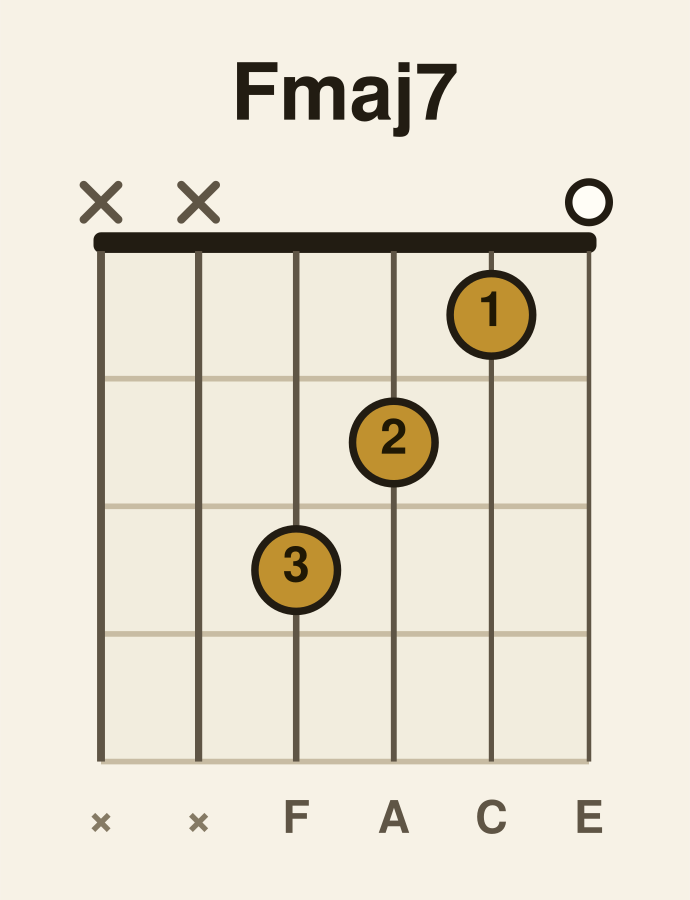
And take the shortcut where one exists. F has a four-string partial — x x 3 2 1 1 — that sounds the same chord with no barre at all, and Fmaj7 (x x 3 2 1 0) substitutes for it in most gentle playing. A partial F in time beats a full barre out of time every day.
Every shape at a glance
All twenty chords in chart notation, low E string first. An x means that string is not played and 0 means play it open.
| Chord | Shape (low E → high E) | Notes | Shape type |
|---|---|---|---|
| A | x02220 | A – C♯ – E | Open |
| Am | x02210 | A – C – E | Open |
| A7 | x02020 | A – C♯ – E – G | Open |
| B7 | x21202 | B – D♯ – F♯ – A | Open |
| Bm | x24432 | B – D – F♯ | Barre |
| C | x32010 | C – E – G | Open |
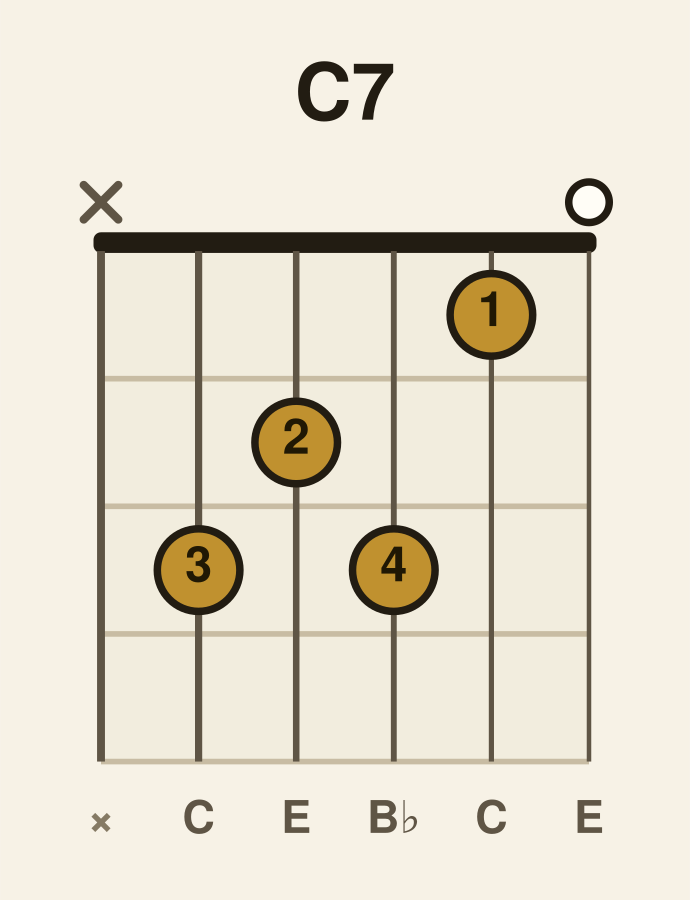
| C7 | x32310 | C – E – G – B♭ | Open |
| D | xx0232 | D – F♯ – A | Open |
| Dm | xx0231 | D – F – A | Open |
| D7 | xx0212 | D – F♯ – A – C | Open |
| E | 022100 | E – G♯ – B | Open |
| Em | 022000 | E – G – B | Open |
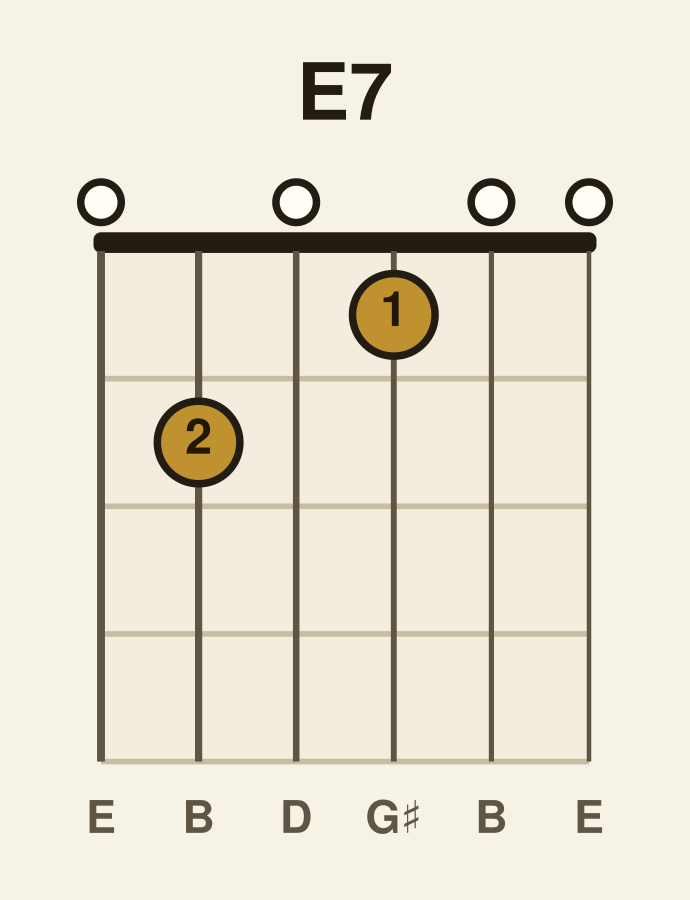
| E7 | 020100 | E – G♯ – B – D | Open |
| F | 133211 | F – A – C | Barre |
| Fmaj7 | xx3210 | F – A – C – E | Open |
| G | 320003 | G – B – D | Open |
| G7 | 320001 | G – B – D – F | Open |
| Cadd9 | x32033 | C – E – G – D | Open |
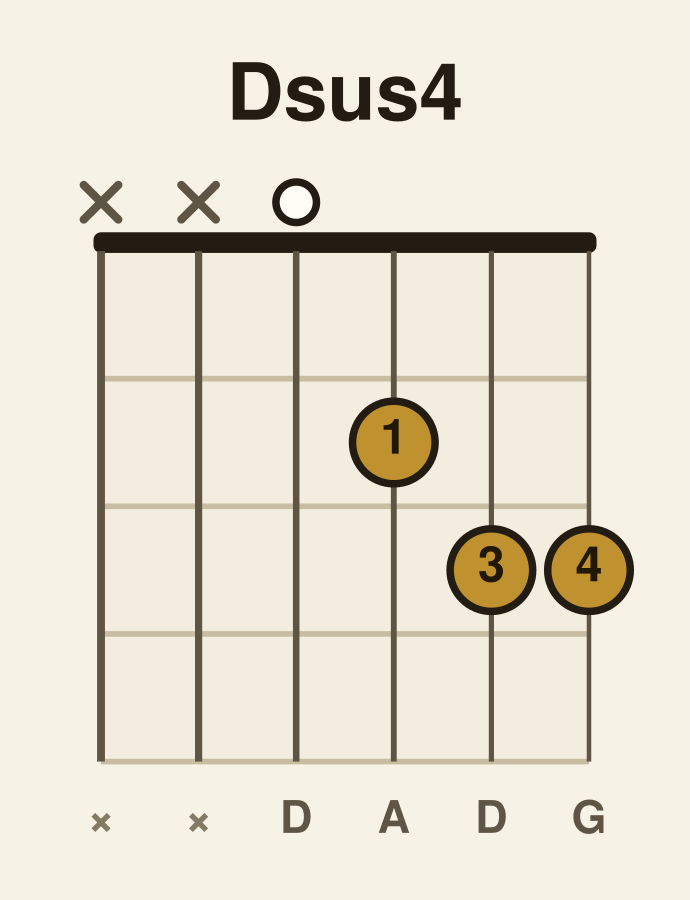
| Dsus4 | xx0233 | D – G – A | Open |
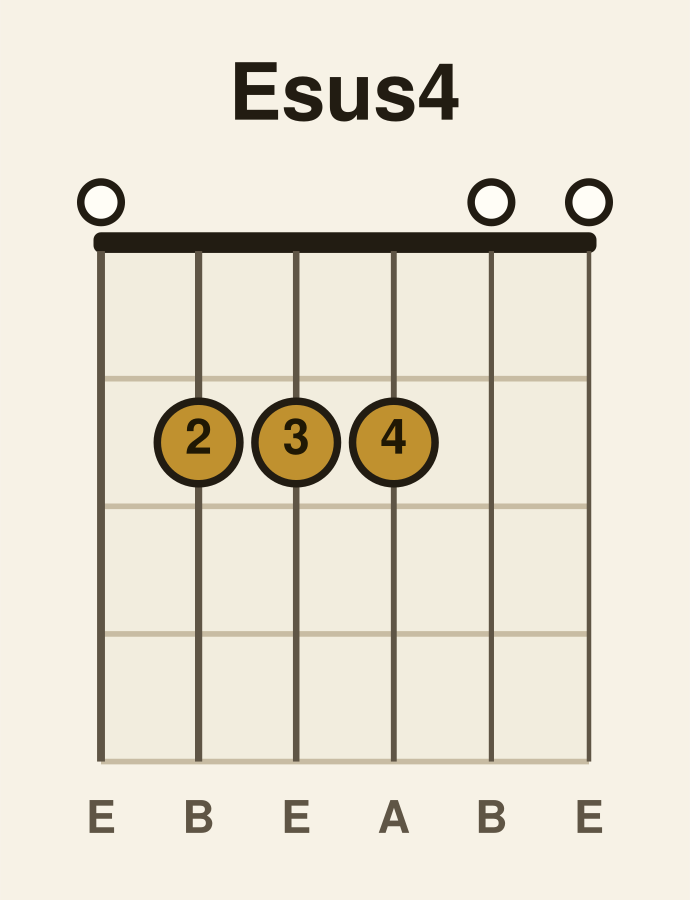
| Esus4 | 022200 | E – A – B | Open |
Frequently asked questions
What are the easiest guitar chords?
E minor and A minor are the easiest: two and three fingers, no stretch, and every remaining string rings open. G, C, D, E major and A major come next, and each of those has an even simpler 7th version — E7 needs only two fingers, A7 only two. Every chord on this page sits in the first four frets and uses at least one open string.
What guitar chords should I learn first?
G, C, D, E minor and A minor. Those five cover the keys of G and C, which is where most simple songs live, and they combine into real progressions straight away — G to C to D, or Am to C to G. Learn to change between them cleanly before adding any more shapes.
How do I read a chord chart?
The six vertical lines are the strings with the low E on the left; the horizontal lines are frets, and the thick bar at the top is the nut. A dot shows where to press, and the number inside it says which finger: 1 is the index, 2 the middle, 3 the ring, 4 the little finger. Above the nut, an O means play that string open and an X means do not play it at all.
Why do my chords buzz?
Almost always one of three things: the fingertip is sitting in the middle of the fret space instead of just behind the fret wire, the finger is lying flat and half-muting the string next to it, or a neighbouring finger is resting against a string that should be ringing. Pick the strings one at a time to find which one is dead, then fix that finger rather than squeezing harder.
Guitar chord data last updated . Every diagram here, in the printable PDF and in the chart image comes from one dataset, so the paper and the screen cannot disagree.