E♭ instrument · 33 notes · B♭3–F♯6
Alto Sax Fingering Chart
This is also the saxophone fingering chart you are looking for: soprano, tenor and baritone saxes use exactly the same fingerings as the alto, so one chart covers the whole family. Tap any note from low B♭ to high F♯ to see the keys, hear the pitch and check what it sounds in concert pitch.
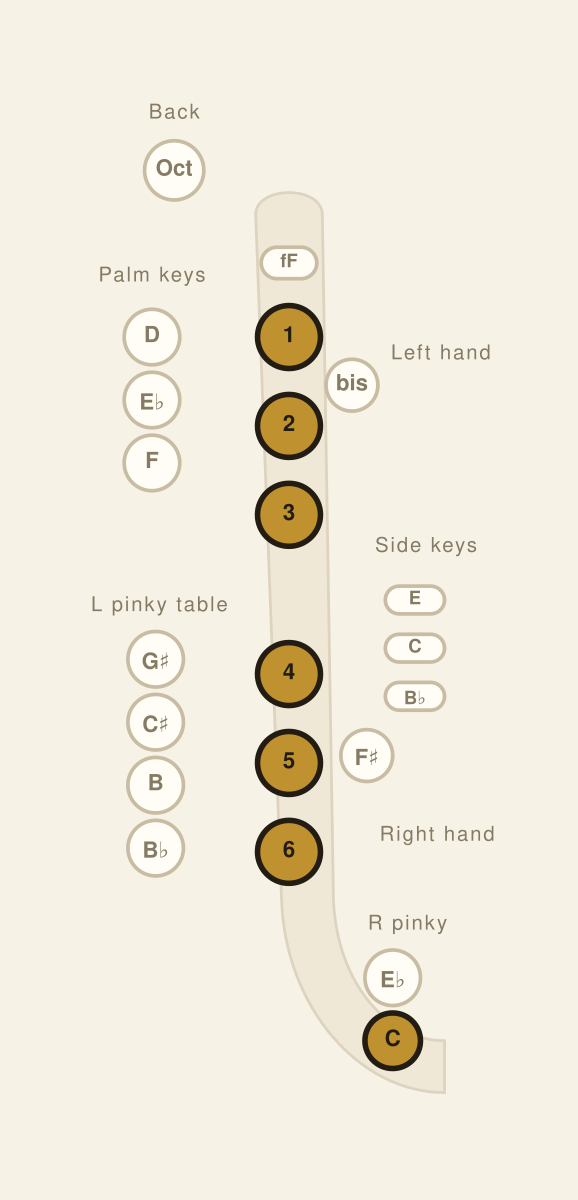
All six fingers plus the right-pinky low C key — the first of the bottom notes most players get reliably. Start it with a soft "doo" rather than a hard tongue stroke and keep the airstream moving through the note; the low register stops speaking the moment the air slows.
Everything about C4 on alto saxophone →One saxophone fingering chart for every sax
Saxophones are one family with one mechanism. The keys sit in the same places and the fingerings are identical whether you are holding a soprano, an alto, a tenor or a baritone — a player who learns alto can pick up a tenor and play it straight away. The tenor sax fingering chart shows the same fingerings with the tenor’s B♭ concert pitches; for soprano and baritone, this page is the chart.
The only difference is transposition. Alto and baritone saxophones are in E♭; soprano and tenor are in B♭. The same written note therefore sounds at a different pitch on each instrument, which is why a section written for alto has different key signatures from the tenor part beside it. Fingers identical, sounding pitch different.
How to read this chart
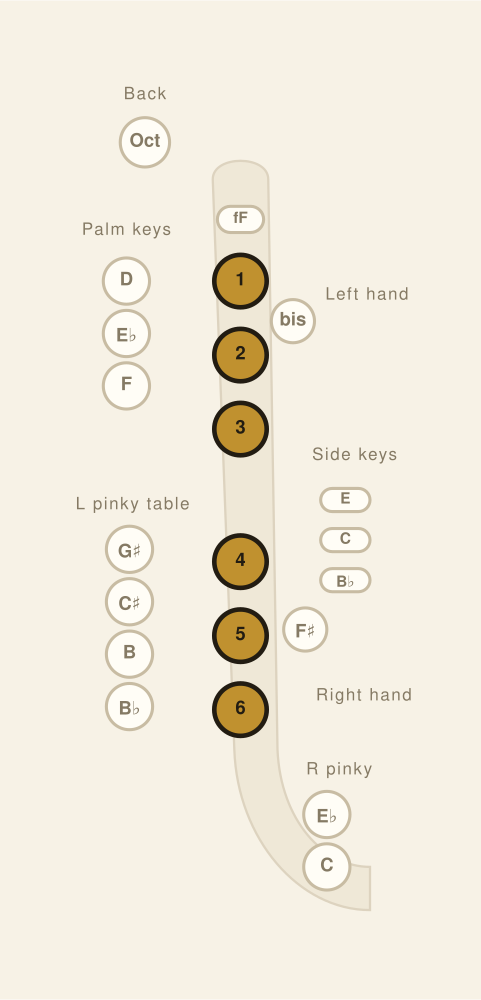
Filled circles are pressed, open circles are not. The layout runs top to bottom the way the horn hangs: the octave key is drawn at the top on the back, because your left thumb sits on it; the left hand’s three pearls come next down the centre, with the small bis key nestled between the first two; then the right hand’s three.
Around the edges are the keys that make a saxophone look complicated. Palm keys (D, E♭, F) sit to the left and are pressed by the heel of the left hand for the notes above C♯6. Side keys (E, C, B♭) sit to the right and are rolled onto with the knuckle of the right index finger. The left-hand pinky table in the bottom-left corner carries G♯, low C♯, low B and low B♭, and the right little finger has low E♭ and low C in the bottom-right. Two of those keys behave backwards, and it is worth knowing which: G♯ and low E♭ open a pad rather than closing one, so adding that finger raises the pitch.
One more convention from the data: the right-hand low C key stays down for low C♯, low C, low B and low B♭ — the left-pinky paddle just selects which of them sounds.
Written vs concert pitch on an E♭ alto sax
The alto saxophone is an E♭ instrument: written C sounds concert E♭ a major sixth below, so written C5 sounds concert E♭4. Every note in the chart above shows both, and the play button sounds the concert pitch — what a listener actually hears.
In practice this is what your band director means by a “concert B♭ scale”: you play a written G scale to get it. It also explains the tuning note. Written F♯5 on alto sounds concert A 440, and written A4 sounds concert C — the same pitch as the piano’s middle C, which is the quickest way to show a beginner what “E♭ instrument” really means.
The three B♭ fingerings — side, bis and one-and-one
B♭ is the note that separates fluent sax players from struggling ones, because there are three fingerings in constant use and each belongs to a different situation. All three are in the chart above — select B♭4 and switch variants to feel them.
- Side B♭ (left index and middle fingers plus the side B♭ key, pressed by the right index knuckle) is the default. It moves cleanly to both A and B natural, so it is the one to reach for when you do not know what is coming.
- Bis B♭ rolls the left index finger onto the B key and the little bis pearl together — one finger, nothing else moving, and the right hand stays completely free. Use it in flat keys where no B natural sits next to the B♭.
- One-and-one B♭ (left index plus right index) is the one to use when the B♭ is next to F, because the right index finger is already down and only the middle and ring fingers have to move.
The same three-way choice repeats an octave up at B♭5 with the octave key added. Choosing by context rather than habit is what makes flat keys and chromatic runs stop feeling awkward.
Palm keys and the top of the range
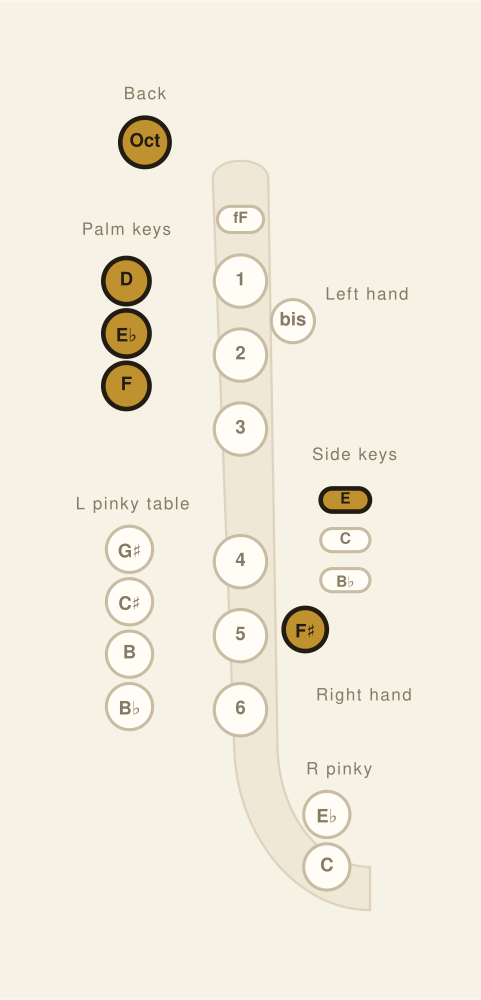
Above C♯6 the ordinary fingering pattern runs out and the palm keys take over. High D is the first palm key with the octave key; E♭6 adds the second; E6 and F6 stack the third palm key and the side E key on top. Roll the heel of the left hand onto them and keep the palm loose — mashing the keys drags your left fingers off their pearls and wrecks whatever note comes next.
Palm-key notes run sharp on most altos, so voice them down by lowering the tongue and relaxing the jaw rather than by pulling the mouthpiece out. Two easier alternates are worth learning early: the front (fork) F and front E, played with the front-F key above the left index pearl. Front F is far easier in F arpeggios, and it is the standard launch fingering for altissimo. Written F♯6 — the high F♯ key, pressed with the right middle finger — tops out this chart; where the horn goes above it is covered on the alto sax altissimo page.
Full alto sax fingering chart — all notes
The complete standard range, written low B♭3 to F♯6, chromatically. Written notes are what you read; the concert column is what sounds on an alto or baritone in E♭.
Octave 32 notes
B♭3
sounds D♭3
B3
sounds D3
Octave 412 notes
C4 (beginner note)
sounds E♭3
C♯4
sounds E3
D4 (beginner note)
sounds F3
E♭4
sounds G♭3
E4 (beginner note)
sounds G3
F4 (beginner note)
sounds A♭3
F♯4 (beginner note)
sounds A3
G4 (beginner note)
sounds B♭3
G♯4
sounds B3
A4 (beginner note)
sounds C4
B♭4 (beginner note)
sounds D♭4
B4 (beginner note)
sounds D4
Octave 512 notes
C5 (beginner note)
sounds E♭4
C♯5 (beginner note)
sounds E4
D5 (beginner note)
sounds F4
E♭5
sounds G♭4
E5 (beginner note)
sounds G4
F5 (beginner note)
sounds A♭4
F♯5 (beginner note)
sounds A4
G5 (beginner note)
sounds B♭4
G♯5
sounds B4
A5
sounds C5
B♭5
sounds D♭5
B5
sounds D5
Octave 67 notes
C6
sounds E♭5
C♯6
sounds E5
D6
sounds F5
E♭6
sounds G♭5
E6
sounds G5
F6
sounds A♭5
F♯6
sounds A5
Pressed or coveredOpenBeginner note
The same chart, written out
Every fingering in words — handy for copying into lesson notes, and it reads aloud properly on a screen reader.
| Written note | Sounds (concert) | Fingering | Beginner |
|---|---|---|---|
| Low B♭ (B♭3) | D♭3 | Left index key + Left middle key + Left ring key + Right index key + Right middle key + Right ring key + Left pinky low B♭ key + Right pinky low C key | — |
| Low B (B3) | D3 | Left index key + Left middle key + Left ring key + Right index key + Right middle key + Right ring key + Left pinky low B key + Right pinky low C key | — |
| Low C (C4) | E♭3 | Left index key + Left middle key + Left ring key + Right index key + Right middle key + Right ring key + Right pinky low C key | Yes |
| Low C♯ (C♯4) | E3 | Left index key + Left middle key + Left ring key + Right index key + Right middle key + Right ring key + Left pinky low C♯ key + Right pinky low C key | — |
| Low D (D4) | F3 | Left index key + Left middle key + Left ring key + Right index key + Right middle key + Right ring key | Yes |
| Low E♭ (E♭4) | G♭3 | Left index key + Left middle key + Left ring key + Right index key + Right middle key + Right ring key + Right pinky low E♭ key | — |
| Low E (E4) | G3 | Left index key + Left middle key + Left ring key + Right index key + Right middle key | Yes |
| Low F (F4) | A♭3 | Left index key + Left middle key + Left ring key + Right index key | Yes |
| Low F♯ (F♯4) | A3 | Left index key + Left middle key + Left ring key + Right middle key | Yes |
| G4 | B♭3 | Left index key + Left middle key + Left ring key | Yes |
| G♯4 | B3 | Left index key + Left middle key + Left ring key + Left pinky G♯ key | — |
| A4 | C4 | Left index key + Left middle key | Yes |
| B♭4 | D♭4 | Left index key + Left middle key + Side B♭ key | Yes |
| B4 | D4 | Left index key | Yes |
| C5 | E♭4 | Left middle key | Yes |
| C♯5 | E4 | Yes | |
| D5 | F4 | Octave key + Left index key + Left middle key + Left ring key + Right index key + Right middle key + Right ring key | Yes |
| E♭5 | G♭4 | Octave key + Left index key + Left middle key + Left ring key + Right index key + Right middle key + Right ring key + Right pinky low E♭ key | — |
| E5 | G4 | Octave key + Left index key + Left middle key + Left ring key + Right index key + Right middle key | Yes |
| F5 | A♭4 | Octave key + Left index key + Left middle key + Left ring key + Right index key | Yes |
| F♯5 | A4 | Octave key + Left index key + Left middle key + Left ring key + Right middle key | Yes |
| G5 | B♭4 | Octave key + Left index key + Left middle key + Left ring key | Yes |
| G♯5 | B4 | Octave key + Left index key + Left middle key + Left ring key + Left pinky G♯ key | — |
| A5 | C5 | Octave key + Left index key + Left middle key | — |
| B♭5 | D♭5 | Octave key + Left index key + Left middle key + Side B♭ key | — |
| B5 | D5 | Octave key + Left index key | — |
| C6 | E♭5 | Octave key + Left middle key | — |
| C♯6 | E5 | Octave key | — |
| High D (D6) | F5 | Octave key + Palm D key | — |
| High E♭ (E♭6) | G♭5 | Octave key + Palm D key + Palm E♭ key | — |
| High E (E6) | G5 | Octave key + Palm D key + Palm E♭ key + Side E key | — |
| High F (F6) | A♭5 | Octave key + Palm D key + Palm E♭ key + Palm F key + Side E key | — |
| High F♯ (F♯6) | A5 | Octave key + Palm D key + Palm E♭ key + Palm F key + Side E key + High F♯ key | — |
Alternate alto saxophone fingerings
Alternates aren’t “better” fingerings — each one earns its place in a specific musical situation. Select any of these notes in the chart above and switch variants to compare them.
- B♭4 (B♭4) — Bis B♭ (left index on the B and bis keys): Left index key + Bis key. In flat keys — B♭, E♭ and A♭ major — where the passage has no B natural next to the B♭. — One-and-one B♭ (left index + right index): Left index key + Right index key. When the B♭ is next to F, so the right index finger is already down and only the middle and ring fingers move.
- C5 (C5) — Side C (left index + side C key): Left index key + Side C key. In chromatic passages and B–C trills, where it avoids swapping the left index for the middle finger.
- B♭5 (B♭5) — Bis B♭ (left index on the B and bis keys): Octave key + Left index key + Bis key. In flat-key passages with no neighbouring B natural, and when the right hand needs to stay free. — One-and-one B♭ (left index + right index): Octave key + Left index key + Right index key. When the B♭ is approached from or resolved to F5.
- C6 (C6) — Side C (left index + side C key): Octave key + Left index key + Side C key. In chromatic passages and B–C trills in the upper register.
- C♯6 (C♯6) — C♯6 with the right hand down: Octave key + Right index key + Right middle key + Right ring key. To steady and darken a note that is otherwise thin and unstable, especially on long or exposed C♯s.
- High E (E6) — Front (fork) E: Octave key + Front F key + Left middle key + Left ring key. When approaching from C6 or C♯6, or when the surrounding line already uses front F. Less stable than the palm-key fingering.
- High F (F6) — Front (fork) F: Octave key + Front F key + Left middle key. In F arpeggios, when coming from C6, and as the standard launch fingering for altissimo. Slightly less stable in tone than the palm-key F.
- High F♯ (F♯6) — Fork (front) F♯: Octave key + Front F key + Left middle key + High F♯ key. When the line already uses front F, and when moving on into altissimo G and above.
Common saxophone fingering mistakes
- Playing F♯ with the right index finger. F♯ is a fork: left hand down, right index up, right middle finger alone. Most horns also carry a separate alternate F♯ key beside the right ring finger, which is far easier in fast chromatic runs.
- Letting the G♯ key creep shut. The G♯ pad is sprung closed and is the pad most likely to stick on a student horn. Press it decisively and hold it for the whole note — a half-open G♯ just sounds like a veiled G.
- Lifting the right pinky off the horn. Slide it between the low E♭ key and the low C key instead. A floating pinky is the usual cause of a clumsy E♭ to D and of a low register that will not connect.
- Brushing the octave key. If low E or low D keeps cracking up an octave, the left thumb is almost certainly touching the octave key. Rest the thumb flat on the pad and move nothing but the tip when you cross the break.
Frequently asked questions
Do all saxophones use the same fingerings?
Yes. Soprano, alto, tenor and baritone saxophones share one key layout and one set of fingerings, so the diagrams on this page work for every one of them. What differs is the transposition: alto and baritone are in E♭, soprano and tenor are in B♭, so the same written note sounds at a different concert pitch on each horn. The fingers do not change — the tenor sax chart on this site shows the identical fingerings with the tenor's concert pitches.
How do I read a saxophone fingering chart?
Filled circles are keys you press, open circles stay up. The diagram is drawn top to bottom: the octave key on the back for your left thumb, then the left hand's three pearls with the small bis key between the first two, then the right hand's three. Palm keys sit to the left (heel of the left hand), side keys to the right (right index knuckle), and the two little-finger clusters are in the bottom corners.
Why is my low B♭ so hard?
Low B♭ needs every finger, the left-pinky B♭ paddle and the right pinky still holding the low C key — and then it needs warm, unhurried air with a relaxed jaw. Squeezing the reed makes it honk or jump up an octave. If it will not sound at all, the instrument is usually to blame rather than you: the bottom notes are the first to die from a leaking pad or bent bell key, so low B♭ doubles as a health check on the horn.
What is the bis key?
The bis key is the small pearl squeezed between the B and A keys for the left index finger. Rolling that one finger onto both at once gives you B♭ without moving anything else — the easiest B♭ on the instrument in flat keys such as B♭, E♭ and A♭ major. The catch is that it is awkward next to a B natural, which is why the side B♭ key exists and why this chart shows all three B♭ fingerings.
Can I print this free?
Yes. The printable saxophone chart comes as Letter and A4 PDFs generated from the same data as this interactive chart, and downloads in one click — no email address, no watermark.
Alto sax fingering data last updated . Every diagram here, in the printable PDF and in the chart image comes from one dataset, so the paper and the screen cannot disagree.