B♭ · Boehm system · 45 notes
Clarinet Fingering Chart (B♭)
Tap any note to see exactly which keys to press, hear the pitch, and check the concert note — from low E to the altissimo register. Print the full chart free below.
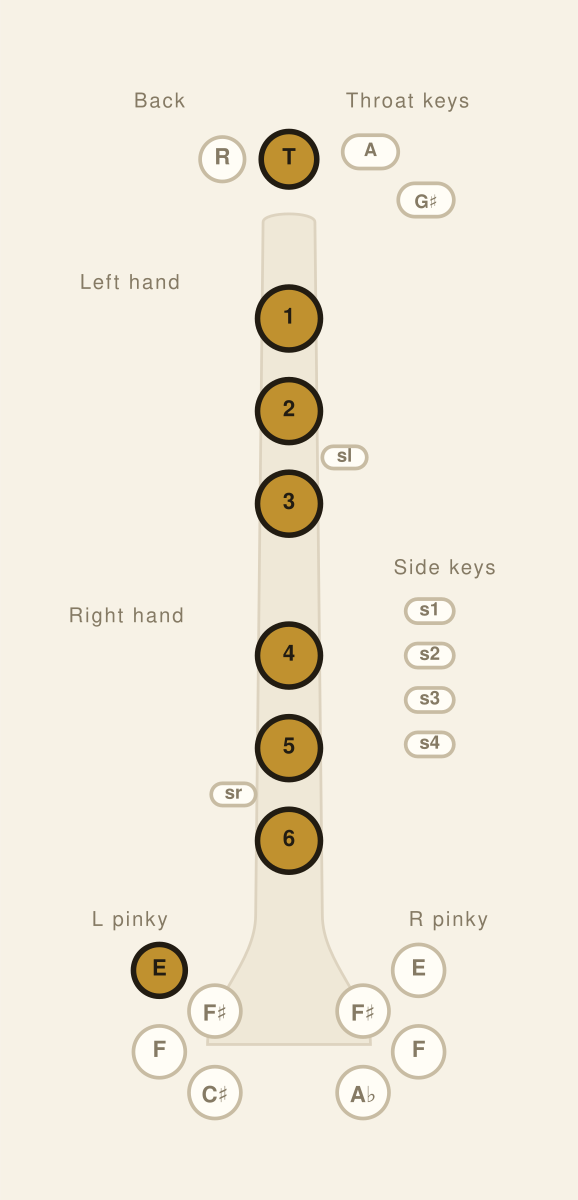
The lowest note on the clarinet: keep the air moving and the throat open, because low E turns flat and stuffy the moment the airstream slows. Don't let the bell rest against your leg either — blocking it pulls the pitch down further.
Everything about E3 on B♭ clarinet →How to read this chart
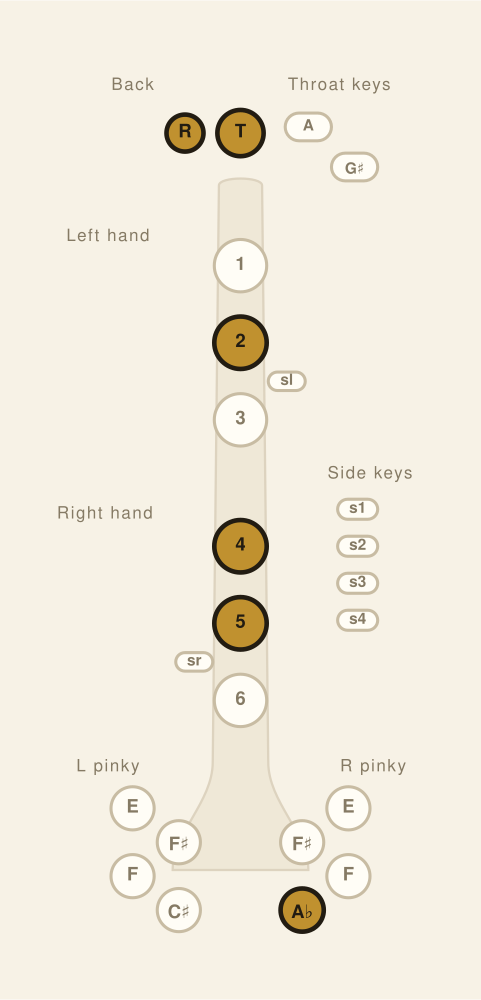
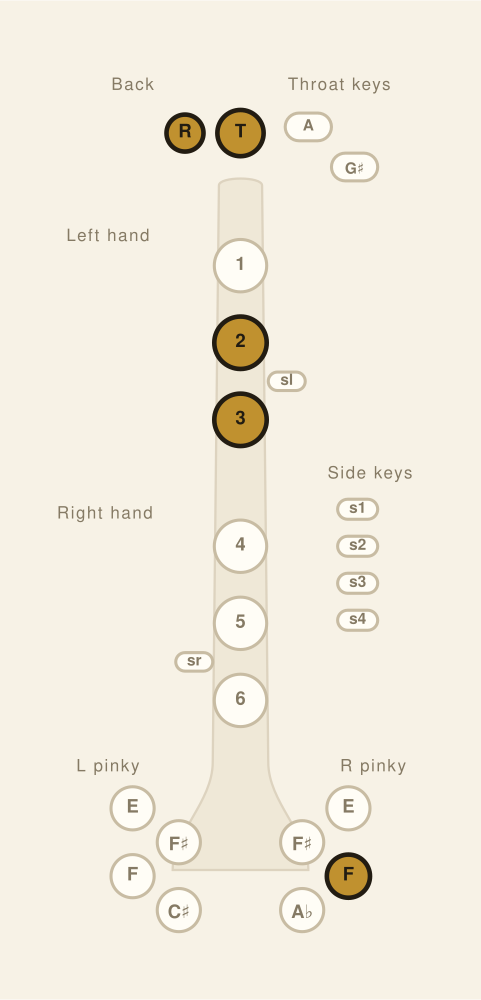
Filled circles are covered holes or pressed keys; open circles stay up. The two keys drawn at the top sit on the back of the instrument: the thumb hole and, just above it, the register key. Holes 1–3 belong to the left hand (top joint), holes 4–6 to the right hand (bottom joint), and the paired pinky clusters at the bottom show the little-finger keys on each side.
Some players call this a clarinet finger chart or note chart — it’s the same thing: one diagram per note across the clarinet’s full practical range.
Written vs concert pitch on a B♭ clarinet
The clarinet is a transposing instrument in B♭: every written note sounds one whole step lower. Written C5 sounds concert B♭4. That’s why your band director asks for a “concert B♭ scale” and you play a written C scale. The chart above always shows both pitches, and the play button sounds the concert pitch — what a listener actually hears.
Full clarinet fingering chart — all notes
The complete B♭ clarinet range, low to high. Chalumeau (low) register notes are made with the bare fingerings; add the register key and most fingerings jump a twelfth into the clarion register; the altissimo begins around written C♯6.
Octave 38 notes
E3 (beginner note)
sounds D3
F3 (beginner note)
sounds E♭3
F♯3 (beginner note)
sounds E3
G3 (beginner note)
sounds F3
G♯3 (beginner note)
sounds F♯3
A3 (beginner note)
sounds G3
B♭3 (beginner note)
sounds A♭3
B3 (beginner note)
sounds A3
Octave 412 notes
C4 (beginner note)
sounds B♭3
C♯4 (beginner note)
sounds B3
D4 (beginner note)
sounds C4
E♭4 (beginner note)
sounds D♭4
E4 (beginner note)
sounds D4
F4 (beginner note)
sounds E♭4
F♯4 (beginner note)
sounds E4
G4 (beginner note)
sounds F4
G♯4 (beginner note)
sounds F♯4
A4 (beginner note)
sounds G4
B♭4 (beginner note)
sounds A♭4
B4 (beginner note)
sounds A4
Octave 512 notes
C5 (beginner note)
sounds B♭4
C♯5
sounds B4
D5
sounds C5
E♭5
sounds D♭5
E5
sounds D5
F5
sounds E♭5
F♯5
sounds E5
G5
sounds F5
G♯5
sounds F♯5
A5
sounds G5
B♭5
sounds A♭5
B5
sounds A5
Octave 612 notes
C6
sounds B♭5
C♯6
sounds B5
D6
sounds C6
E♭6
sounds D♭6
E6
sounds D6
F6
sounds E♭6
F♯6
sounds E6
G6
sounds F6
G♯6
sounds F♯6
A6
sounds G6
B♭6
sounds A♭6
B6
sounds A6
Octave 71 note
C7
sounds B♭6
Pressed or coveredOpenBeginner note
The same chart, written out
Every fingering in words — handy for copying into lesson notes, and it reads aloud properly on a screen reader.
| Written note | Sounds (concert) | Fingering | Beginner |
|---|---|---|---|
| Low E (E3) | D3 | Thumb hole + Left index (hole 1) + Left middle (hole 2) + Left ring (hole 3) + Left pinky E/B key + Right index (hole 4) + Right middle (hole 5) + Right ring (hole 6) | Yes |
| Low F (F3) | E♭3 | Thumb hole + Left index (hole 1) + Left middle (hole 2) + Left ring (hole 3) + Right index (hole 4) + Right middle (hole 5) + Right ring (hole 6) + Right pinky F/C key | Yes |
| Low F♯ (F♯3) | E3 | Thumb hole + Left index (hole 1) + Left middle (hole 2) + Left ring (hole 3) + Left pinky F♯/C♯ key + Right index (hole 4) + Right middle (hole 5) + Right ring (hole 6) | Yes |
| Low G (G3) | F3 | Thumb hole + Left index (hole 1) + Left middle (hole 2) + Left ring (hole 3) + Right index (hole 4) + Right middle (hole 5) + Right ring (hole 6) | Yes |
| Low G♯ (G♯3) | F♯3 | Thumb hole + Left index (hole 1) + Left middle (hole 2) + Left ring (hole 3) + Right index (hole 4) + Right middle (hole 5) + Right ring (hole 6) + Right pinky A♭/E♭ key | Yes |
| Low A (A3) | G3 | Thumb hole + Left index (hole 1) + Left middle (hole 2) + Left ring (hole 3) + Right index (hole 4) + Right middle (hole 5) | Yes |
| Low B♭ (B♭3) | A♭3 | Thumb hole + Left index (hole 1) + Left middle (hole 2) + Left ring (hole 3) + Right index (hole 4) | Yes |
| Low B (B3) | A3 | Thumb hole + Left index (hole 1) + Left middle (hole 2) + Left ring (hole 3) + Right middle (hole 5) | Yes |
| Low C (C4) | B♭3 | Thumb hole + Left index (hole 1) + Left middle (hole 2) + Left ring (hole 3) | Yes |
| Low C♯ (C♯4) | B3 | Thumb hole + Left index (hole 1) + Left middle (hole 2) + Left ring (hole 3) + Left pinky C♯/G♯ key | Yes |
| Low D (D4) | C4 | Thumb hole + Left index (hole 1) + Left middle (hole 2) | Yes |
| Low E♭ (E♭4) | D♭4 | Thumb hole + Left index (hole 1) + Left middle (hole 2) + Side key 4 | Yes |
| E4 | D4 | Thumb hole + Left index (hole 1) | Yes |
| F4 | E♭4 | Thumb hole | Yes |
| F♯4 | E4 | Left index (hole 1) | Yes |
| Throat G (G4) | F4 | Yes | |
| Throat G♯ (G♯4) | F♯4 | G♯ key | Yes |
| Throat A (A4) | G4 | A key | Yes |
| Throat Bb (B♭4) | A♭4 | Register key + A key | Yes |
| B4 | A4 | Register key + Thumb hole + Left index (hole 1) + Left middle (hole 2) + Left ring (hole 3) + Left pinky E/B key + Right index (hole 4) + Right middle (hole 5) + Right ring (hole 6) | Yes |
| C5 | B♭4 | Register key + Thumb hole + Left index (hole 1) + Left middle (hole 2) + Left ring (hole 3) + Right index (hole 4) + Right middle (hole 5) + Right ring (hole 6) + Right pinky F/C key | Yes |
| C♯5 | B4 | Register key + Thumb hole + Left index (hole 1) + Left middle (hole 2) + Left ring (hole 3) + Left pinky F♯/C♯ key + Right index (hole 4) + Right middle (hole 5) + Right ring (hole 6) | — |
| D5 | C5 | Register key + Thumb hole + Left index (hole 1) + Left middle (hole 2) + Left ring (hole 3) + Right index (hole 4) + Right middle (hole 5) + Right ring (hole 6) | — |
| E♭5 | D♭5 | Register key + Thumb hole + Left index (hole 1) + Left middle (hole 2) + Left ring (hole 3) + Right index (hole 4) + Right middle (hole 5) + Right ring (hole 6) + Right pinky A♭/E♭ key | — |
| E5 | D5 | Register key + Thumb hole + Left index (hole 1) + Left middle (hole 2) + Left ring (hole 3) + Right index (hole 4) + Right middle (hole 5) | — |
| F5 | E♭5 | Register key + Thumb hole + Left index (hole 1) + Left middle (hole 2) + Left ring (hole 3) + Right index (hole 4) | — |
| F♯5 | E5 | Register key + Thumb hole + Left index (hole 1) + Left middle (hole 2) + Left ring (hole 3) + Right middle (hole 5) | — |
| G5 | F5 | Register key + Thumb hole + Left index (hole 1) + Left middle (hole 2) + Left ring (hole 3) | — |
| G♯5 | F♯5 | Register key + Thumb hole + Left index (hole 1) + Left middle (hole 2) + Left ring (hole 3) + Left pinky C♯/G♯ key | — |
| A5 | G5 | Register key + Thumb hole + Left index (hole 1) + Left middle (hole 2) | — |
| B♭5 | A♭5 | Register key + Thumb hole + Left index (hole 1) + Left middle (hole 2) + Side key 4 | — |
| B5 | A5 | Register key + Thumb hole + Left index (hole 1) | — |
| C6 | B♭5 | Register key + Thumb hole | — |
| Altissimo C♯ (C♯6) | B5 | Register key + Thumb hole + Left middle (hole 2) + Left ring (hole 3) + Right index (hole 4) + Right middle (hole 5) | — |
| Altissimo D (D6) | C6 | Register key + Thumb hole + Left middle (hole 2) + Left ring (hole 3) + Right index (hole 4) + Right pinky A♭/E♭ key | — |
| Altissimo E♭ (E♭6) | D♭6 | Register key + Thumb hole + Left middle (hole 2) + Left ring (hole 3) + Right index (hole 4) + Right sliver key + Right pinky A♭/E♭ key | — |
| Altissimo E (E6) | D6 | Register key + Thumb hole + Left middle (hole 2) + Left ring (hole 3) + Right pinky A♭/E♭ key | — |
| Altissimo F (F6) | E♭6 | Register key + Thumb hole + Left middle (hole 2) + Left ring (hole 3) + Left pinky C♯/G♯ key + Right pinky A♭/E♭ key | — |
| Altissimo F♯ (F♯6) | E6 | Register key + Thumb hole + Left middle (hole 2) + Right pinky A♭/E♭ key | — |
| Altissimo G (G6) | F6 | Register key + Thumb hole + Left middle (hole 2) + Right index (hole 4) + Right middle (hole 5) + Right pinky A♭/E♭ key | — |
| Altissimo G♯ (G♯6) | F♯6 | Register key + Thumb hole + Left middle (hole 2) + Left ring (hole 3) + Left pinky F♯/C♯ key + Right index (hole 4) + Right ring (hole 6) + Right pinky F♯/C♯ key | — |
| Altissimo A (A6) | G6 | Register key + Thumb hole + Left middle (hole 2) + Left ring (hole 3) + Right pinky F/C key | — |
| Altissimo B♭ (B♭6) | A♭6 | Register key + Thumb hole + G♯ key + Left middle (hole 2) + Left ring (hole 3) + Left pinky C♯/G♯ key + Right pinky A♭/E♭ key | — |
| Altissimo B (B6) | A6 | Register key + Thumb hole + G♯ key + Left index (hole 1) + Left middle (hole 2) + Right index (hole 4) + Right middle (hole 5) | — |
| Altissimo C (C7) | B♭6 | Register key + Thumb hole + G♯ key + Left index (hole 1) + Right index (hole 4) + Right pinky F♯/C♯ key | — |
Alternate B♭ clarinet fingerings
Alternates aren’t “better” fingerings — each one earns its place in a specific musical situation. Select any of these notes in the chart above and switch variants to compare them.
- Low E (E3) — Right little-finger E/B key: Thumb hole + Left index (hole 1) + Left middle (hole 2) + Left ring (hole 3) + Right index (hole 4) + Right middle (hole 5) + Right ring (hole 6) + Right pinky E/B key. Use whichever little finger the surrounding notes leave free — the right one here when the left is needed for low F or low F♯.
- Low F (F3) — Left little-finger F/C key: Thumb hole + Left index (hole 1) + Left middle (hole 2) + Left ring (hole 3) + Left pinky F/C key + Right index (hole 4) + Right middle (hole 5) + Right ring (hole 6). Use the left side when the right little finger is already committed to the E/B or A♭/E♭ key.
- Low F♯ (F♯3) — Right little-finger F♯/C♯ key: Thumb hole + Left index (hole 1) + Left middle (hole 2) + Left ring (hole 3) + Right index (hole 4) + Right middle (hole 5) + Right ring (hole 6) + Right pinky F♯/C♯ key. Switch to the right side when the left little finger is needed for low E, low F or low C♯.
- Low B (B3) — B/F♯ sliver key: Thumb hole + Left index (hole 1) + Left middle (hole 2) + Left ring (hole 3) + Right index (hole 4) + Right sliver key. Use in chromatic movement between B♭ and B, where it saves lifting the index finger and dropping the middle finger at the same time.
- Low E♭ (E♭4) — Left-hand E♭/B♭ sliver key: Thumb hole + Left index (hole 1) + Left middle (hole 2) + Left sliver key. Use when moving between D and E♭ or trilling, since only the left hand has to move. — Fork fingering (right index): Thumb hole + Left index (hole 1) + Right index (hole 4). Slightly sharp; use for facility when the neighbouring notes already put the right index finger down.
- F♯4 (F♯4) — Chromatic F♯ (side keys 3 and 4): Thumb hole + Side key 3 + Side key 4. Use next to F4 so the thumb and left index finger can stay exactly where they are.
- Throat G (G4) — Resonance fingering (right hand down): Right index (hole 4) + Right middle (hole 5) + Right ring (hole 6). Use on sustained or exposed G, where the right hand is free, to fill out a thin tone.
- Throat G♯ (G♯4) — Resonance fingering (right hand down): G♯ key + Right index (hole 4) + Right middle (hole 5) + Right ring (hole 6). Use when G♯ is held or exposed and the right hand is otherwise idle.
- Throat A (A4) — Resonance fingering (right-hand shading): A key + Right middle (hole 5) + Right ring (hole 6) + Right pinky F/C key. Use on sustained throat A to fill out the sound and settle the pitch.
- Throat Bb (B♭4) — Resonance fingering (both hands shading): Register key + A key + Left middle (hole 2) + Left ring (hole 3) + Right middle (hole 5) + Right ring (hole 6) + Right pinky F/C key. Use on longer B♭s where there is time to set the extra fingers — it sounds fuller and sits closer to pitch. — Side-key B♭ (G♯ key with the first side key): G♯ key + Side key 1. Use in trills and quick passages around A and B where a clear, ringing B♭ matters more than the security of the standard fingering.
- B4 (B4) — Right little-finger E/B key: Register key + Thumb hole + Left index (hole 1) + Left middle (hole 2) + Left ring (hole 3) + Right index (hole 4) + Right middle (hole 5) + Right ring (hole 6) + Right pinky E/B key. Pick the side that leaves the other little finger free for whatever comes next.
- C5 (C5) — Left little-finger F/C key: Register key + Thumb hole + Left index (hole 1) + Left middle (hole 2) + Left ring (hole 3) + Left pinky F/C key + Right index (hole 4) + Right middle (hole 5) + Right ring (hole 6). Use when the right little finger is already on the E/B or A♭/E♭ key.
- C♯5 (C♯5) — Right little-finger F♯/C♯ key: Register key + Thumb hole + Left index (hole 1) + Left middle (hole 2) + Left ring (hole 3) + Right index (hole 4) + Right middle (hole 5) + Right ring (hole 6) + Right pinky F♯/C♯ key. Use when the left little finger is needed for B, C or G♯ nearby.
- F♯5 (F♯5) — B/F♯ sliver key: Register key + Thumb hole + Left index (hole 1) + Left middle (hole 2) + Left ring (hole 3) + Right index (hole 4) + Right sliver key. Use for chromatic movement between F and F♯ so the right hand can stay still.
- G♯5 (G♯5) — Right-hand alternate: Register key + Thumb hole + Left index (hole 1) + Left middle (hole 2) + Right index (hole 4) + Right middle (hole 5). Use when the surrounding notes already have right-hand fingers down and the left little finger is busy.
- B♭5 (B♭5) — Left-hand E♭/B♭ sliver key: Register key + Thumb hole + Left index (hole 1) + Left middle (hole 2) + Left sliver key. Use for A–B♭ trills and chromatic runs, where only the left hand needs to move. — Fork fingering (right index): Register key + Thumb hole + Left index (hole 1) + Right index (hole 4). Use for facility when the neighbouring notes already involve the right index finger.
- Altissimo D (D6) — Short fingering (G♯ key with the lowest side key): Register key + Thumb hole + G♯ key + Side key 4. Less flat than the bare short fingering; used mainly for a quick trill against C6. — Trill fingering (G♯ key only): Register key + Thumb hole + G♯ key. Use for a rapid trill against C6, not for sustained notes — it is noticeably flat.
- Altissimo E♭ (E♭6) — Right ring finger vent: Register key + Thumb hole + Left middle (hole 2) + Left ring (hole 3) + Right ring (hole 6) + Right pinky A♭/E♭ key. Use when arriving from clarion notes that already have the right hand down.
- Altissimo F (F6) — Covered F: Register key + Thumb hole + Left index (hole 1) + Left middle (hole 2) + Left ring (hole 3) + Left pinky C♯/G♯ key + Right index (hole 4) + Right middle (hole 5) + Right ring (hole 6). Use for slurring up from the lower registers and for quiet playing, where the vented fingering can misfire.
- Altissimo F♯ (F♯6) — Left hand with the lowest side key: Register key + Thumb hole + Left index (hole 1) + Left middle (hole 2) + Side key 4 + Right pinky A♭/E♭ key. Use when pitch accuracy matters and for wide leaps — it responds at every dynamic. — Covered F♯: Register key + Thumb hole + Left index (hole 1) + Left middle (hole 2) + Right index (hole 4) + Right middle (hole 5) + Right ring (hole 6) + Right pinky A♭/E♭ key. Use for slurs out of the clarion register and for sustained notes at the extremes of the dynamic range.
- Altissimo G (G6) — Left index vent: Register key + Thumb hole + Left index (hole 1) + Right index (hole 4) + Right middle (hole 5) + Right pinky A♭/E♭ key. Use when slurring up from clarion notes, where keeping the left index finger down steadies the entry.
- Altissimo G♯ (G♯6) — Right little-finger F♯/C♯ key: Register key + Thumb hole + Left middle (hole 2) + Left ring (hole 3) + Right index (hole 4) + Right ring (hole 6) + Right pinky F♯/C♯ key. The same fingering with the F♯/C♯ key on the other hand — take whichever side the phrase leaves free. — Short A♭ (right index with the A♭/E♭ key): Register key + Thumb hole + Right index (hole 4) + Right pinky A♭/E♭ key. Use where an easy, well-tuned fingering matters more than matching the neighbouring altissimo notes.
- Altissimo A (A6) — Left little-finger F/C key: Register key + Thumb hole + Left middle (hole 2) + Left ring (hole 3) + Left pinky F/C key. Take it with the left little finger when the right one is already holding another key in the same phrase. — F♯/C♯ key vent: Register key + Thumb hole + Left middle (hole 2) + Left ring (hole 3) + Right pinky F♯/C♯ key. A slightly different colour and pitch centre; try it when the standard fingering will not speak on your instrument.
- Altissimo B♭ (B♭6) — Side-key B♭: Register key + Thumb hole + G♯ key + Left middle (hole 2) + Left ring (hole 3) + Left pinky C♯/G♯ key + Side key 3 + Side key 4. Use for exposed entries, where response and intonation matter more than fingering economy.
- Altissimo B (B6) — Without the side G♯ key: Register key + Thumb hole + Left index (hole 1) + Left middle (hole 2) + Right index (hole 4) + Right middle (hole 5) + Right pinky F♯/C♯ key. Use when the neighbouring notes do not need the G♯ lever, so the left index finger can stay flat on its hole.
- Altissimo C (C7) — A♭/E♭ key version: Register key + Thumb hole + Left index (hole 1) + Right index (hole 4) + Right pinky A♭/E♭ key. Try this when the standard fingering will not centre — altissimo C differs a lot between set-ups.
Trill fingerings
Trill fingerings trade a little tone quality for speed — use them for rapid alternation, not sustained notes.
- Low B♭ (B♭3) ↔ B3 — Trill the B/F♯ sliver key with the right middle finger: Thumb hole + Left index (hole 1) + Left middle (hole 2) + Left ring (hole 3) + Right index (hole 4) + Right sliver key
- Low D (D4) ↔ E♭4 — Trill the left-hand E♭/B♭ sliver key: Thumb hole + Left index (hole 1) + Left middle (hole 2) + Left sliver key
- F4 (F4) ↔ F♯4 — Trill side keys 3 and 4 with the right index finger: Thumb hole + Side key 3 + Side key 4
- Throat G♯ (G♯4) ↔ A4 — Trill the second side key: G♯ key + Side key 2
- Throat G♯ (G♯4) ↔ B♭4 — Trill the first side key: G♯ key + Side key 1
- Throat A (A4) ↔ B♭4 — Trill the second side key: A key + Side key 2
- Throat A (A4) ↔ B4 — Trill the first side key, which avoids crossing the break: A key + Side key 1
- Throat Bb (B♭4) ↔ B4 — Trill the second side key: Register key + A key + Side key 2
- Throat Bb (B♭4) ↔ C5 — Trill the first side key: Register key + A key + Side key 1
- F5 (F5) ↔ F♯5 — Trill the B/F♯ sliver key: Register key + Thumb hole + Left index (hole 1) + Left middle (hole 2) + Left ring (hole 3) + Right index (hole 4) + Right sliver key
- A5 (A5) ↔ B♭5 — Trill the left-hand E♭/B♭ sliver key: Register key + Thumb hole + Left index (hole 1) + Left middle (hole 2) + Left sliver key
- C6 (C6) ↔ D6 — Trill the side G♯ key: Register key + Thumb hole + G♯ key
Common clarinet fingering mistakes
- Uncovered ring edges. Most squeaks on crossing the break come from a fingertip that seals 90% of a hole. Flatten the pads of your fingers, don’t use the tips.
- Ignoring the left/right pinky choice. The E/B and F/C keys exist on both sides so you can alternate — pick the side that leaves your next note free instead of sliding.
- Throat tones with a dead right hand. Adding right-hand fingers under throat A and B♭ (resonance fingerings) steadies pitch and improves tone.
- Biting for the altissimo. High notes come from voicing and air speed, not jaw pressure — biting makes them sharp, thin and squeak-prone.
Frequently asked questions
Is this fingering chart for B♭ clarinet?
Yes — every diagram shows standard Boehm-system fingerings for the B♭ clarinet, the model virtually all band students play. An A clarinet uses the same fingerings; only the sounding pitch differs.
How do I read a clarinet fingering chart?
Filled circles mean cover that hole or press that key; open circles stay untouched. Read top to bottom: thumb and register key on the back, left-hand holes 1–3, then right-hand holes 4–6 and the pinky keys at the bottom.
Do Yamaha and Buffet clarinets use the same fingerings?
Yes. Yamaha, Buffet, Selmer, Jupiter and other mainstream brands all build Boehm-system clarinets, so this chart applies to all of them. Only German (Oehler) system clarinets differ, and those are rare in school bands.
Why doesn't my note match the piano?
The B♭ clarinet is a transposing instrument: written C sounds as concert B♭, one whole step lower. This chart shows both the written note you read and the concert pitch you actually hear.
Why does my clarinet squeak when I add the register key?
Usually the voicing, not the fingering — keep the tongue high (think 'ee'), take a bit more mouthpiece, and use faster air. Squeaks also come from leaking pads or fingers not sealing hole rings completely.
Can I print this chart for free?
Yes. The printable PDF (Letter and A4) is generated from the same data as this interactive chart and downloads with one click — no email address required.
Clarinet fingering data last updated . Every diagram here, in the printable PDF and in the chart image comes from one dataset, so the paper and the screen cannot disagree.