B♭ · low E♭ extension · 34 notes
Bass Clarinet Fingering Chart
Tap any note from low E♭ to C6 to see exactly which keys to press, hear the pitch, and check the concert note a major ninth below. The fingerings are the soprano clarinet’s; the low E♭ key and the sound are the bass’s own. Print the full chart free below.
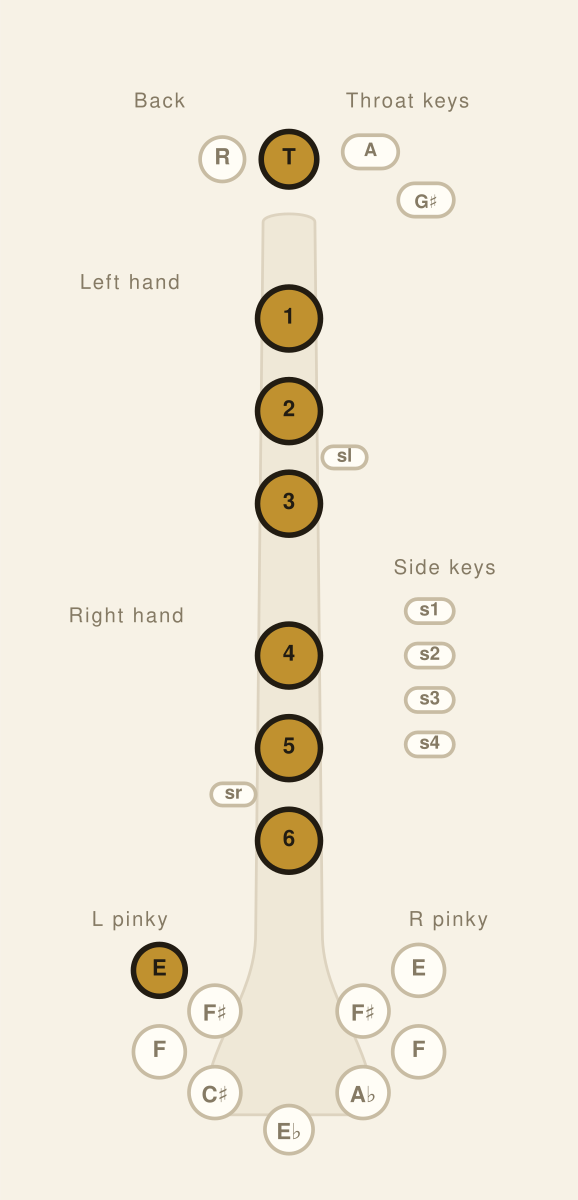
Every hole covered plus the E/B key. Bass clarinet low E wants slow, wide air and a very relaxed jaw; the long tube speaks late if you rush it. Set the floor peg so the instrument is not resting on the bell, or the note goes flat and stuffy.
Everything about E3 on bass clarinet →How to read this chart
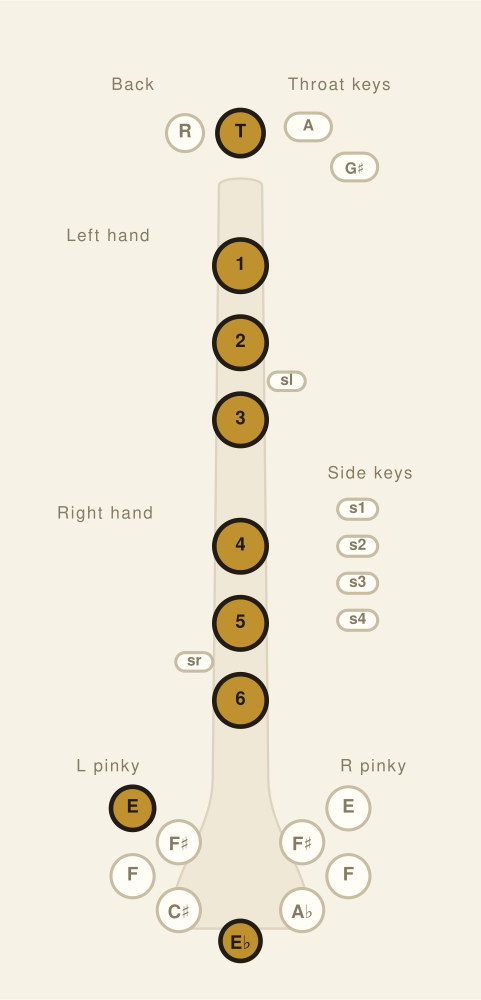
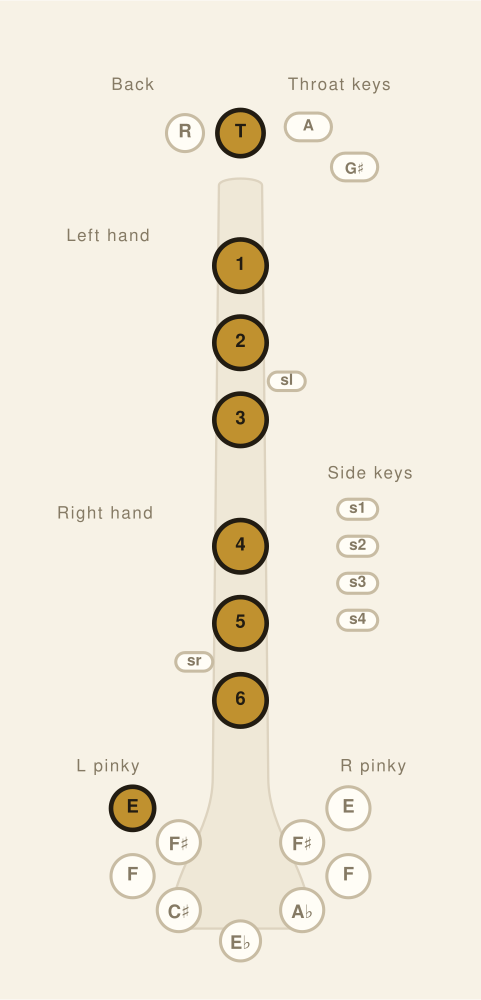
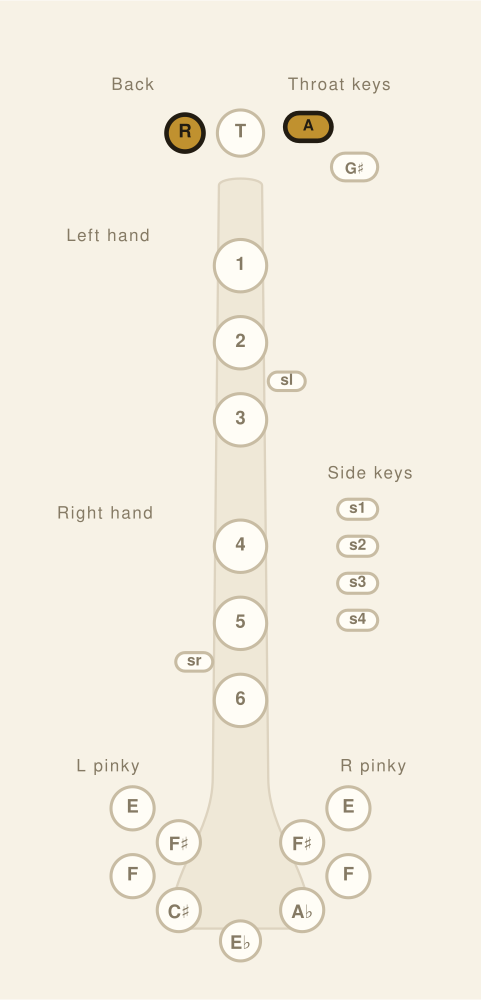
Filled circles mean press that key or cover that hole; open circles stay up. The diagram runs top to bottom: the thumb and register key on the back, the throat levers beside them, the left hand’s three tone holes, then the right hand’s three with the side keys to their right, and the two little-finger clusters at the bottom. The extra key at the very bottom is the low E♭ extension.
On a bass clarinet the tone holes are covered by plateau keys rather than open rings, so the “hole” you cover is a pad you press. The seal comes from firm, flat finger pressure — a soprano player’s worry about fingertips riding the edge of a ring does not apply.
Written vs concert pitch
The bass clarinet is a B♭ instrument written in treble clef, sounding a major ninth below what is written: written C5 sounds concert B♭3, the band tuning note, and written C4 sounds B♭2. That is an octave below the soprano clarinet reading the same part, which is the point — a bass clarinettist reads with the same fingerings as the section and sounds in the cello range. The play button in the chart sounds the concert pitch.
The low E♭ key and what lies below
The soprano clarinet stops at written low E. Almost every student bass clarinet adds one key below it for low E♭: finger low E and add the extension key — under the right little finger on most models, a right-thumb lever on some. It sounds concert D♭2. Professional instruments continue to low C with a further cluster of keys; those notes vary by maker and are not covered here.
The bottom of the horn wants slow, wide air and a very relaxed jaw. Set the floor peg so the instrument is not sitting on its bell, or the low notes go flat and stuffy.
Full bass clarinet fingering chart — all notes
The complete standard range, written E♭3 to C6, chromatically: chalumeau, throat notes and clarion. The concert column shows what each written note actually sounds.
Octave 39 notes
E♭3
sounds D♭2
E3 (beginner note)
sounds D2
F3 (beginner note)
sounds E♭2
F♯3 (beginner note)
sounds E2
G3 (beginner note)
sounds F2
G♯3 (beginner note)
sounds G♭2
A3 (beginner note)
sounds G2
B♭3 (beginner note)
sounds A♭2
B3 (beginner note)
sounds A2
Octave 412 notes
C4 (beginner note)
sounds B♭2
C♯4 (beginner note)
sounds B2
D4 (beginner note)
sounds C3
E♭4 (beginner note)
sounds D♭3
E4 (beginner note)
sounds D3
F4 (beginner note)
sounds E♭3
F♯4 (beginner note)
sounds E3
G4 (beginner note)
sounds F3
G♯4 (beginner note)
sounds G♭3
A4 (beginner note)
sounds G3
B♭4 (beginner note)
sounds A♭3
B4 (beginner note)
sounds A3
Octave 512 notes
C5 (beginner note)
sounds B♭3
C♯5
sounds B3
D5
sounds C4
E♭5
sounds D♭4
E5
sounds D4
F5
sounds E♭4
F♯5
sounds E4
G5
sounds F4
G♯5
sounds G♭4
A5
sounds G4
B♭5
sounds A♭4
B5
sounds A4
Octave 61 note
C6
sounds B♭4
Pressed or coveredOpenBeginner note
The same chart, written out
Every fingering in words — handy for copying into lesson notes, and it reads aloud properly on a screen reader.
| Written note | Sounds (concert) | Fingering | Beginner |
|---|---|---|---|
| Low E♭3 (E♭3) | D♭2 | Thumb hole + Left index (hole 1) + Left middle (hole 2) + Left ring (hole 3) + Left pinky E/B key + Right index (hole 4) + Right middle (hole 5) + Right ring (hole 6) + Low E♭ extension key | — |
| Low E (E3) | D2 | Thumb hole + Left index (hole 1) + Left middle (hole 2) + Left ring (hole 3) + Left pinky E/B key + Right index (hole 4) + Right middle (hole 5) + Right ring (hole 6) | Yes |
| Low F (F3) | E♭2 | Thumb hole + Left index (hole 1) + Left middle (hole 2) + Left ring (hole 3) + Right index (hole 4) + Right middle (hole 5) + Right ring (hole 6) + Right pinky F/C key | Yes |
| Low F♯ (F♯3) | E2 | Thumb hole + Left index (hole 1) + Left middle (hole 2) + Left ring (hole 3) + Left pinky F♯/C♯ key + Right index (hole 4) + Right middle (hole 5) + Right ring (hole 6) | Yes |
| Low G (G3) | F2 | Thumb hole + Left index (hole 1) + Left middle (hole 2) + Left ring (hole 3) + Right index (hole 4) + Right middle (hole 5) + Right ring (hole 6) | Yes |
| Low G♯ (G♯3) | G♭2 | Thumb hole + Left index (hole 1) + Left middle (hole 2) + Left ring (hole 3) + Right index (hole 4) + Right middle (hole 5) + Right ring (hole 6) + Right pinky A♭/E♭ key | Yes |
| Low A (A3) | G2 | Thumb hole + Left index (hole 1) + Left middle (hole 2) + Left ring (hole 3) + Right index (hole 4) + Right middle (hole 5) | Yes |
| Low B♭ (B♭3) | A♭2 | Thumb hole + Left index (hole 1) + Left middle (hole 2) + Left ring (hole 3) + Right index (hole 4) | Yes |
| Low B (B3) | A2 | Thumb hole + Left index (hole 1) + Left middle (hole 2) + Left ring (hole 3) + Right middle (hole 5) | Yes |
| Low C (C4) | B♭2 | Thumb hole + Left index (hole 1) + Left middle (hole 2) + Left ring (hole 3) | Yes |
| Low C♯ (C♯4) | B2 | Thumb hole + Left index (hole 1) + Left middle (hole 2) + Left ring (hole 3) + Left pinky C♯/G♯ key | Yes |
| Low D (D4) | C3 | Thumb hole + Left index (hole 1) + Left middle (hole 2) | Yes |
| Low E♭ (E♭4) | D♭3 | Thumb hole + Left index (hole 1) + Left middle (hole 2) + Side key 4 | Yes |
| E4 | D3 | Thumb hole + Left index (hole 1) | Yes |
| F4 | E♭3 | Thumb hole | Yes |
| F♯4 | E3 | Left index (hole 1) | Yes |
| Throat G (G4) | F3 | Yes | |
| Throat G♯ (G♯4) | G♭3 | G♯ key | Yes |
| Throat A (A4) | G3 | A key | Yes |
| Throat Bb (B♭4) | A♭3 | Register key + A key | Yes |
| B4 | A3 | Register key + Thumb hole + Left index (hole 1) + Left middle (hole 2) + Left ring (hole 3) + Left pinky E/B key + Right index (hole 4) + Right middle (hole 5) + Right ring (hole 6) | Yes |
| C5 | B♭3 | Register key + Thumb hole + Left index (hole 1) + Left middle (hole 2) + Left ring (hole 3) + Right index (hole 4) + Right middle (hole 5) + Right ring (hole 6) + Right pinky F/C key | Yes |
| C♯5 | B3 | Register key + Thumb hole + Left index (hole 1) + Left middle (hole 2) + Left ring (hole 3) + Left pinky F♯/C♯ key + Right index (hole 4) + Right middle (hole 5) + Right ring (hole 6) | — |
| D5 | C4 | Register key + Thumb hole + Left index (hole 1) + Left middle (hole 2) + Left ring (hole 3) + Right index (hole 4) + Right middle (hole 5) + Right ring (hole 6) | — |
| E♭5 | D♭4 | Register key + Thumb hole + Left index (hole 1) + Left middle (hole 2) + Left ring (hole 3) + Right index (hole 4) + Right middle (hole 5) + Right ring (hole 6) + Right pinky A♭/E♭ key | — |
| E5 | D4 | Register key + Thumb hole + Left index (hole 1) + Left middle (hole 2) + Left ring (hole 3) + Right index (hole 4) + Right middle (hole 5) | — |
| F5 | E♭4 | Register key + Thumb hole + Left index (hole 1) + Left middle (hole 2) + Left ring (hole 3) + Right index (hole 4) | — |
| F♯5 | E4 | Register key + Thumb hole + Left index (hole 1) + Left middle (hole 2) + Left ring (hole 3) + Right middle (hole 5) | — |
| G5 | F4 | Register key + Thumb hole + Left index (hole 1) + Left middle (hole 2) + Left ring (hole 3) | — |
| G♯5 | G♭4 | Register key + Thumb hole + Left index (hole 1) + Left middle (hole 2) + Left ring (hole 3) + Left pinky C♯/G♯ key | — |
| A5 | G4 | Register key + Thumb hole + Left index (hole 1) + Left middle (hole 2) | — |
| B♭5 | A♭4 | Register key + Thumb hole + Left index (hole 1) + Left middle (hole 2) + Side key 4 | — |
| B5 | A4 | Register key + Thumb hole + Left index (hole 1) | — |
| C6 | B♭4 | Register key + Thumb hole | — |
Alternate bass clarinet fingerings
Alternates aren’t “better” fingerings — each one earns its place in a specific musical situation. Select any of these notes in the chart above and switch variants to compare them.
- Low E (E3) — Right little-finger E/B key: Thumb hole + Left index (hole 1) + Left middle (hole 2) + Left ring (hole 3) + Right index (hole 4) + Right middle (hole 5) + Right ring (hole 6) + Right pinky E/B key. Use whichever little finger the surrounding notes leave free — the right one here when the left is needed for low F or low F♯.
- Low F (F3) — Left little-finger F/C key: Thumb hole + Left index (hole 1) + Left middle (hole 2) + Left ring (hole 3) + Left pinky F/C key + Right index (hole 4) + Right middle (hole 5) + Right ring (hole 6). Use the left side when the right little finger is already committed to the E/B or A♭/E♭ key.
- Low F♯ (F♯3) — Right little-finger F♯/C♯ key: Thumb hole + Left index (hole 1) + Left middle (hole 2) + Left ring (hole 3) + Right index (hole 4) + Right middle (hole 5) + Right ring (hole 6) + Right pinky F♯/C♯ key. Switch to the right side when the left little finger is needed for low E, low F or low C♯.
- Low B (B3) — B/F♯ sliver key: Thumb hole + Left index (hole 1) + Left middle (hole 2) + Left ring (hole 3) + Right index (hole 4) + Right sliver key. Use in chromatic movement between B♭ and B, where it saves lifting the index finger and dropping the middle finger at the same time.
- Low E♭ (E♭4) — Left-hand E♭/B♭ sliver key: Thumb hole + Left index (hole 1) + Left middle (hole 2) + Left sliver key. Use when moving between D and E♭ or trilling, since only the left hand has to move. — Fork fingering (right index): Thumb hole + Left index (hole 1) + Right index (hole 4). Slightly sharp; use for facility when the neighbouring notes already put the right index finger down.
- F♯4 (F♯4) — Chromatic F♯ (side keys 3 and 4): Thumb hole + Side key 3 + Side key 4. Use next to F4 so the thumb and left index finger can stay exactly where they are.
- Throat G (G4) — Resonance fingering (right hand down): Right index (hole 4) + Right middle (hole 5) + Right ring (hole 6). Use on sustained or exposed G, where the right hand is free, to fill out a thin tone.
- Throat G♯ (G♯4) — Resonance fingering (right hand down): G♯ key + Right index (hole 4) + Right middle (hole 5) + Right ring (hole 6). Use when G♯ is held or exposed and the right hand is otherwise idle.
- Throat A (A4) — Resonance fingering (right-hand shading): A key + Right middle (hole 5) + Right ring (hole 6) + Right pinky F/C key. Use on sustained throat A to fill out the sound and settle the pitch.
- Throat Bb (B♭4) — Resonance fingering (both hands shading): Register key + A key + Left middle (hole 2) + Left ring (hole 3) + Right middle (hole 5) + Right ring (hole 6) + Right pinky F/C key. Use on longer B♭s where there is time to set the extra fingers — it sounds fuller and sits closer to pitch. — Side-key B♭ (G♯ key with the first side key): G♯ key + Side key 1. Use in trills and quick passages around A and B where a clear, ringing B♭ matters more than the security of the standard fingering.
- B4 (B4) — Right little-finger E/B key: Register key + Thumb hole + Left index (hole 1) + Left middle (hole 2) + Left ring (hole 3) + Right index (hole 4) + Right middle (hole 5) + Right ring (hole 6) + Right pinky E/B key. Pick the side that leaves the other little finger free for whatever comes next.
- C5 (C5) — Left little-finger F/C key: Register key + Thumb hole + Left index (hole 1) + Left middle (hole 2) + Left ring (hole 3) + Left pinky F/C key + Right index (hole 4) + Right middle (hole 5) + Right ring (hole 6). Use when the right little finger is already on the E/B or A♭/E♭ key.
- C♯5 (C♯5) — Right little-finger F♯/C♯ key: Register key + Thumb hole + Left index (hole 1) + Left middle (hole 2) + Left ring (hole 3) + Right index (hole 4) + Right middle (hole 5) + Right ring (hole 6) + Right pinky F♯/C♯ key. Use when the left little finger is needed for B, C or G♯ nearby.
- F♯5 (F♯5) — B/F♯ sliver key: Register key + Thumb hole + Left index (hole 1) + Left middle (hole 2) + Left ring (hole 3) + Right index (hole 4) + Right sliver key. Use for chromatic movement between F and F♯ so the right hand can stay still.
- G♯5 (G♯5) — Right-hand alternate: Register key + Thumb hole + Left index (hole 1) + Left middle (hole 2) + Right index (hole 4) + Right middle (hole 5). Use when the surrounding notes already have right-hand fingers down and the left little finger is busy.
- B♭5 (B♭5) — Left-hand E♭/B♭ sliver key: Register key + Thumb hole + Left index (hole 1) + Left middle (hole 2) + Left sliver key. Use for A–B♭ trills and chromatic runs, where only the left hand needs to move. — Fork fingering (right index): Register key + Thumb hole + Left index (hole 1) + Right index (hole 4). Use for facility when the neighbouring notes already involve the right index finger.
Trill fingerings
Trill fingerings trade a little tone quality for speed — use them for rapid alternation, not sustained notes.
- Low B♭ (B♭3) ↔ B3 — Trill the B/F♯ sliver key with the right middle finger: Thumb hole + Left index (hole 1) + Left middle (hole 2) + Left ring (hole 3) + Right index (hole 4) + Right sliver key
- Low D (D4) ↔ E♭4 — Trill the left-hand E♭/B♭ sliver key: Thumb hole + Left index (hole 1) + Left middle (hole 2) + Left sliver key
- F4 (F4) ↔ F♯4 — Trill side keys 3 and 4 with the right index finger: Thumb hole + Side key 3 + Side key 4
- Throat G♯ (G♯4) ↔ A4 — Trill the second side key: G♯ key + Side key 2
- Throat G♯ (G♯4) ↔ B♭4 — Trill the first side key: G♯ key + Side key 1
- Throat A (A4) ↔ B♭4 — Trill the second side key: A key + Side key 2
- Throat A (A4) ↔ B4 — Trill the first side key, which avoids crossing the break: A key + Side key 1
- Throat Bb (B♭4) ↔ B4 — Trill the second side key: Register key + A key + Side key 2
- Throat Bb (B♭4) ↔ C5 — Trill the first side key: Register key + A key + Side key 1
- F5 (F5) ↔ F♯5 — Trill the B/F♯ sliver key: Register key + Thumb hole + Left index (hole 1) + Left middle (hole 2) + Left ring (hole 3) + Right index (hole 4) + Right sliver key
- A5 (A5) ↔ B♭5 — Trill the left-hand E♭/B♭ sliver key: Register key + Thumb hole + Left index (hole 1) + Left middle (hole 2) + Left sliver key
- C6 (C6) ↔ D6 — Trill the side G♯ key: Register key + Thumb hole + G♯ key
Common bass clarinet mistakes
- Biting. The bass takes a bigger reed and mouthpiece than the soprano and needs a looser jaw and slower air. Squeezing thins the sound, sharpens the pitch and makes the low register refuse to speak.
- Half-pressing the plateau keys. A pad that is not fully down leaks, and the note gurgles. Press flat and firm, especially in the right hand.
- Leaving the right hand off for throat notes. The resonance fingerings — right-hand fingers added to open G, G♯, A and B♭ — matter more on bass than on soprano, and they set the right hand up for the break.
- Resting the bell on the floor or a leg. The bass clarinet has a floor peg for a reason: a blocked bell pulls the lowest notes flat and stuffy.
Frequently asked questions
Are bass clarinet fingerings the same as clarinet?
For the whole standard range, yes. From low E to the top of the clarion (written C6) a bass clarinet is fingered exactly like a B♭ soprano clarinet — same thumb, register key, tone holes, side keys and little-finger clusters. The differences are at the edges: the bass adds a low E♭ key below the soprano's lowest note (professional models go to low C), and above C6 the altissimo fingerings differ.
What does a bass clarinet sound when I play written C?
Concert B♭, a major ninth below — an octave lower than a soprano clarinet reading the same note. Written C5 sounds B♭3, the band tuning note; written C4 sounds B♭2. Bass clarinet parts are written in treble clef with this transposition, so the fingering you read is the soprano's and the sound is an octave down.
Why does this chart start at low E♭?
Because that is where a student bass clarinet stops. Nearly all school instruments carry one extension key below low E, giving E♭ (the key is usually under the right little finger, on some makers a thumb lever). Professional bass clarinets extend to low C with several more keys, and those notes are beyond this chart.
Why does this chart stop at C6?
C6 is the top of the clarion register, and up to there the fingerings are the same on every clarinet. Above it the bass clarinet's altissimo uses its own vents and half-hole fingerings that vary between instruments, so there is no single chart worth printing as standard. The soprano clarinet altissimo page covers the soprano's fingerings, which are not reliably the bass's.
Can I print this chart for free?
Yes. The printable PDF (Letter and A4) is generated from the same data as this interactive chart and downloads with one click — no email address required.
Bass clarinet fingering data last updated . Every diagram here, in the printable PDF and in the chart image comes from one dataset, so the paper and the screen cannot disagree.
Need the soprano chart instead? See the B♭ clarinet fingering chart.