BB♭ · three valves · bass clef · 31 notes
Tuba Fingering Chart (BB♭)
Tap any note from low E to B♭3 to see which valves to press, hear the pitch and check the harmonic partial it sits in. Written in bass clef at concert pitch, the way tuba parts actually come. Print the full chart free below.
Second partial with 1-2, or valve 3 alone. Drop the jaw and open the throat: if the note will not start, the aperture is too tight, not the air too soft.
Everything about G1 on BB♭ tuba →How to read this chart
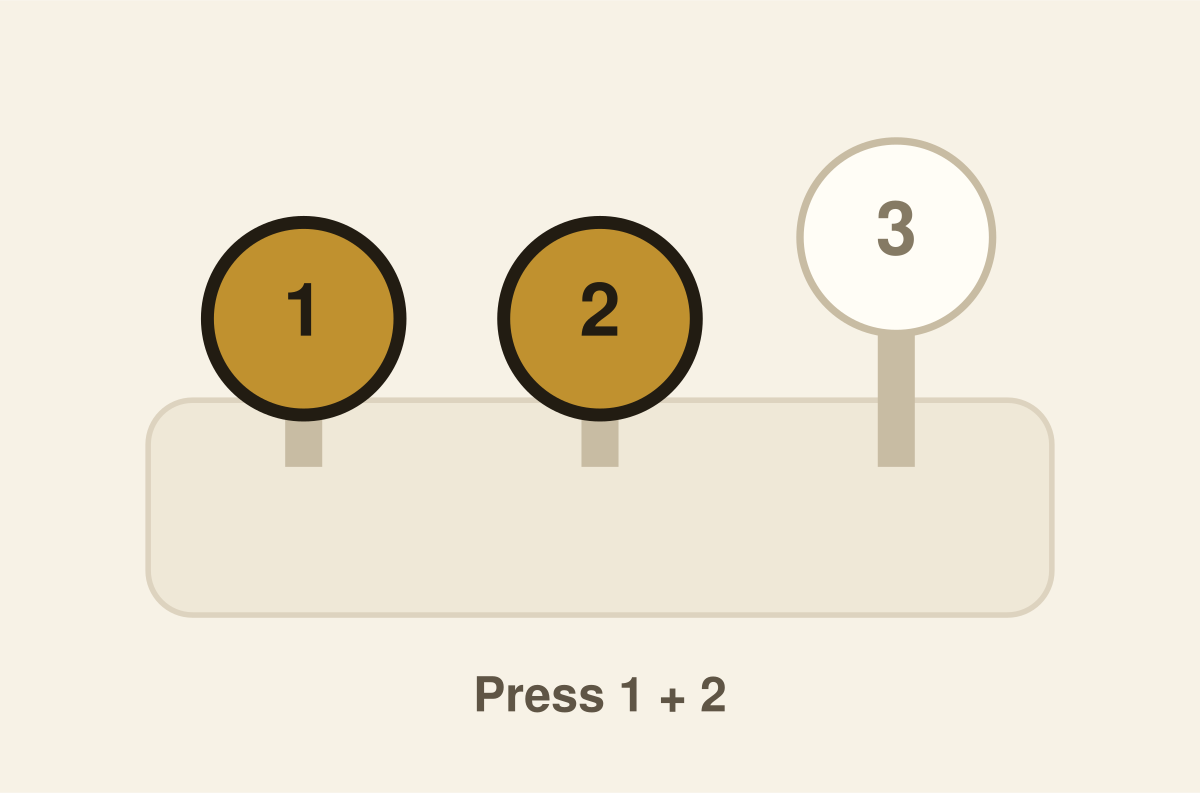
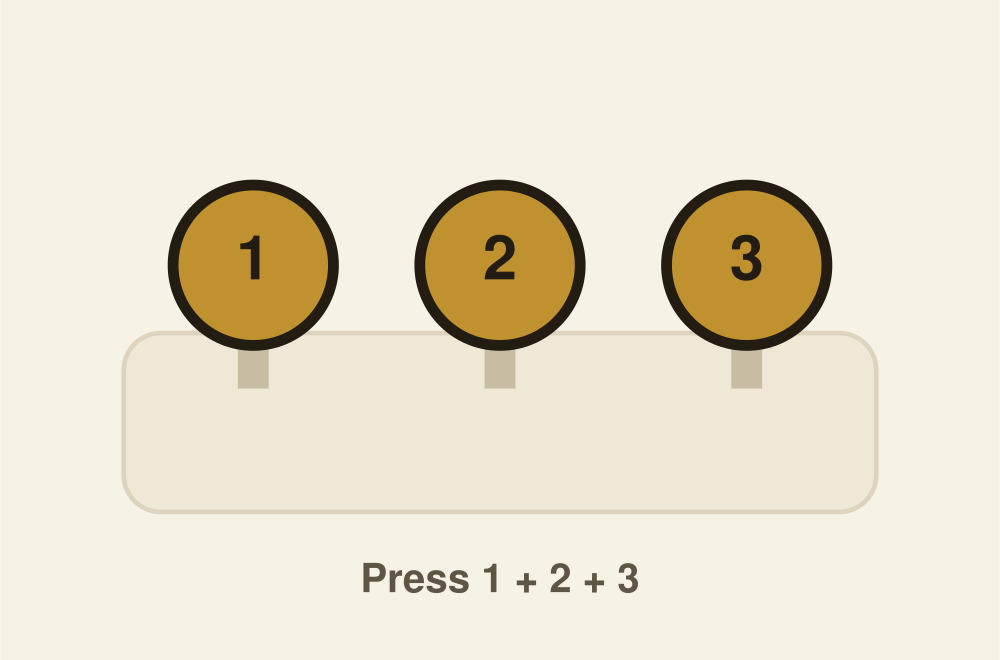
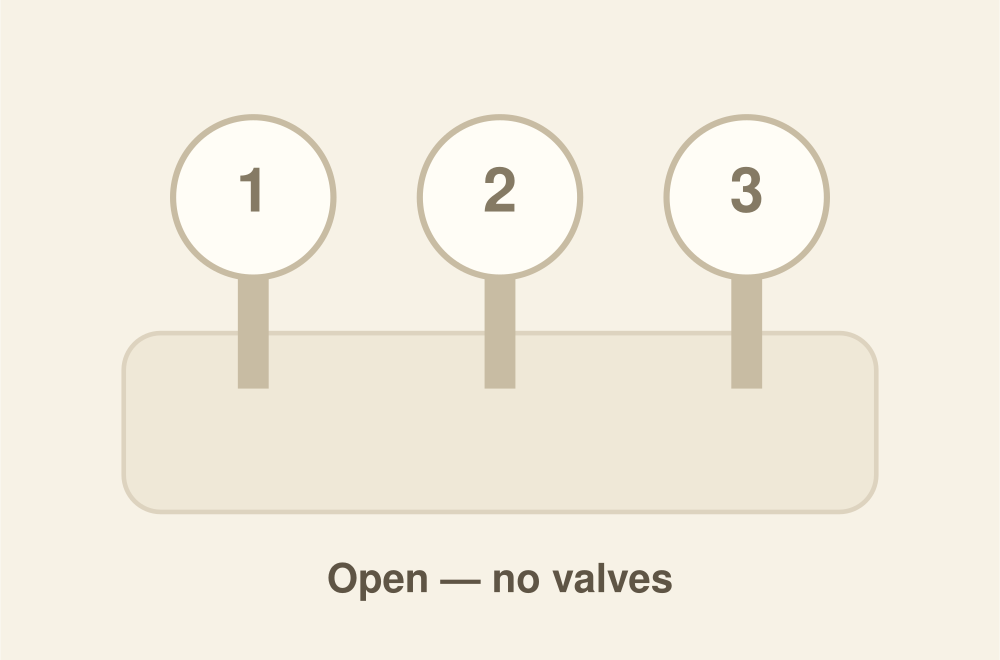
The valves are numbered 1, 2 and 3 in the order your index, middle and ring fingers sit on them. A filled, dropped cap means press that valve; a pale, raised cap means leave it up. No caps down is an open note.
The same fingering appears at several pitches and that is not a mistake: valves only set the tube length, and your air and lips choose which note of that tube’s harmonic series speaks. Every note is therefore tagged with its partial as well as its valves.
A sousaphone is a BB♭ tuba wrapped for marching, so this chart is the sousaphone fingering chart too.
Bass clef and concert pitch
Tuba music is written in bass clef at concert pitch: the note on the page is the note you hear. That makes the tuba unlike the B♭ trumpet or clarinet, whose players read a C when the band plays concert B♭. When the director asks for a concert B♭ scale, the tuba plays B♭ — open horn on the 2nd partial — and reads it as B♭ too. The “BB♭” in the name only says which key the open horn is built in.
The lowest notes sit well below the staff, so expect several ledger lines: low E1 is four lines under the bass staff. The staff in the chart above draws each note exactly as a part would print it.
Full tuba fingering chart — all notes
The complete three-valve range, E1 up to B♭3, chromatically. From any open note valve 2 lowers it a semitone, valve 1 a whole step, 1-2 (or 3) a minor third, 2-3 four semitones, 1-3 five and 1-2-3 six — the same seven combinations that generate every valved brass chart.
Octave 18 notes
E1
F1
G♭1
G1 (beginner note)
A♭1 (beginner note)
A1 (beginner note)
B♭1 (beginner note)
B1
Octave 212 notes
C2 (beginner note)
D♭2 (beginner note)
D2 (beginner note)
E♭2 (beginner note)
E2 (beginner note)
F2 (beginner note)
G♭2 (beginner note)
G2 (beginner note)
A♭2 (beginner note)
A2 (beginner note)
B♭2 (beginner note)
B2
Octave 311 notes
C3 (beginner note)
D♭3 (beginner note)
D3 (beginner note)
E♭3 (beginner note)
E3
F3
G♭3
G3
A♭3
A3
B♭3
Pressed or coveredOpenBeginner note
The same chart, written out
Every fingering in words — handy for copying into lesson notes, and it reads aloud properly on a screen reader.
| Written note | Fingering | Beginner |
|---|---|---|
| E1 | Valves 1 + 2 + 3 | — |
| F1 | Valves 1 + 3 | — |
| G♭1 | Valves 2 + 3 | — |
| G1 | Valves 1 + 2 | Yes |
| A♭1 | Valves 1 | Yes |
| A1 | Valves 2 | Yes |
| B♭1 | Open (no valves) | Yes |
| B1 | Valves 1 + 2 + 3 | — |
| C2 | Valves 1 + 3 | Yes |
| D♭2 | Valves 2 + 3 | Yes |
| D2 | Valves 1 + 2 | Yes |
| E♭2 | Valves 1 | Yes |
| E2 | Valves 2 | Yes |
| F2 | Open (no valves) | Yes |
| G♭2 | Valves 2 + 3 | Yes |
| G2 | Valves 1 + 2 | Yes |
| A♭2 | Valves 1 | Yes |
| A2 | Valves 2 | Yes |
| B♭2 | Open (no valves) | Yes |
| B2 | Valves 1 + 2 | — |
| C3 | Valves 1 | Yes |
| D♭3 | Valves 2 | Yes |
| D3 | Open (no valves) | Yes |
| E♭3 | Valves 1 | Yes |
| E3 | Valves 2 | — |
| F3 | Open (no valves) | — |
| G♭3 | Valves 2 + 3 | — |
| G3 | Valves 1 + 2 | — |
| A♭3 | Valves 1 | — |
| A3 | Valves 2 | — |
| B♭3 | Open (no valves) | — |
Why the same valves play different notes
A three-valve tuba has exactly seven valve combinations, and each one is a complete harmonic series. The open horn alone plays B♭1 on the 2nd partial, F2 on the 3rd, B♭2 on the 4th, D3 on the 5th, F3 on the 6th and B♭3 on the 8th: six usable notes, one fingering, nothing changing in the fingers. Faster air behind a slightly smaller aperture moves you up a slot; slower, wider air drops you down one.
The tuning quirks come with the partials. The 5th partial (D3, C3, B2) runs flat on most tubas, the 3rd and 6th run a touch sharp, and the 7th is so flat it is unusable — which is why A♭3 is played 2-3 rather than open. When a note will not speak, ask which of two things is wrong: the valve combination, or the slot your lips are aiming for. It is usually the slot.
Three valves or four?
Student tubas have three valves; many intermediate and all professional tubas add a fourth, and on a compensating horn a fifth. Valve 4 lowers the instrument a fourth by itself, the same interval as 1-3 — but in tune, because one long valve slide can be cut to the right length where two shorter ones added together always come out short. The rule of thumb is simple: play 4 wherever this chart shows 1-3 (F1, C2 and their upper octaves) and 2-4 wherever it shows 1-2-3 (E1, B1).
The fourth valve also opens up the notes below E1 that a three-valve tuba cannot reach — E♭1 with 2-3-4, D1 with 1-3-4 and so on down toward the pedal B♭0 — though those combinations run sharp and need slide pulls or a compensating system. They are beyond this chart, which stops where a three-valve instrument does.
Alternate BB♭ tuba fingerings
Alternates aren’t “better” fingerings — each one earns its place in a specific musical situation. Select any of these notes in the chart above and switch variants to compare them.
- G1 (G1) — 3: Valves 3. Valve 3 alone lowers the same minor third as 1-2 and often sits truer in tune this low.
- D2 (D2) — 3: Valves 3. Valve 3 alone is the standard substitute for 1-2 and is often smoother in a slurred line.
- E2 (E2) — 1-2-3: Valves 1 + 2 + 3. Reaches the same pitch from the 4th partial; much sharper, so it is kept for trills and awkward slurs.
- F2 (F2) — 1-3: Valves 1 + 3. A 4th-partial fingering for the same pitch, used for lip-flexibility work; it inherits the sharpness of 1-3.
- G2 (G2) — 3: Valves 3. The usual alternate — same minor third, same slot; it saves a finger move in a chromatic run.
- A♭2 (A♭2) — 1-2-3: Valves 1 + 2 + 3. Reaches the same pitch from the 5th partial; sharp and unwieldy, so a trill fingering only.
- A2 (A2) — 1-3: Valves 1 + 3. The same pitch off the 5th partial, used for trills; sharp like every 1-3 fingering.
- B♭2 (B♭2) — 2-3: Valves 2 + 3. A 5th-partial fingering for the same pitch, useful where an open note would break a slur.
- B2 (B2) — 3: Valves 3. The common substitute for 1-2 in this register; often easier to slur into and out of.
- C3 (C3) — 1-3: Valves 1 + 3. Reaches C3 from the 6th partial instead of the 5th; useful for avoiding a flat 5th-partial slot.
- D♭3 (D♭3) — 2-3: Valves 2 + 3. A 6th-partial fingering for the same note, a standard substitute when it is approached from above.
- D3 (D3) — 1-2: Valves 1 + 2. Places D3 on the 6th partial rather than the flat 5th — a trill and flexibility fingering.
- F3 (F3) — 1-3: Valves 1 + 3. The same pitch off the 8th partial; a flexibility fingering, sharp like all 1-3 combinations.
- G3 (G3) — 3: Valves 3. The standard 1-2 substitute; many players prefer its security this high.
- A♭3 (A♭3) — Open (7th partial): Open (no valves). The open 7th partial sounds roughly this pitch but about a third of a semitone flat; listed for reference only, not as a usable fingering.
Common tuba fingering mistakes
- Trusting the valves to find the note. Open horn plays six different notes; the fingering cannot choose between them. Hear the pitch first, then finger it — otherwise the same open fingering that should give F2 comes out as B♭1 or B♭2.
- Ignoring how sharp 1-3 and 1-2-3 are. F1, E1, C2 and B1 sit noticeably high on a three-valve tuba. Pull the first valve slide, lip them down, or use the fourth valve if you have one.
- Blowing pressure instead of volume. A tuba wants a large, slow, warm column of air, not a hard fast one. Low notes that crack or refuse to start usually need a bigger aperture and more air, not more force.
- Pressing valves halfway. A valve caught between up and down leaks and gargles. Press straight down with the pads of the fingers, all the way, and keep the fingers curved on the caps.
Frequently asked questions
Is this chart for BB♭ tuba?
Yes — every diagram shows three-valve BB♭ tuba fingerings, the tuba nearly all school and community bands use, and the sousaphone takes exactly the same combinations. An E♭ tuba is a different instrument: its open notes sit a fourth higher, so its chart is different. C and F tubas differ again.
Why is the tuba chart in bass clef and concert pitch?
Because tuba parts are written where they sound. Unlike a B♭ trumpet or clarinet, a BB♭ tuba does not transpose: the B♭ on the page is the B♭ you hear, and a tuba player reading a concert B♭ scale plays B♭, C, D and so on. The "BB♭" only names the key the open horn is pitched in.
What does the fourth valve do?
It lowers the horn a fourth on its own — the same as 1-3 — but in tune, because a single longer valve slide is cut correctly where two shorter ones together are too short. Four-valve players use 4 wherever this chart shows 1-3, and 2-4 wherever it shows 1-2-3; the fourth valve also opens up the notes between E1 and the pedal B♭0 that a three-valve tuba cannot reach.
Why does the same fingering play different notes?
Each valve combination gives a whole harmonic series, not one pitch. Open horn plays B♭1, F2, B♭2, D3, F3 and B♭3 with nothing pressed. Your air and lips choose which of those partials sounds; the valves only decide how long the tube is.
Can I print this chart free?
Yes. The printable PDF (Letter and A4) is generated from the same data as this interactive chart and downloads with one click — no email address required.
Tuba fingering data last updated . Every diagram here, in the printable PDF and in the chart image comes from one dataset, so the paper and the screen cannot disagree.
Looking for another brass chart? The instrument index lists every fingering chart on the site.