E♭ baritone sax · treble clef · 34 notes
Bari Sax Fingering Chart (Baritone Saxophone)
Tap any note to see which keys to press and hear the pitch, from low A to high F♯. Every saxophone uses the same fingerings, so this is the alto chart plus the bari's low A key.
Plays the real sound: written C4 sounds concert E♭2 on baritone saxophone.
Written C4 sounds concert E♭2, an octave and a major sixth lower. Same keys as on alto and tenor sax. Bari low notes need an open throat, a relaxed embouchure and a lot of air; start them softly and let the horn ring.
Everything about C4 on baritone saxophone →How to read this chart
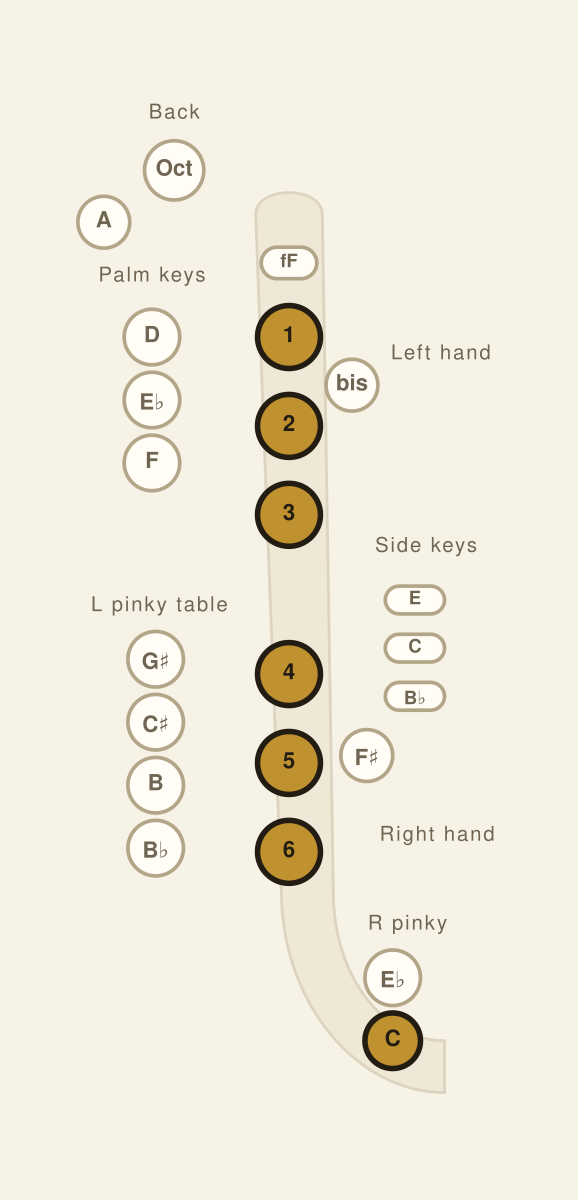
The octave key and low A key sit on the back, under the left thumb. The six main keys run down the middle — left hand on top, right hand below — with the palm keys to the left, the side keys to the right and the little-finger tables at the bottom corners. Filled keys are pressed; open ones stay up.
If you play alto or tenor, every fingering here is already yours. The bari adds one key: low A, pressed with the left thumb together with the low B♭ fingering.
Written vs concert pitch on bari sax
The baritone saxophone is in E♭ and sounds an octave and a major sixth lower than written — the alto's transposition, one octave down. Written C sounds concert E♭, so when the band plays a concert B♭ scale you play a written G scale. The chart shows both pitches, and the play button sounds the concert pitch.
The low A key
Most modern baris have a low A key, worked by the left thumb beside the thumb rest. Press it with the full low B♭ fingering and the horn sounds written low A — concert C2, the bari's lowest note. Some older and student instruments stop at low B♭; if yours has no key next to the thumb rest, low A simply is not available on it.
Full bari sax fingering chart — all notes
Written low A3 to high F♯6, chromatically, with the alto's alternates (bis B♭, side C, fork E and F) where they apply.
Octave 3
3 notesA3
sounds C2
B♭3
sounds D♭2
B3
sounds D2
Octave 4
12 notesC4 (beginner note)
sounds E♭2
C♯4
sounds E2
D4 (beginner note)
sounds F2
E♭4
sounds G♭2
E4 (beginner note)
sounds G2
F4 (beginner note)
sounds A♭2
F♯4 (beginner note)
sounds A2
G4 (beginner note)
sounds B♭2
G♯4
sounds B2
A4 (beginner note)
sounds C3
B♭4 (beginner note)
sounds D♭3
B4 (beginner note)
sounds D3
Octave 5
12 notesC5 (beginner note)
sounds E♭3
C♯5 (beginner note)
sounds E3
D5 (beginner note)
sounds F3
E♭5
sounds G♭3
E5 (beginner note)
sounds G3
F5 (beginner note)
sounds A♭3
F♯5 (beginner note)
sounds A3
G5 (beginner note)
sounds B♭3
G♯5
sounds B3
A5
sounds C4
B♭5
sounds D♭4
B5
sounds D4
Octave 6
7 notesC6
sounds E♭4
C♯6
sounds E4
D6
sounds F4
E♭6
sounds G♭4
E6
sounds G4
F6
sounds A♭4
F♯6
sounds A4
Pressed or coveredOpenBeginner note
The same chart, written out
Every fingering in words — handy for copying into lesson notes, and it reads aloud properly on a screen reader.
| Written note | Sounds (concert) | Fingering | Beginner |
|---|---|---|---|
| Low A (A3) | C2 | Left index key + Left middle key + Left ring key + Right index key + Right middle key + Right ring key + Left pinky low B♭ key + Right pinky low C key + Low A key (left thumb) | — |
| Low B♭ (B♭3) | D♭2 | Left index key + Left middle key + Left ring key + Right index key + Right middle key + Right ring key + Left pinky low B♭ key + Right pinky low C key | — |
| Low B (B3) | D2 | Left index key + Left middle key + Left ring key + Right index key + Right middle key + Right ring key + Left pinky low B key + Right pinky low C key | — |
| Low C (C4) | E♭2 | Left index key + Left middle key + Left ring key + Right index key + Right middle key + Right ring key + Right pinky low C key | Yes |
| Low C♯ (C♯4) | E2 | Left index key + Left middle key + Left ring key + Right index key + Right middle key + Right ring key + Left pinky low C♯ key + Right pinky low C key | — |
| Low D (D4) | F2 | Left index key + Left middle key + Left ring key + Right index key + Right middle key + Right ring key | Yes |
| Low E♭ (E♭4) | G♭2 | Left index key + Left middle key + Left ring key + Right index key + Right middle key + Right ring key + Right pinky low E♭ key | — |
| Low E (E4) | G2 | Left index key + Left middle key + Left ring key + Right index key + Right middle key | Yes |
| Low F (F4) | A♭2 | Left index key + Left middle key + Left ring key + Right index key | Yes |
| Low F♯ (F♯4) | A2 | Left index key + Left middle key + Left ring key + Right middle key | Yes |
| G4 | B♭2 | Left index key + Left middle key + Left ring key | Yes |
| G♯4 | B2 | Left index key + Left middle key + Left ring key + Left pinky G♯ key | — |
| A4 | C3 | Left index key + Left middle key | Yes |
| B♭4 | D♭3 | Left index key + Left middle key + Side B♭ key | Yes |
| B4 | D3 | Left index key | Yes |
| C5 | E♭3 | Left middle key | Yes |
| C♯5 | E3 | Yes | |
| D5 | F3 | Octave key + Left index key + Left middle key + Left ring key + Right index key + Right middle key + Right ring key | Yes |
| E♭5 | G♭3 | Octave key + Left index key + Left middle key + Left ring key + Right index key + Right middle key + Right ring key + Right pinky low E♭ key | — |
| E5 | G3 | Octave key + Left index key + Left middle key + Left ring key + Right index key + Right middle key | Yes |
| F5 | A♭3 | Octave key + Left index key + Left middle key + Left ring key + Right index key | Yes |
| F♯5 | A3 | Octave key + Left index key + Left middle key + Left ring key + Right middle key | Yes |
| G5 | B♭3 | Octave key + Left index key + Left middle key + Left ring key | Yes |
| G♯5 | B3 | Octave key + Left index key + Left middle key + Left ring key + Left pinky G♯ key | — |
| A5 | C4 | Octave key + Left index key + Left middle key | — |
| B♭5 | D♭4 | Octave key + Left index key + Left middle key + Side B♭ key | — |
| B5 | D4 | Octave key + Left index key | — |
| C6 | E♭4 | Octave key + Left middle key | — |
| C♯6 | E4 | Octave key | — |
| High D (D6) | F4 | Octave key + Palm D key | — |
| High E♭ (E♭6) | G♭4 | Octave key + Palm D key + Palm E♭ key | — |
| High E (E6) | G4 | Octave key + Palm D key + Palm E♭ key + Side E key | — |
| High F (F6) | A♭4 | Octave key + Palm D key + Palm E♭ key + Palm F key + Side E key | — |
| High F♯ (F♯6) | A4 | Octave key + Palm D key + Palm E♭ key + Palm F key + Side E key + High F♯ key | — |
Getting the low notes to speak
Big low notes come from open air, not force. Drop the jaw, keep the throat open and start low notes softly; once they speak you can add volume. Biting or pushing too hard makes them crack up an octave.
On an instrument this size, a tiny pad leak stops the low notes completely. If low B♭ or A will not speak with good air, have the pads checked before blaming your embouchure.
Alternate baritone saxophone fingerings
Alternates aren’t “better” fingerings — each one earns its place in a specific musical situation. Select any of these notes in the chart above and switch variants to compare them.
- B♭4 (B♭4) — Bis B♭ (left index on the B and bis keys): Left index key + Bis key. In flat keys — B♭, E♭ and A♭ major — where the passage has no B natural next to the B♭. — One-and-one B♭ (left index + right index): Left index key + Right index key. When the B♭ is next to F, so the right index finger is already down and only the middle and ring fingers move.
- C5 (C5) — Side C (left index + side C key): Left index key + Side C key. In chromatic passages and B–C trills, where it avoids swapping the left index for the middle finger.
- B♭5 (B♭5) — Bis B♭ (left index on the B and bis keys): Octave key + Left index key + Bis key. In flat-key passages with no neighboring B natural, and when the right hand needs to stay free. — One-and-one B♭ (left index + right index): Octave key + Left index key + Right index key. When the B♭ is approached from or resolved to F5.
- C6 (C6) — Side C (left index + side C key): Octave key + Left index key + Side C key. In chromatic passages and B–C trills in the upper register.
- C♯6 (C♯6) — C♯6 with the right hand down: Octave key + Right index key + Right middle key + Right ring key. To steady and darken a note that is otherwise thin and unstable, especially on long or exposed C♯s.
- High E (E6) — Front (fork) E: Octave key + Front F key + Left middle key + Left ring key. When approaching from C6 or C♯6, or when the surrounding line already uses front F. Less stable than the palm-key fingering.
- High F (F6) — Front (fork) F: Octave key + Front F key + Left middle key. In F arpeggios, when coming from C6, and as the standard launch fingering for altissimo. Slightly less stable in tone than the palm-key F.
- High F♯ (F♯6) — Fork (front) F♯: Octave key + Front F key + Left middle key + High F♯ key. When the line already uses front F, and when moving on into altissimo G and above.
Common bari sax fingering mistakes
- Biting. A tight embouchure thins the sound and sends low notes up an octave. Keep a relaxed, round mouth and let the reed vibrate freely.
- Too little air. The bari needs a lot of slow, steady air. Short, shallow breaths are the most common reason low notes fail to speak.
- Blaming yourself for a leak. If one particular low note never works, check that note's pads before practicing it for another week.
Frequently asked questions
Is bari sax fingering the same as alto sax?
Yes. All saxophones share one fingering system, so every note from low B♭ up is fingered exactly as on alto or tenor. The bari adds a low A key for the left thumb.
What key is the bari sax in?
E♭, like the alto, but an octave lower. Written C sounds concert E♭, an octave and a major sixth below the written note.
What is the lowest note on a bari sax?
Written low A on instruments with a low A key, which sounds concert C2. Without that key the lowest note is written low B♭.
Can I print this chart free?
Yes — Letter and A4 PDFs generated from this chart, one click, no email.
Baritone Saxophone fingering data last updated . Every diagram here, in the printable PDF and in the chart image comes from one dataset, so the paper and the screen cannot disagree.