Piccolo Fingering Chart
Tap a note to see which keys to press and hear it. Gold (filled) = press the key or cover the hole; half filled = cover half. 32 notes from Low D (D4) to High A (A6).
Play along: hear the note for 2 beats, then you play it for 2.
- Thumb B key
- Left index (key 1)
- Right index (key 4)
- E♭ key (right little finger)
The same fingers as on flute: thumb on the B key, left first finger, right first finger and right little finger on the E♭ key. Low notes are quiet on piccolo: use a small, fast stream of air and don't blow hard. More about Low B♭
The same fingers as on flute: thumb on the B key, left first finger, right first finger and right little finger on the E♭ key. Low notes are quiet on piccolo: use a small, fast stream of air and don't blow hard. More about Low B♭
Sound and display
Next moves
Teaching a class? Class mode keeps Stand mode and Test me on the notes your class is learning.
Full piccolo fingering chart — all notes
Written D4 to A6, chromatically, with the flute's alternates and trill fingerings where they apply. Every diagram is the flute fingering for the same written note.
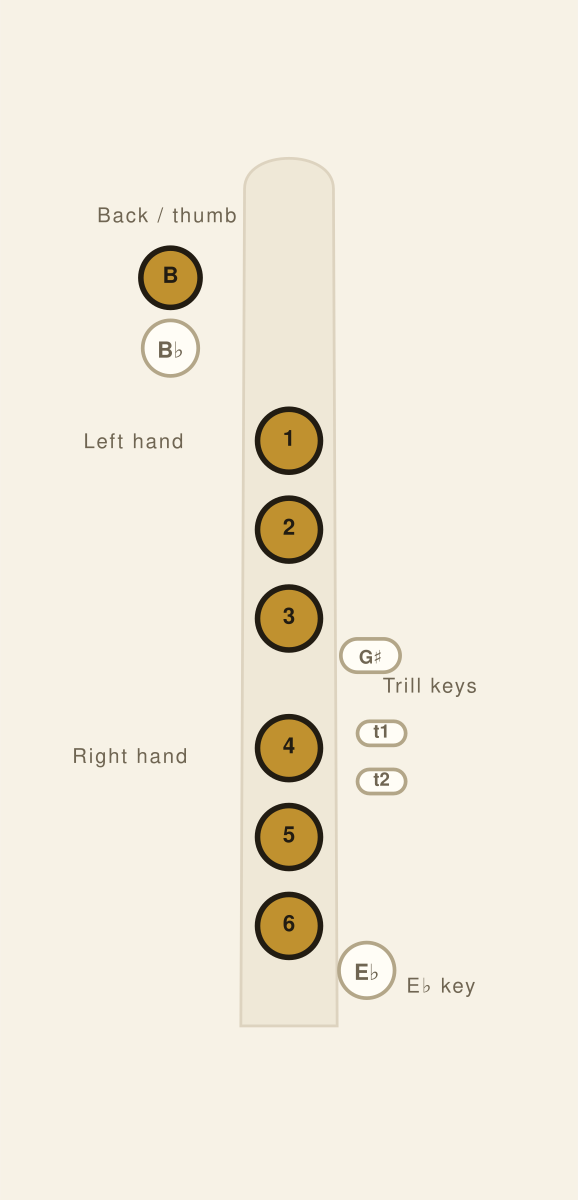
Gold (filled): pressed or coveredOpenHas an alternate fingering
Every note has its own page
The same chart, written out
Every fingering in words: handy for copying into lesson notes, and it reads aloud properly on a screen reader.
| Written note | Sounds (concert) | Fingering | Beginner |
|---|---|---|---|
| Low D (D4) | D5 | Thumb B key + Left index (key 1) + Left middle (key 2) + Left ring (key 3) + Right index (key 4) + Right middle (key 5) + Right ring (key 6) | Yes |
| Low E♭ (E♭4) | E♭5 | Thumb B key + Left index (key 1) + Left middle (key 2) + Left ring (key 3) + Right index (key 4) + Right middle (key 5) + Right ring (key 6) + E♭ key (right little finger) | Yes |
| Low E (E4) | E5 | Thumb B key + Left index (key 1) + Left middle (key 2) + Left ring (key 3) + Right index (key 4) + Right middle (key 5) + E♭ key (right little finger) | Yes |
| Low F (F4) | F5 | Thumb B key + Left index (key 1) + Left middle (key 2) + Left ring (key 3) + Right index (key 4) + E♭ key (right little finger) | Yes |
| Low F♯ (F♯4) | F♯5 | Thumb B key + Left index (key 1) + Left middle (key 2) + Left ring (key 3) + Right ring (key 6) + E♭ key (right little finger) | Yes |
| Low G (G4) | G5 | Thumb B key + Left index (key 1) + Left middle (key 2) + Left ring (key 3) + E♭ key (right little finger) | Yes |
| Low A♭ (A♭4) | A♭5 | Thumb B key + Left index (key 1) + Left middle (key 2) + Left ring (key 3) + G♯ key (left little finger) + E♭ key (right little finger) | Yes |
| Low A (A4) | A5 | Thumb B key + Left index (key 1) + Left middle (key 2) + E♭ key (right little finger) | Yes |
| Low B♭ (B♭4) | B♭5 | Thumb B key + Left index (key 1) + Right index (key 4) + E♭ key (right little finger) | Yes |
| Low B (B4) | B5 | Thumb B key + Left index (key 1) + E♭ key (right little finger) | Yes |
| C5 | C6 | Left index (key 1) + E♭ key (right little finger) | Yes |
| C♯5 | C♯6 | E♭ key (right little finger) | Yes |
| D5 | D6 | Thumb B key + Left middle (key 2) + Left ring (key 3) + Right index (key 4) + Right middle (key 5) + Right ring (key 6) | Yes |
| E♭5 | E♭6 | Thumb B key + Left middle (key 2) + Left ring (key 3) + Right index (key 4) + Right middle (key 5) + Right ring (key 6) + E♭ key (right little finger) | Yes |
| E5 | E6 | Thumb B key + Left index (key 1) + Left middle (key 2) + Left ring (key 3) + Right index (key 4) + Right middle (key 5) + E♭ key (right little finger) | Yes |
| F5 | F6 | Thumb B key + Left index (key 1) + Left middle (key 2) + Left ring (key 3) + Right index (key 4) + E♭ key (right little finger) | Yes |
| F♯5 | F♯6 | Thumb B key + Left index (key 1) + Left middle (key 2) + Left ring (key 3) + Right ring (key 6) + E♭ key (right little finger) | Yes |
| G5 | G6 | Thumb B key + Left index (key 1) + Left middle (key 2) + Left ring (key 3) + E♭ key (right little finger) | Yes |
| A♭5 | A♭6 | Thumb B key + Left index (key 1) + Left middle (key 2) + Left ring (key 3) + G♯ key (left little finger) + E♭ key (right little finger) | — |
| A5 | A6 | Thumb B key + Left index (key 1) + Left middle (key 2) + E♭ key (right little finger) | — |
| B♭5 | B♭6 | Thumb B key + Left index (key 1) + Right index (key 4) + E♭ key (right little finger) | — |
| B5 | B6 | Thumb B key + Left index (key 1) + E♭ key (right little finger) | — |
| C6 | C7 | Left index (key 1) + E♭ key (right little finger) | — |
| C♯6 | C♯7 | E♭ key (right little finger) | — |
| High D (D6) | D7 | Thumb B key + Left middle (key 2) + Left ring (key 3) + E♭ key (right little finger) | — |
| High E♭ (E♭6) | E♭7 | Thumb B key + Left index (key 1) + Left middle (key 2) + Left ring (key 3) + G♯ key (left little finger) + Right index (key 4) + Right middle (key 5) + Right ring (key 6) + E♭ key (right little finger) | — |
| High E (E6) | E7 | Thumb B key + Left index (key 1) + Left middle (key 2) + Right index (key 4) + Right middle (key 5) + E♭ key (right little finger) | — |
| High F (F6) | F7 | Thumb B key + Left index (key 1) + Left ring (key 3) + Right index (key 4) + E♭ key (right little finger) | — |
| High F♯ (F♯6) | F♯7 | Thumb B key + Left index (key 1) + Left ring (key 3) + Right ring (key 6) + E♭ key (right little finger) | — |
| High G (G6) | G7 | Left index (key 1) + Left middle (key 2) + Left ring (key 3) + E♭ key (right little finger) | — |
| High A♭ (A♭6) | A♭7 | Left middle (key 2) + Left ring (key 3) + G♯ key (left little finger) + E♭ key (right little finger) | — |
| High A (A6) | A7 | Thumb B key + Left middle (key 2) + Right index (key 4) + E♭ key (right little finger) | — |
Tap any note to see which keys to press and hear the pitch, from low D up to high A. The piccolo uses flute fingerings, so if you play flute you already know most of this chart.
How to read this chart
The diagram is the flute's, drawn vertically: the thumb keys on the back at the top, the left hand's three keys down the middle, then the right hand's three. Filled keys are pressed; open ones stay up. The piccolo has no foot joint, so there are no low C or C♯ keys — its lowest note is D.
Read each note as written. Piccolo parts are written an octave below where they sound to save ledger lines, and every fingering here is for the note on the page.
Written vs sounding pitch
The piccolo is pitched in C, so it plays in the same key as the flute — but it sounds an octave higher than written. Written D4, the lowest note, sounds D5; written A6 sounds A7. The chart shows both, and the play button sounds the real pitch.
Why this chart stops at high A
Up to written A6 the piccolo takes the flute's fingerings almost everywhere. Above that, the best fingering for B♭6, B6 and C7 depends on the individual piccolo — its maker, bore and headjoint — far more than on flute. A generic chart would be wrong for many players, so for those notes use the chart from your teacher or your piccolo's maker.
What changes from flute
The fingers stay the same; the air does not. The piccolo's embouchure hole is tiny, so it needs a smaller, faster airstream and much less of it. Flute players who blow a flute-sized stream into a piccolo go sharp and shrill.
Its registers also behave differently. The bottom octave is soft and hard to project, so do not force it; the second octave is the sweet spot; the third octave is loud and tends sharp, so aim the air slightly down and back off the pressure.
Ranges
Piccolo registers
Low notes with relaxed, slow air. The foot joint keys add the lowest notes.
Mostly the same fingers as the first octave, with faster air (D and E♭ lift the left index).
New fingerings that use harmonics. Keep the air fast and the lips small.
For when the standard one is awkward
Alternate piccolo fingerings
Alternates aren’t “better” fingerings: each one earns its place in a specific musical situation, like tuning or a fast passage. The standard fingering is always shown first. Tap one to show it on the chart above; each alternate has its own link to send.
- StandardStandard
F-sharp with right 2 (Thumb B key + Left index (key 1) + Left middle (key 2) + Left ring (key 3) + Right middle (key 5) + E♭ key (right little finger)) — Only for the E–F-sharp trill and fast slurs with E; go back to right 3 for anything sustained or being tuned. Show it big
- StandardStandard
Thumb B-flat (Briccialdi lever) (Thumb B♭ lever (Briccialdi) + Left index (key 1) + E♭ key (right little finger)) — Use in flat keys and any passage with no B natural in it — the thumb simply lives on the B-flat lever throughout. Show it big
- StandardStandard
E with the second (E-flat) trill key added (Thumb B key + Left index (key 1) + Left middle (key 2) + Left ring (key 3) + Right index (key 4) + Right middle (key 5) + Second (E♭) trill key + E♭ key (right little finger)) — Add the second trill key when second-octave E keeps cracking; it steadies the note without changing anything around it. Show it big
- StandardStandard
F-sharp with right 2 (Thumb B key + Left index (key 1) + Left middle (key 2) + Left ring (key 3) + Right middle (key 5) + E♭ key (right little finger)) — For the E–F-sharp trill and fast slurs from E only; right 3 remains the fingering for sustained notes. Show it big
- StandardStandard
Thumb B-flat (Briccialdi lever) (Thumb B♭ lever (Briccialdi) + Left index (key 1) + E♭ key (right little finger)) — Use when the passage sits in a flat key and contains no B natural; the thumb stays on the B-flat lever throughout. Show it big
11 trills · free
Trill fingerings
A trill is a fast wobble between two notes. Hold the first note and shake one key: press it and let it go, fast. The key to shake is drawn in green. Trill fingerings trade a little tone quality for speed, so use them for rapid alternation, not sustained notes.
- TrillLow D → E♭4D4 to E♭4
HoldLow D: Left hand: B key, 1, 2, 3 · Right hand: 4, 5, 6
ShakeE♭ key (right little finger)
Hold low D and shake the E-flat key with the right little finger. Full fingering with the trill key down: Thumb B key + Left index (key 1) + Left middle (key 2) + Left ring (key 3) + Right index (key 4) + Right middle (key 5) + Right ring (key 6) + E♭ key (right little finger).
- TrillC5 → D5
HoldC5: Left hand: 1 + E♭ key
ShakeFirst (D) trill key
Hold C and shake the first (D) trill key with the right index finger. Full fingering with the trill key down: Left index (key 1) + First (D) trill key + E♭ key (right little finger).
- TrillC♯5 → D5
HoldC♯5: E♭ key only
ShakeFirst (D) trill key
Shake the first (D) trill key; nothing else is held down. Full fingering with the trill key down: First (D) trill key + E♭ key (right little finger).
- TrillC♯5 → E♭5
HoldC♯5: E♭ key only
ShakeSecond (E♭) trill key
Shake the second (E-flat) trill key for the whole-step trill. Full fingering with the trill key down: Second (E♭) trill key + E♭ key (right little finger).
- TrillD5 → E♭5
HoldD5: Left hand: B key, 2, 3 · Right hand: 4, 5, 6
ShakeE♭ key (right little finger)
Hold second-octave D and shake the E-flat key. Full fingering with the trill key down: Thumb B key + Left middle (key 2) + Left ring (key 3) + Right index (key 4) + Right middle (key 5) + Right ring (key 6) + E♭ key (right little finger).
- TrillC6 → D6
HoldC6: Left hand: 1 + E♭ key
ShakeSecond (E♭) trill key
Hold C and shake the second (E-flat) trill key — the first trill key gives a flat D here. Full fingering with the trill key down: Left index (key 1) + Second (E♭) trill key + E♭ key (right little finger).
- TrillC♯6 → D6
HoldC♯6: E♭ key only
ShakeFirst (D) trill key
Shake the first (D) trill key. Full fingering with the trill key down: First (D) trill key + E♭ key (right little finger).
- TrillC♯6 → E♭6
HoldC♯6: E♭ key only
ShakeFirst (D) trill key + Second (E♭) trill key
Press and release both trill keys together. Full fingering with the trill key down: First (D) trill key + Second (E♭) trill key + E♭ key (right little finger).
- TrillHigh D → E♭6D6 to E♭6
HoldHigh D: Left hand: B key, 2, 3 + E♭ key
ShakeSecond (E♭) trill key
Hold high D and shake the second (E-flat) trill key. Full fingering with the trill key down: Thumb B key + Left middle (key 2) + Left ring (key 3) + Second (E♭) trill key + E♭ key (right little finger).
- TrillHigh G → A♭6G6 to A♭6
HoldHigh G: Left hand: 1, 2, 3 + E♭ key
ShakeFirst (D) trill key
Hold high G and shake the first (D) trill key. Full fingering with the trill key down: Left index (key 1) + Left middle (key 2) + Left ring (key 3) + First (D) trill key + E♭ key (right little finger).
- TrillHigh A♭ → A6A♭6 to A6
HoldHigh A♭: Left hand: 2, 3 + G♯ key, E♭ key
ShakeFirst (D) trill key
Hold high A-flat and shake the first (D) trill key. Full fingering with the trill key down: Left middle (key 2) + Left ring (key 3) + G♯ key (left little finger) + First (D) trill key + E♭ key (right little finger).
Gold (filled): hold these downGreen with a dark ring: shake this key, press and release it fast
Common piccolo fingering mistakes
- Blowing a flute-sized airstream. Too much air makes the piccolo sharp and harsh. Use less air, moving faster, through a smaller lip opening.
- Biting for the high notes. Tightening the lips pinches the tone and raises the pitch further. Keep the lips loose and let the air speed do the work.
- Expecting the low register to project. Low piccolo notes are naturally quiet. Play them with a focused tone rather than more air, which only makes them crack.
Frequently asked questions
Is piccolo fingering the same as flute?
For almost every note up to written A6, yes — the piccolo uses Boehm-system flute fingerings. It has no foot joint, so it starts at D, and above A6 the best fingerings vary between instruments.
What is the lowest note on the piccolo?
Written D4 (low D), which sounds D5. There are no low C or C♯ keys because the piccolo has no foot joint.
Why is my piccolo sharp in the top octave?
Most piccolos tend sharp up there, and blowing harder makes it worse. Aim the airstream slightly down, relax the lips and use less air pressure; your teacher may also suggest alternate fingerings for specific notes.
Can I print this chart free?
Yes — Letter and A4 PDFs generated from this chart, one click, no email.
Piccolo fingering data last updated . Every diagram here, in the printable PDF and in the chart image comes from one dataset, so the paper and the screen cannot disagree.