Piano · note names
Piano Notes Chart
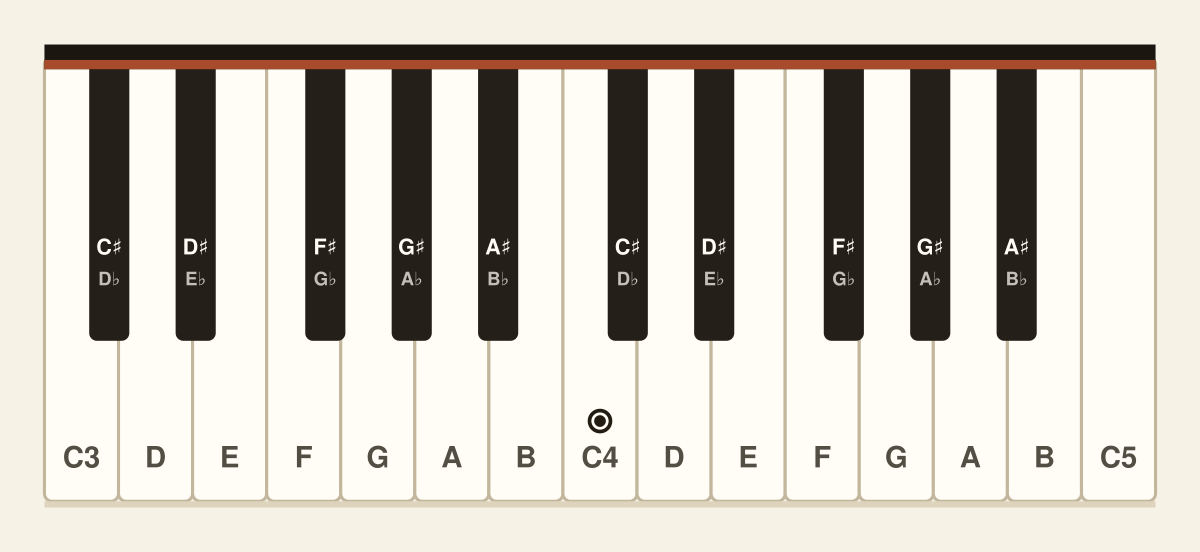
Every note name on the keyboard, labeled and playable. Tap any key to hear it and see it on the staff — white keys, black keys, octave numbers and both names for every sharp and flat.
61 keys · 36 white · 25 black · C2–C7Click a key, then play with A–J and W–U; arrows move one key.
- Note name: C4
- Octave: 4 — this is middle C, C4
- Pitch: 261.63 Hz · MIDI 60
Counting keys rather than naming them? The 88-key layout, white and black key totals are here.
How piano note names work: the A to G cycle
Piano notes use just seven letters: A, B, C, D, E, F, G — and then the cycle starts again. Walk up the white keys of a piano or keyboard from any C and you get C, D, E, F, G, A, B, and the next key is C again, sounding higher but carrying the same name.
The seven letters cover the white keys. The five black keys in each octave are named from their neighbours as sharps and flats, which is why there are twelve different notes per octave but only seven letters. Nothing about that changes further up or down the instrument: all 88 keys are those same twelve notes, repeated.
The fastest way to find your place is to read the black keys, not the white ones. C is always the white key immediately left of a group of two black keys; F is always the white key immediately left of a group of three.
Octave numbers and middle C (C4)
Because every letter appears seven or eight times on a keyboard, note names carry an octave number: C4, C5, F♯3. The number changes at every C, counting up from the bottom of an 88-key piano — so the lowest key is A0 and the highest is C8. This is called scientific pitch notation, and it is what this chart, MIDI software and tuner apps all use.
Middle C is C4. On a full-size piano it is the fourth C from the left and the 40th key of the 88, sitting roughly in the centre of the instrument under the maker’s name. It matters because it is the pivot for reading music: notes above it are usually written in the treble clef for the right hand, notes below it in the bass clef for the left.
One octave up from middle C is C5, one down is C3. The tuning reference A440 is A4, the A above middle C, which sounds at 440 Hz — tap it on the chart above and the exact frequency of any key is listed beside the staff.
Notes on the staff: treble and bass clef
Piano music uses two staves at once, joined by a brace. The upper staff carries the treble clef and the lower one the bass clef; together they cover the middle of the keyboard without needing a forest of ledger lines. Each staff has five lines and four spaces, and a note sits either on a line or in a space.
The bass clef is the half most self-taught players skip, and it is worth the hour it takes. Its two dots straddle the fourth line, which is F3 — that is what the clef is telling you, and why it is also called the F clef. The treble clef spirals around the second line, G4, so it is the G clef.
Landmark notes on both clefs
Learn these twelve positions and you can work out any other note by stepping up or down from the nearest one, which is far faster than counting lines from the bottom.
| Clef | Note | Where it sits | Hand |
|---|---|---|---|
| Treble | E4 | Bottom line | Right |
| Treble | G4 | Second line — the line the treble clef curls around | Right |
| Treble | B4 | Middle line | Right |
| Treble | D5 | Fourth line | Right |
| Treble | F5 | Top line | Right |
| Treble | C4 | One ledger line below the staff — middle C | Either |
| Bass | G2 | Bottom line | Left |
| Bass | B2 | Second line | Left |
| Bass | D3 | Middle line | Left |
| Bass | F3 | Fourth line — the line between the two dots of the bass clef | Left |
| Bass | A3 | Top line | Left |
| Bass | C4 | One ledger line above the staff — middle C | Either |
Left hand and right hand notes
On the page, the split is by clef: the right hand reads the treble staff and plays the notes from middle C upwards, while the left hand reads the bass staff and plays from middle C down. Middle C is the shared boundary, and it can be written in either clef depending on which hand is meant to take it.
In practice the hands do different jobs, not just different notes. The left hand usually supplies the bass note and the harmony — root notes, chords, broken chord patterns — while the right hand carries the melody and the top of the chords. That is why the left hand spends most of its time between C2 and C4, and the right hand between C4 and C6.
Neither hand is stuck in its zone: composers cross hands, move the melody to the left and write ledger lines whenever a passage runs out of staff. When a piece asks the left hand to play well above middle C, the bass staff often switches to a treble clef for a few bars rather than stacking up ledger lines.
How to read the notes on your keyboard, step by step
- Find middle C first, every time. On the keyboard, look for the group of two black keys nearest the middle and take the white key to its left. On the page, it is the ledger line just below the treble staff or just above the bass staff.
- Read by shape, not by counting. Notes on adjacent lines are always two letters apart (a skip); a line to the next space is one letter (a step). Reading the interval between notes is quicker and more musical than naming each one from scratch.
- Check the key signature before the first note. Sharps or flats at the start of a line apply to every note of that letter, in every octave, for the whole piece — so one sharp on the F line means every F you play is F♯.
- Say note names out loud as you play. Slowly, with the chart above open. Linking the printed note, the key under your finger and the sound is the whole skill, and it forms much faster when all three happen together.
- Then drill it. Reading gets fluent through repetition on random notes, not through re-reading pieces you already know — that is what the note trainer is for.
Keyboard notes on 61-key and 76-key instruments
Keyboard notes and piano notes are the same notes — there is no separate system to learn. A 61-key keyboard runs C2 to C7 and a 76-key runs E1 to G7, so both are simply the middle of an 88-key piano with the extremes trimmed off. The pattern of white and black keys, the note names and the octave numbers are unchanged.
The only practical difference is where things sit under your hands. Middle C is the third C from the left on a 61-key or 76-key instrument, and the fourth C from the left on an 88-key piano. Use the Keys control on the chart above to switch it to your own instrument and the labels will follow.
Frequently asked questions
How do you read piano notes?
Find one landmark note, then read by distance from it rather than counting up from the bottom of the staff every time. The three landmarks worth memorising are middle C (one ledger line below the treble staff, one above the bass staff), G4 on the second line of the treble staff, and F3 on the fourth line of the bass staff. From there, a note one line higher is two letters up, and a note in the next space is one letter up.
What are the notes on a piano?
Seven note names — A, B, C, D, E, F and G — repeat up the white keys, and the five black keys in each octave are the sharps and flats between them. That gives twelve different notes per octave, and every one of the 88 keys is one of those twelve, just in a higher or lower octave.
How do I remember piano notes?
Use the classic mnemonics for the staff: treble lines from the bottom are E-G-B-D-F (Every Good Boy Deserves Fudge) and treble spaces spell FACE. Bass lines are G-B-D-F-A (Good Boys Deserve Fudge Always) and bass spaces are A-C-E-G (All Cows Eat Grass). On the keyboard itself, use the black keys instead: C is always the white key just left of a group of two, and F is always the white key just left of a group of three.
Are keyboard notes the same as piano notes?
Yes — identical. A 61-key keyboard, a 76-key keyboard and an 88-key piano all use the same twelve note names in the same repeating pattern; the smaller instruments simply start and stop at different points. Middle C is the third C from the left on a 61-key keyboard and the fourth C from the left on an 88-key piano, but it is the same note, C4.