F/B♭ double horn · written in F · 31 notes
French Horn Fingering Chart (Double Horn)
Tap any note to see the valves — and whether the thumb is down — and hear the pitch. Every note lists both its F-side and its B♭-side fingering.
Plays the real sound: written C4 sounds concert F3 on french horn.
Written C4 is open on the F horn: the 4th partial. It sounds concert F3. This slot is close to in tune, so it is a good reference for the hand position in the bell. Most players stay on the F side up to written G4, where its partials are still far enough apart to find.
Everything about C4 on french horn →How to read this chart
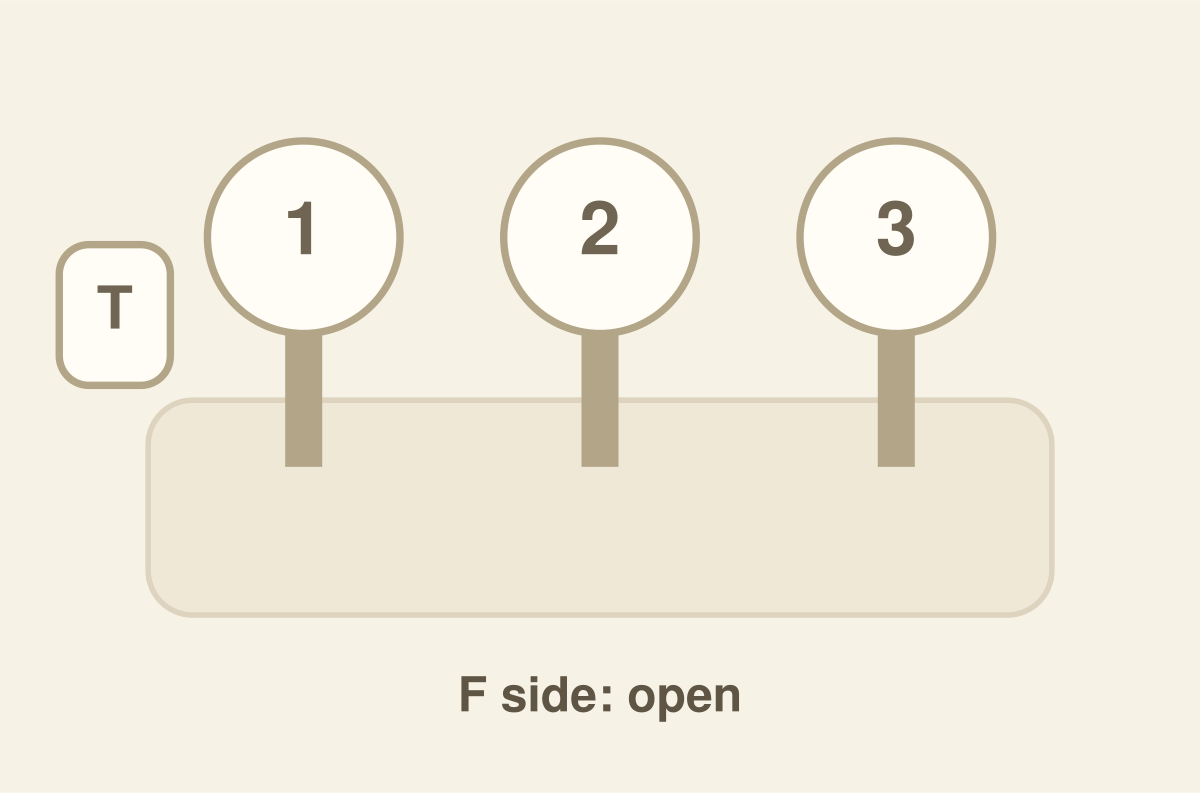
The horn's valves are played with the left hand: valve 1 under the index finger, 2 under the middle, 3 under the ring finger. The lever marked T on the left of the diagram is the thumb valve. Filled and dropped means pressed; pale and raised means up.
Thumb up puts the horn on its F side; thumb down switches to the shorter B♭ side. Each note's diagram shows the side this chart recommends, and the alternate underneath gives the same note on the other side.
F side and B♭ side
A double horn is two horns sharing one bell and mouthpipe. The F horn is longer, with a warm sound, but high up its partials crowd together and notes are easy to miss. The B♭ horn is a fourth shorter, so in the upper register its partials are farther apart and notes are easier to hit.
This chart uses the F side up to written G4 and the B♭ side from G♯4 up, the switch point many band methods teach. Teachers differ — some stay on F higher, some switch earlier — so if your teacher's chart switches somewhere else, follow it; the alternate on each note shows you the other side.
Playing a single F horn? Use the F-side fingering for every note: it is the alternate wherever the chart shows the thumb down.
Written vs concert pitch on horn
Horn parts are written in F: every note sounds a perfect fifth lower than written. Written C sounds concert F, so when the band tunes to concert B♭ you play a written F. The chart shows both pitches, and the play button sounds the concert pitch.
Full double horn fingering chart — all notes
Written F♯3 to C6, chromatically. Read the T on each diagram to see which side of the horn the note is on; the alternate below the chart gives the other side.
Octave 3
6 notesF♯3
sounds B2
G3
sounds C3
A♭3
sounds D♭3
A3
sounds D3
B♭3
sounds E♭3
B3
sounds E3
Octave 4
12 notesC4 (beginner note)
sounds F3
C♯4 (beginner note)
sounds G♭3
D4 (beginner note)
sounds G3
E♭4 (beginner note)
sounds A♭3
E4 (beginner note)
sounds A3
F4 (beginner note)
sounds B♭3
F♯4 (beginner note)
sounds B3
G4 (beginner note)
sounds C4
A♭4 (beginner note)
sounds D♭4
A4 (beginner note)
sounds D4
B♭4 (beginner note)
sounds E♭4
B4 (beginner note)
sounds E4
Octave 5
12 notesC5 (beginner note)
sounds F4
C♯5
sounds G♭4
D5
sounds G4
E♭5
sounds A♭4
E5
sounds A4
F5
sounds B♭4
F♯5
sounds B4
G5
sounds C5
A♭5
sounds D♭5
A5
sounds D5
B♭5
sounds E♭5
B5
sounds E5
Octave 6
1 noteC6
sounds F5
Pressed or coveredOpenBeginner note
The same chart, written out
Every fingering in words — handy for copying into lesson notes, and it reads aloud properly on a screen reader.
| Written note | Sounds (concert) | Fingering | Beginner |
|---|---|---|---|
| F♯3 | B2 | F side + valves 2 | — |
| G3 | C3 | F side, open | — |
| A♭3 | D♭3 | F side + valves 2 + 3 | — |
| A3 | D3 | F side + valves 1 + 2 | — |
| B♭3 | E♭3 | F side + valves 1 | — |
| B3 | E3 | F side + valves 2 | — |
| C4 | F3 | F side, open | Yes |
| C♯4 | G♭3 | F side + valves 1 + 2 | Yes |
| D4 | G3 | F side + valves 1 | Yes |
| E♭4 | A♭3 | F side + valves 2 | Yes |
| E4 | A3 | F side, open | Yes |
| F4 | B♭3 | F side + valves 1 | Yes |
| F♯4 | B3 | F side + valves 2 | Yes |
| G4 | C4 | F side, open | Yes |
| A♭4 | D♭4 | Thumb (B♭ side) + valves 2 | Yes |
| A4 | D4 | Thumb (B♭ side), open | Yes |
| B♭4 | E♭4 | Thumb (B♭ side) + valves 1 | Yes |
| B4 | E4 | Thumb (B♭ side) + valves 2 | Yes |
| C5 | F4 | Thumb (B♭ side), open | Yes |
| C♯5 | G♭4 | Thumb (B♭ side) + valves 2 + 3 | — |
| D5 | G4 | Thumb (B♭ side) + valves 1 + 2 | — |
| E♭5 | A♭4 | Thumb (B♭ side) + valves 1 | — |
| E5 | A4 | Thumb (B♭ side) + valves 2 | — |
| F5 | B♭4 | Thumb (B♭ side), open | — |
| F♯5 | B4 | Thumb (B♭ side) + valves 2 | — |
| G5 | C5 | Thumb (B♭ side), open | — |
| A♭5 | D♭5 | Thumb (B♭ side) + valves 2 | — |
| A5 | D5 | Thumb (B♭ side), open | — |
| B♭5 | E♭5 | Thumb (B♭ side) + valves 1 | — |
| B5 | E5 | Thumb (B♭ side) + valves 2 | — |
| C6 | F5 | Thumb (B♭ side), open | — |
The right hand changes the pitch
The right hand sits in the bell, and how much of the bell it covers moves the pitch and the tone. Covering more darkens the sound and lowers the pitch; opening the hand brightens it and raises it. That is why the explanations below suggest hand adjustments for sharp and flat partials, and why a note that is out of tune with correct fingers is often a hand-position problem.
Alternate french horn fingerings
Alternates aren’t “better” fingerings — each one earns its place in a specific musical situation. Select any of these notes in the chart above and switch variants to compare them.
- F♯3 (F♯3) — B♭ side (thumb): valves 1-2-3: Thumb (B♭ side) + valves 1 + 2 + 3. The same note on the B♭ horn (3rd partial). Safer to hit in fast or loud passages; check the tuning against the F side.
- G3 (G3) — B♭ side (thumb): valves 1-3: Thumb (B♭ side) + valves 1 + 3. The same note on the B♭ horn (3rd partial). Safer to hit in fast or loud passages; check the tuning against the F side.
- A♭3 (A♭3) — B♭ side (thumb): valves 2-3: Thumb (B♭ side) + valves 2 + 3. The same note on the B♭ horn (3rd partial). Safer to hit in fast or loud passages; check the tuning against the F side.
- A3 (A3) — B♭ side (thumb): valves 1-2: Thumb (B♭ side) + valves 1 + 2. The same note on the B♭ horn (3rd partial). Safer to hit in fast or loud passages; check the tuning against the F side.
- B♭3 (B♭3) — B♭ side (thumb): valves 1: Thumb (B♭ side) + valves 1. The same note on the B♭ horn (3rd partial). Safer to hit in fast or loud passages; check the tuning against the F side.
- B3 (B3) — B♭ side (thumb): valves 2: Thumb (B♭ side) + valves 2. The same note on the B♭ horn (3rd partial). Safer to hit in fast or loud passages; check the tuning against the F side.
- C4 (C4) — B♭ side (thumb): open: Thumb (B♭ side), open. The same note on the B♭ horn (3rd partial). Safer to hit in fast or loud passages; check the tuning against the F side.
- C♯4 (C♯4) — B♭ side (thumb): valves 2-3: Thumb (B♭ side) + valves 2 + 3. The same note on the B♭ horn (4th partial). Safer to hit in fast or loud passages; check the tuning against the F side.
- D4 (D4) — B♭ side (thumb): valves 1-2: Thumb (B♭ side) + valves 1 + 2. The same note on the B♭ horn (4th partial). Safer to hit in fast or loud passages; check the tuning against the F side.
- E♭4 (E♭4) — B♭ side (thumb): valves 1: Thumb (B♭ side) + valves 1. The same note on the B♭ horn (4th partial). Safer to hit in fast or loud passages; check the tuning against the F side.
- E4 (E4) — B♭ side (thumb): valves 2: Thumb (B♭ side) + valves 2. The same note on the B♭ horn (4th partial). Safer to hit in fast or loud passages; check the tuning against the F side.
- F4 (F4) — B♭ side (thumb): open: Thumb (B♭ side), open. The same note on the B♭ horn (4th partial). Safer to hit in fast or loud passages; check the tuning against the F side.
- F♯4 (F♯4) — B♭ side (thumb): valves 1-2: Thumb (B♭ side) + valves 1 + 2. The same note on the B♭ horn (5th partial). Safer to hit in fast or loud passages; check the tuning against the F side.
- G4 (G4) — B♭ side (thumb): valves 1: Thumb (B♭ side) + valves 1. The same note on the B♭ horn (5th partial). Safer to hit in fast or loud passages; check the tuning against the F side.
- A♭4 (A♭4) — F side: valves 2-3: F side + valves 2 + 3. The same note on the F horn (8th partial). Often the better sound in this range; use it when the passage around it stays on the F side.
- A4 (A4) — F side: valves 1-2: F side + valves 1 + 2. The same note on the F horn (8th partial). Often the better sound in this range; use it when the passage around it stays on the F side.
- B♭4 (B♭4) — F side: valves 1: F side + valves 1. The same note on the F horn (8th partial). Often the better sound in this range; use it when the passage around it stays on the F side.
- B4 (B4) — F side: valves 2: F side + valves 2. The same note on the F horn (8th partial). Often the better sound in this range; use it when the passage around it stays on the F side.
- C5 (C5) — F side: open: F side, open. The same note on the F horn (8th partial). Often the better sound in this range; use it when the passage around it stays on the F side.
- C♯5 (C♯5) — F side: valves 2: F side + valves 2. The same note on the F horn (9th partial). Often the better sound in this range; use it when the passage around it stays on the F side.
- D5 (D5) — F side: open: F side, open. The same note on the F horn (9th partial). Often the better sound in this range; use it when the passage around it stays on the F side.
- E♭5 (E♭5) — F side: valves 2: F side + valves 2. The same note on the F horn (10th partial). Often the better sound in this range; use it when the passage around it stays on the F side.
- E5 (E5) — F side: open: F side, open. The same note on the F horn (10th partial). Often the better sound in this range; use it when the passage around it stays on the F side.
- F5 (F5) — F side: valves 1: F side + valves 1. The same note on the F horn (12th partial). Often the better sound in this range; use it when the passage around it stays on the F side.
- F♯5 (F♯5) — F side: valves 2: F side + valves 2. The same note on the F horn (12th partial). Often the better sound in this range; use it when the passage around it stays on the F side.
- G5 (G5) — F side: open: F side, open. The same note on the F horn (12th partial). Often the better sound in this range; use it when the passage around it stays on the F side.
- A♭5 (A♭5) — F side: valves 1-2: F side + valves 1 + 2. The same note on the F horn (15th partial). Often the better sound in this range; use it when the passage around it stays on the F side.
- A5 (A5) — F side: valves 1: F side + valves 1. The same note on the F horn (15th partial). Often the better sound in this range; use it when the passage around it stays on the F side.
- B♭5 (B♭5) — F side: valves 2: F side + valves 2. The same note on the F horn (15th partial). Often the better sound in this range; use it when the passage around it stays on the F side.
- B5 (B5) — F side: open: F side, open. The same note on the F horn (15th partial). Often the better sound in this range; use it when the passage around it stays on the F side.
- C6 (C6) — F side: open: F side, open. The same note on the F horn (16th partial). Often the better sound in this range; use it when the passage around it stays on the F side.
Common french horn fingering mistakes
- Forgetting the thumb. Switching sides mid-phrase is the most common wrong note on double horn. Mark the thumb changes in your music until they are automatic.
- Aiming at the wrong partial. On the horn, partials sit close together, so a correct fingering can still crack onto a neighbor. Hear the pitch before you play it.
- A closed-up right hand. Too much hand in the bell makes the sound muffled and flat. Keep the hand cupped, fingers together, covering roughly half the bell opening.
Frequently asked questions
Why is the French horn played with the left hand?
Because the right hand belongs in the bell, where it shapes the tone and adjusts the pitch. The valves were added to the instrument later, on the side the free hand could reach.
What is a double horn?
A horn with both an F and a B♭ set of tubing, selected by a thumb valve. Thumb up is the F side; thumb down is the B♭ side. Most students move to a double horn after starting on a single F or single B♭ horn.
What key is the French horn in?
Horn parts are written in F, sounding a perfect fifth lower. The double horn itself combines an F horn and a B♭ horn.
Can I print this chart free?
Yes — Letter and A4 PDFs generated from this chart, with the thumb valve marked on every note. One click, no email.
French Horn fingering data last updated . Every diagram here, in the printable PDF and in the chart image comes from one dataset, so the paper and the screen cannot disagree.