Tenor trombone · bass clef · concert pitch · 38 notes
Trombone Slide Position Chart
Tap any note to see its slide position and hear the pitch, from low E to high F. Every note shows the partial it sits on, and the alternate positions worth knowing.
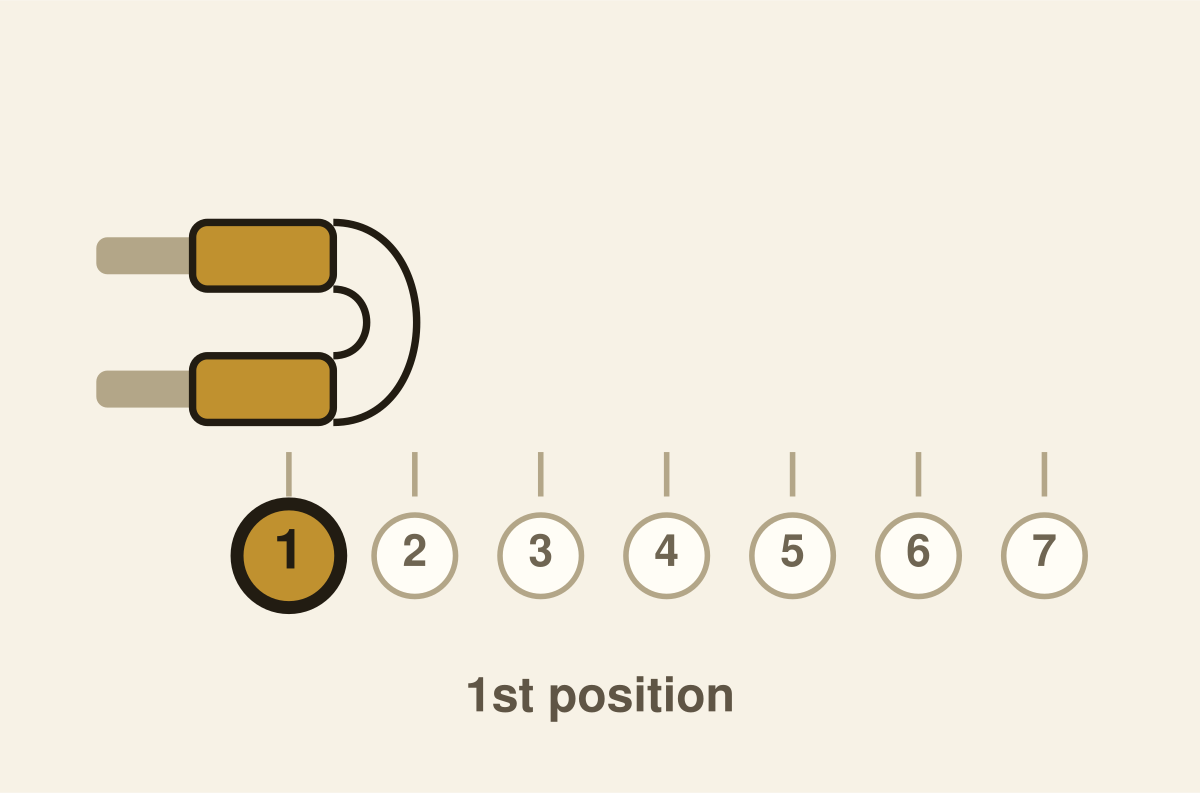
B♭2 is 1st position on the 2nd partial. The slide is all the way in — closed, but not slammed against the stops. This partial sits in tune at the standard spot, so it is a good note to check your positions against. Low register: keep the air slow and wide and the jaw dropped.
Everything about B♭2 on trombone →How to read this chart
The trombone has seven positions. 1st is the slide all the way in; each position after it lengthens the tube by one semitone, so 7th — the slide almost fully out — is six semitones below 1st. The diagram draws the slide out to the position you need, and the filled number underneath is the one to use.
Positions are places you learn by ear, not marks on the slide. As a starting point on a tenor trombone: 3rd is just before the bell, 4th is about level with the edge of the bell, 5th just past it, and 6th and 7th need the arm almost or fully extended.
Why one position plays several notes
Every position is a whole harmonic series. In 1st position the trombone plays B♭2, F3, B♭3, D4, F4 and B♭4 — one slide position, several notes, chosen by air speed and lip aperture. Move to 2nd and every one of those drops a semitone: A2, E3, A3, D♭4, E4, A4.
That is why the chart tags each note with its partial. When a note will not come out, ask whether the slide is in the right place and whether your lips are aiming at the right partial — the second is usually the problem.
Full trombone slide position chart — all notes
Concert pitch in bass clef, low E2 to high F5, chromatically. Reading up any one position you can see the harmonic series; reading across a partial you can see the slide stepping out a semitone at a time.
Octave 2
8 notesE2
F2
G♭2
G2
A♭2
A2
B♭2 (beginner note)
B2 (beginner note)
Octave 3
12 notesC3 (beginner note)
D♭3 (beginner note)
D3 (beginner note)
E♭3 (beginner note)
E3 (beginner note)
F3 (beginner note)
G♭3 (beginner note)
G3 (beginner note)
A♭3 (beginner note)
A3 (beginner note)
B♭3 (beginner note)
B3 (beginner note)
Octave 4
12 notesC4 (beginner note)
D♭4 (beginner note)
D4 (beginner note)
E♭4 (beginner note)
E4 (beginner note)
F4 (beginner note)
G♭4
G4
A♭4
A4
B♭4
B4
Octave 5
6 notesC5
D♭5
D5
E♭5
E5
F5
Pressed or coveredOpenBeginner note
The same chart, written out
Every fingering in words — handy for copying into lesson notes, and it reads aloud properly on a screen reader.
| Written note | Fingering | Beginner |
|---|---|---|
| E2 | 7th position | — |
| F2 | 6th position | — |
| G♭2 | 5th position | — |
| G2 | 4th position | — |
| A♭2 | 3rd position | — |
| A2 | 2nd position | — |
| B♭2 | 1st position | Yes |
| B2 | 7th position | Yes |
| C3 | 6th position | Yes |
| D♭3 | 5th position | Yes |
| D3 | 4th position | Yes |
| E♭3 | 3rd position | Yes |
| E3 | 2nd position | Yes |
| F3 | 1st position | Yes |
| G♭3 | 5th position | Yes |
| G3 | 4th position | Yes |
| A♭3 | 3rd position | Yes |
| A3 | 2nd position | Yes |
| B♭3 | 1st position | Yes |
| B3 | 4th position | Yes |
| C4 | 3rd position | Yes |
| D♭4 | 2nd position | Yes |
| D4 | 1st position | Yes |
| E♭4 | 3rd position | Yes |
| E4 | 2nd position | Yes |
| F4 | 1st position | Yes |
| G♭4 | 5th position | — |
| G4 | 4th position | — |
| A♭4 | 3rd position | — |
| A4 | 2nd position | — |
| B♭4 | 1st position | — |
| B4 | 2nd position | — |
| C5 | 1st position | — |
| D♭5 | 2nd position | — |
| D5 | 1st position | — |
| E♭5 | 3rd position | — |
| E5 | 2nd position | — |
| F5 | 1st position | — |
Alternate positions and tuning
Many notes can be played in two positions on different partials. The classic alternates are F3 in 6th, B♭3 in 5th and D4 in 4th: each saves a long slide move in a fast passage or makes a slur smoother. Above the staff, B4 (2nd or 4th) and C5 (1st or 3rd) are both standard either way.
Positions also bend with the partial. The 5th partial (D4, D♭4, C4, B3) sits flat, so bring the slide in slightly from the standard spot; the 3rd and 6th partials run a touch sharp. The 7th partial is so flat that its positions move noticeably in — that is why it only appears here as an alternate.
If your trombone has an F attachment (a trigger under the left thumb), pressing it lowers the whole series a fourth: C3 moves from 6th position to 1st with the trigger, and B2 from 7th to 2nd. This chart shows the straight B♭ positions every trombone has.
Alternate trombone fingerings
Alternates aren’t “better” fingerings — each one earns its place in a specific musical situation. Select any of these notes in the chart above and switch variants to compare them.
- E3 (E3) — 7th position (4th partial): 7th position. Same pitch on the 4th partial; use it when it keeps the slide close to the notes around it, or for a smoother slur. Both positions are standard.
- F3 (F3) — 6th position (4th partial): 6th position. Same pitch on the 4th partial; use it when it keeps the slide close to the notes around it, or for a smoother slur. Both positions are standard.
- A♭3 (A♭3) — 7th position (5th partial): 7th position. Same pitch on the 5th partial; use it when it keeps the slide close to the notes around it, or for a smoother slur. Both positions are standard.
- A3 (A3) — 6th position (5th partial): 6th position. Same pitch on the 5th partial; use it when it keeps the slide close to the notes around it, or for a smoother slur. Both positions are standard.
- B♭3 (B♭3) — 5th position (5th partial): 5th position. Same pitch on the 5th partial; use it when it keeps the slide close to the notes around it, or for a smoother slur. Both positions are standard.
- B3 (B3) — 7th position (6th partial): 7th position. Same pitch on the 6th partial; use it when it keeps the slide close to the notes around it, or for a smoother slur. Both positions are standard.
- C4 (C4) — 6th position (6th partial): 6th position. Same pitch on the 6th partial; use it when it keeps the slide close to the notes around it, or for a smoother slur. Both positions are standard.
- D♭4 (D♭4) — 5th position (6th partial): 5th position. Same pitch on the 6th partial; use it when it keeps the slide close to the notes around it, or for a smoother slur. Both positions are standard.
- D4 (D4) — 4th position (6th partial): 4th position. Same pitch on the 6th partial; use it when it keeps the slide close to the notes around it, or for a smoother slur. Both positions are standard. — 7th position (7th partial): 7th position. On the 7th partial, which sits well flat: bring the slide in noticeably from the normal 7th position. Used for smooth slurs in fast passages.
- E♭4 (E♭4) — 6th position (7th partial): 6th position. On the 7th partial, which sits well flat: bring the slide in noticeably from the normal 6th position. Used for smooth slurs in fast passages.
- E4 (E4) — 5th position (7th partial): 5th position. On the 7th partial, which sits well flat: bring the slide in noticeably from the normal 5th position. Used for smooth slurs in fast passages.
- F4 (F4) — 4th position (7th partial): 4th position. On the 7th partial, which sits well flat: bring the slide in noticeably from the normal 4th position. Used for smooth slurs in fast passages.
- G♭4 (G♭4) — 3rd position (7th partial): 3rd position. On the 7th partial, which sits well flat: bring the slide in noticeably from the normal 3rd position. Used for smooth slurs in fast passages.
- G4 (G4) — 2nd position (7th partial): 2nd position. On the 7th partial, which sits well flat: bring the slide in noticeably from the normal 2nd position. Used for smooth slurs in fast passages.
- A♭4 (A♭4) — 1st position (7th partial): 1st position. On the 7th partial, which sits well flat: bring the slide in noticeably from the normal 1st position. Used for smooth slurs in fast passages. — 5th position (9th partial): 5th position. Same pitch on the 9th partial; use it when it keeps the slide close to the notes around it, or for a smoother slur. Both positions are standard.
- A4 (A4) — 4th position (9th partial): 4th position. Same pitch on the 9th partial; use it when it keeps the slide close to the notes around it, or for a smoother slur. Both positions are standard.
- B♭4 (B♭4) — 3rd position (9th partial): 3rd position. Same pitch on the 9th partial; use it when it keeps the slide close to the notes around it, or for a smoother slur. Both positions are standard. — 5th position (10th partial): 5th position. Same pitch on the 10th partial; use it when it keeps the slide close to the notes around it, or for a smoother slur. Both positions are standard.
- B4 (B4) — 4th position (10th partial): 4th position. Same pitch on the 10th partial; use it when it keeps the slide close to the notes around it, or for a smoother slur. Both positions are standard.
- C5 (C5) — 3rd position (10th partial): 3rd position. Same pitch on the 10th partial; use it when it keeps the slide close to the notes around it, or for a smoother slur. Both positions are standard.
- D♭5 (D♭5) — 5th position (12th partial): 5th position. Same pitch on the 12th partial; use it when it keeps the slide close to the notes around it, or for a smoother slur. Both positions are standard.
- D5 (D5) — 4th position (12th partial): 4th position. Same pitch on the 12th partial; use it when it keeps the slide close to the notes around it, or for a smoother slur. Both positions are standard.
Common trombone slide position chart fingering mistakes
- Locking the wrist. A stiff wrist and arm make the slide jerky and positions inaccurate. Hold the slide brace lightly with the fingertips and move from the elbow.
- Finding positions by sight. The bell is a guide, not a ruler. Use it to get close, then listen and adjust — especially on 5th-partial notes, which sit flat.
- Moving the slide too slowly in legato. A slow slide smears the pitch between notes. Move it quickly and at the exact moment the note changes, with a soft legato tongue to cover the move.
- Ignoring the alternates. F3 in 6th and B♭3 in 5th exist to save long moves. Using 1st every time makes fast passages between low C and those notes much harder.
Frequently asked questions
How many positions does a trombone have?
Seven. 1st is the slide closed, 7th is nearly fully extended, and each position in between lowers the pitch by one semitone.
Where is 4th position on a trombone?
On most tenor trombones 4th position is about level with the edge of the bell, with 3rd just before it and 5th just past it. Use that as a starting point and adjust by ear.
What is an F attachment?
A valve, worked by the left thumb, that adds tubing and lowers the trombone a perfect fourth. It replaces long positions with short ones — C3 in 1st position with the trigger instead of 6th — and fills in the low notes below E2.
Is trombone music at concert pitch?
Yes, in bass and tenor clef: written B♭ sounds B♭. (British brass band trombone parts in treble clef are the exception — they are written in B♭ like a baritone part.)
Can I print this chart free?
Yes — Letter and A4 PDFs generated from this chart, one click, no email.
Trombone fingering data last updated . Every diagram here, in the printable PDF and in the chart image comes from one dataset, so the paper and the screen cannot disagree.