Guitar chord · Open shape · Standard tuning
C dominant 7 guitar chord (C7)
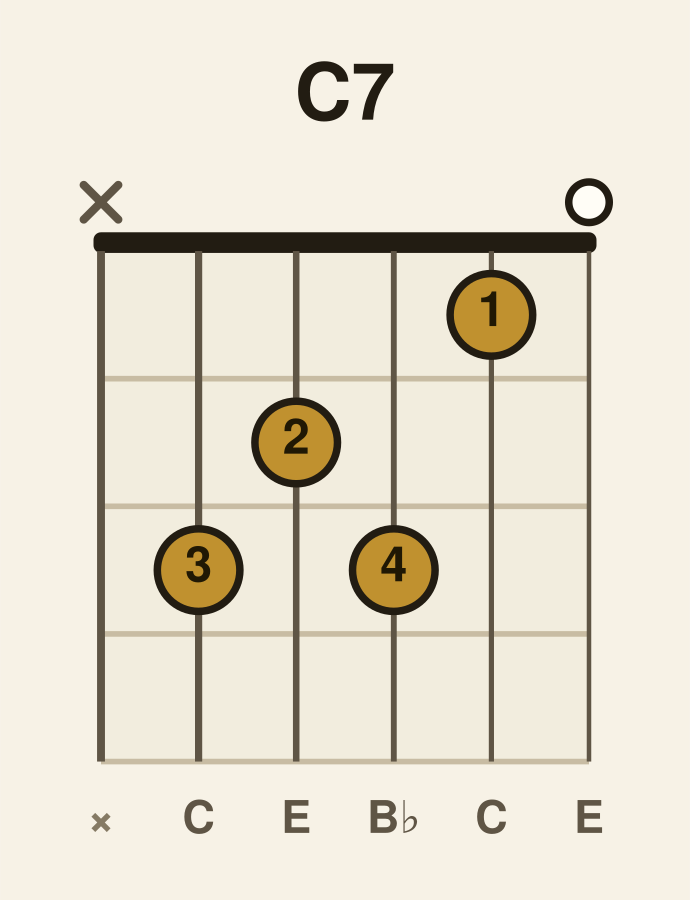
4 fingers, 5 strings, chart notation x32310. Tap the chord chart to hear it strummed, then arpeggio it to check every note is ringing cleanly.
All the strings in one sweep, low to high — how the chord sounds in a song.
- Strings, low to high
- C · E · B♭ · C · E
- Chord tones
- C R · E 3 · G 5 · B♭ b7
How to play C7
Finger numbers run 1 for the index to 4 for the little finger. String names are given as players say them — the low E is the thickest string (the 6th) and the high E is the thinnest (the 1st).
- 1st finger (index) — 1st fret, B string
- 2nd finger (middle) — 2nd fret, D string
- 3rd finger (ring) — 3rd fret, A string
- 4th finger (little) — 3rd fret, G string
- Play open: high E (1st) — strum it without fretting anything.
- Leave out: low E (6th) — start the strum below it, or damp it with the side of the thumb.
| String | Fret | Finger | Note it sounds |
|---|---|---|---|
| 6th — low E | Not played | — | × |
| 5th — A | 3rd fret | 3 (ring) | C |
| 4th — D | 2nd fret | 2 (middle) | E |
| 3rd — G | 3rd fret | 4 (little) | B♭ |
| 2nd — B | 1st fret | 1 (index) | C |
| 1st — high E | Open | — | E |
Notes and intervals in C7
C7 is built from 4 notes: C, E, G and B♭.
- C — the root (R)
- E — the major 3rd (3)
- G — the perfect 5th (5)
- B♭ — the flat 7th (b7)
Across the six strings the shape sounds C · E · B♭ · C · E from low to high, so some notes are doubled in different octaves — that is what gives an open guitar chord its width compared with the same chord on a keyboard.
This voicing leaves out the G entirely. That is normal for a 7th chord on guitar: with only six strings something has to go, and the 5th is the note the ear misses least.
What C7 is used for
C7 adds a B♭ on the 3rd fret of the G string to the C shape, which is what forces the little finger into action. It is the V7 of F and the opening chord of a blues in C. This voicing leaves out the 5th (G) altogether: dominant 7th chords give up their 5th readily because the flat 7th is what creates the pull.
Common mistakes with C7
- Avoiding the little finger. C7 needs all four; putting the ring finger on the G string collapses the shape and mutes the B string.
- Muting the open high E, usually because the little finger has arrived flat rather than on its tip.
- Strumming the 6th string — the root C sits on the 5th string.
Guitar chord data last updated . Every diagram here, in the printable PDF and in the chart image comes from one dataset, so the paper and the screen cannot disagree.