Bassoon Fingering Chart
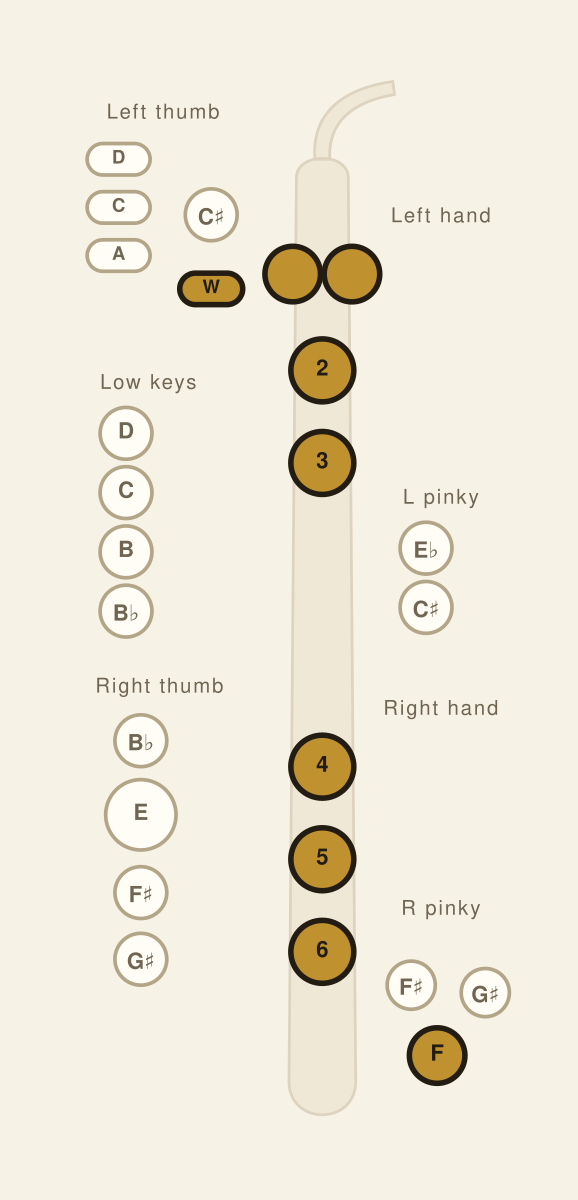
Tap a note to see which keys to press and hear it. Gold (filled) = press the key or cover the hole; half filled = cover half. 39 notes from Low B♭ (B♭1) to High C (C5).
Play along: hear the note for 2 beats, then you play it for 2.
- Whisper key (left thumb)
- Left index hole
- Left middle hole
- Left ring key
- B♭ key (right thumb)
- Right index hole
- Right middle hole
Your left thumb on the whisper key, all three left-hand fingers, your right first and middle fingers, and your right thumb on the B♭ key. This is the band's tuning note. Blow slow, warm air and let your lips cushion the reed: don't bite. More about B♭2
Your left thumb on the whisper key, all three left-hand fingers, your right first and middle fingers, and your right thumb on the B♭ key. This is the band's tuning note. Blow slow, warm air and let your lips cushion the reed: don't bite. More about B♭2
Sound and display
Next moves
Teaching a class? Class mode keeps Stand mode and Test me on the notes your class is learning.
Full bassoon fingering chart — all notes
B♭1 to C5, chromatically, at concert pitch. Alternates are shown where the right thumb or little finger is busy and for soft E♭3 and slurred C♯4.
Gold (filled): pressed or coveredOpenHas an alternate fingering
Every note has its own page
The same chart, written out
Every fingering in words: handy for copying into lesson notes, and it reads aloud properly on a screen reader.
| Written note | Fingering | Beginner |
|---|---|---|
| B♭1 | Low B♭ key (left thumb) + Low B key (left thumb) + Low C key (left thumb) + Low D key (left thumb) + Left index hole + Left middle hole + Left ring key + E key (right thumb) + Right index hole + Right middle hole + Right ring key + F key (right little finger) | — |
| B1 | Low B key (left thumb) + Low C key (left thumb) + Low D key (left thumb) + Left index hole + Left middle hole + Left ring key + E key (right thumb) + Right index hole + Right middle hole + Right ring key + F key (right little finger) | — |
| C2 | Low C key (left thumb) + Low D key (left thumb) + Left index hole + Left middle hole + Left ring key + E key (right thumb) + Right index hole + Right middle hole + Right ring key + F key (right little finger) | — |
| C♯2 | Low C key (left thumb) + Low D key (left thumb) + Left index hole + Left middle hole + Left ring key + C♯ key (left little finger) + E key (right thumb) + Right index hole + Right middle hole + Right ring key + F key (right little finger) | — |
| D2 | Low D key (left thumb) + Left index hole + Left middle hole + Left ring key + E key (right thumb) + Right index hole + Right middle hole + Right ring key + F key (right little finger) | — |
| E♭2 | Low D key (left thumb) + Left index hole + Left middle hole + Left ring key + E♭ key (left little finger) + E key (right thumb) + Right index hole + Right middle hole + Right ring key + F key (right little finger) | — |
| E2 | Whisper key (left thumb) + Left index hole + Left middle hole + Left ring key + E key (right thumb) + Right index hole + Right middle hole + Right ring key + F key (right little finger) | — |
| F2 | Whisper key (left thumb) + Left index hole + Left middle hole + Left ring key + Right index hole + Right middle hole + Right ring key + F key (right little finger) | Yes |
| F♯2 | Whisper key (left thumb) + Left index hole + Left middle hole + Left ring key + F♯ key (right thumb) + Right index hole + Right middle hole + Right ring key + F key (right little finger) | — |
| G2 | Whisper key (left thumb) + Left index hole + Left middle hole + Left ring key + Right index hole + Right middle hole + Right ring key | Yes |
| G♯2 | Whisper key (left thumb) + Left index hole + Left middle hole + Left ring key + Right index hole + Right middle hole + Right ring key + G♯ key (right little finger) | — |
| A2 | Whisper key (left thumb) + Left index hole + Left middle hole + Left ring key + Right index hole + Right middle hole | Yes |
| B♭2 | Whisper key (left thumb) + Left index hole + Left middle hole + Left ring key + B♭ key (right thumb) + Right index hole + Right middle hole | Yes |
| B2 | Whisper key (left thumb) + Left index hole + Left middle hole + Left ring key + Right index hole | Yes |
| C3 | Whisper key (left thumb) + Left index hole + Left middle hole + Left ring key | Yes |
| C♯3 | Low D key (left thumb) + C♯ key (left thumb) + Whisper key (left thumb) + Left index hole + Left middle hole + Left ring key | — |
| D3 | Whisper key (left thumb) + Left index hole + Left middle hole | Yes |
| E♭3 | Whisper key (left thumb) + Left index hole + Left ring key | Yes |
| E3 | Whisper key (left thumb) + Left index hole | Yes |
| F3 | Whisper key (left thumb) | Yes |
| F♯3 | Whisper key (left thumb) + Left index hole (half) + Left middle hole + Left ring key + F♯ key (right thumb) + Right index hole + Right middle hole + Right ring key + F key (right little finger) | — |
| G3 | Whisper key (left thumb) + Left index hole (half) + Left middle hole + Left ring key + E♭ key (left little finger) + Right index hole + Right middle hole + Right ring key | Yes |
| G♯3 | Whisper key (left thumb) + Left index hole (half) + Left middle hole + Left ring key + Right index hole + Right middle hole + Right ring key + G♯ key (right little finger) | — |
| A3 | Left index hole + Left middle hole + Left ring key + Right index hole + Right middle hole | Yes |
| B♭3 | Left index hole + Left middle hole + Left ring key + B♭ key (right thumb) + Right index hole + Right middle hole | Yes |
| B3 | Left index hole + Left middle hole + Left ring key + Right index hole | Yes |
| C4 | Left index hole + Left middle hole + Left ring key | Yes |
| C♯4 | Low D key (left thumb) + C♯ key (left thumb) + Left index hole + Left middle hole + Left ring key | — |
| D4 | Left index hole + Left middle hole | — |
| E♭4 | Left index hole + Left middle hole + Right index hole + Right middle hole + Right ring key | — |
| E4 | Left index hole + Left ring key + E♭ key (left little finger) + Right index hole + Right middle hole + Right ring key | — |
| F4 | Left index hole + Left ring key + E♭ key (left little finger) + Right index hole + Right middle hole | — |
| F♯4 | Left middle hole + Left ring key + E♭ key (left little finger) + B♭ key (right thumb) + Right index hole + Right middle hole | — |
| G4 | Whisper key (left thumb) + Left index hole (half) + Left middle hole + Left ring key + E♭ key (left little finger) + Right index hole + F key (right little finger) | — |
| G♯4 | Whisper key (left thumb) + Left index hole (half) + Left middle hole + Left ring key + E♭ key (left little finger) + Right ring key | — |
| A4 | A flick key (left thumb) + C♯ key (left thumb) + Left index hole + Left middle hole + Left ring key + E♭ key (left little finger) + Right ring key | — |
| B♭4 | A flick key (left thumb) + C♯ key (left thumb) + Left index hole + Left middle hole + Left ring key + E♭ key (left little finger) + Right index hole + Right middle hole + F key (right little finger) | — |
| B4 | C flick key (left thumb) + Left index hole + Left middle hole + E♭ key (left little finger) + B♭ key (right thumb) + Right index hole + Right middle hole + F key (right little finger) | — |
| C5 | C flick key (left thumb) + Left index hole + E♭ key (left little finger) + B♭ key (right thumb) + Right index hole + Right middle hole + F key (right little finger) | — |
Tap any note to see which holes and keys to press and hear the pitch, from low B♭ up to C5. Each diagram shows both thumbs, so you can see when the whisper key and the half-hole come in.
How to read this chart
The left hand's three holes run down the top half of the diagram and the right hand's three down the bottom half, as you hold the bassoon. The left thumb's keys are drawn on the left at the top: the A, C and D flick keys, the C♯ key and the whisper key (W), with the four low keys below them. The right thumb's keys sit beside the right hand, the large E key among them, and the little-finger keys are on the right. Filled keys and holes are pressed or covered; open ones stay up.
The left index hole is drawn as two small circles. Both filled means the hole is fully covered; one filled means half-hole.
The whisper key
The whisper key, under the left thumb, closes the tiny vent on the bocal, the curved metal tube the reed sits on. With the vent closed, low and middle notes speak cleanly; left open, they tend to crack upward. Hold it from low E (E2) up to G♯3, let go for A3 and above, and put it back for G4 and G♯4.
Below E2 the chart does not show it, because the left thumb is busy with the low keys. On most bassoons the right-thumb E key closes the vent for you on those notes.
Half-hole notes
For F♯3, G3 and G♯3, and for G4 and G♯4 an octave up, roll the left index finger down toward your hand so only part of its hole is covered. The opening changes with the note: about three quarters open for F♯, half for G and a quarter open for G♯. Roll the finger rather than lifting it, and let your ear find the exact amount.
Flick keys for A3 to D4
Slurring up to A3, B♭3, B3, C4 or D4, the note can crack and sound an octave low. Bassoonists flick: tap a left-thumb vent key just as the note starts, then let go. Use the A key for A3 and B♭3, the C key for B3 and C4, and the D key for D4.
Because a flick is let go straight away, the diagrams for those notes show only the fingering you hold. From A4 up the thumb keeps the A or C key down for the whole note, and the diagram shows it.
Why this chart stops at C5
Above C5, published charts give several fingerings for each note and no single standard one: the best choice for C♯5, D5 and E5 depends on the individual bassoon and reed. A generic chart would be wrong for many players, so for those notes use the chart from your teacher or your bassoon's maker.
High bassoon parts often switch to tenor clef to save ledger lines. The notes here are named by pitch, so C4 is middle C whichever clef it is written in.
Ranges
Bassoon registers
B♭1 to F3. Hold the whisper key from E2 up; below that the left thumb works the low keys.
F♯3 to G♯3, and G4 to G♯4: roll the left index finger to open part of its hole.
A3 to F♯4 with the whisper key off. Flick the A, C or D key on slurs up to A3–D4.
A4 and up: the left thumb holds the A or C key through the whole note.
For when the standard one is awkward
Alternate bassoon fingerings
Alternates aren’t “better” fingerings: each one earns its place in a specific musical situation, like tuning or a fast passage. The standard fingering is always shown first. Tap one to show it on the chart above; each alternate has its own link to send.
- StandardStandard
Little-finger F♯ (Whisper key (left thumb) + Left index hole + Left middle hole + Left ring key + Right index hole + Right middle hole + Right ring key + F key (right little finger) + F♯ key (right little finger)) — When the right thumb is busy on another key, such as the B♭ key in a passage around B♭2. Show it big
- StandardStandard
Thumb G♯ (Whisper key (left thumb) + Left index hole + Left middle hole + Left ring key + G♯ key (right thumb) + Right index hole + Right middle hole + Right ring key) — When the right little finger is busy on the F key, as in passages moving between F or F♯ and G♯. Show it big
- StandardStandard
Soft E♭ (Whisper key (left thumb) + Left index hole + Left ring key + B♭ key (right thumb) + Right middle hole) — For very soft playing: the right-thumb B♭ key and right middle finger make the note easier to control at pianissimo. Show it big
- StandardStandard
Little-finger F♯ (Whisper key (left thumb) + Left index hole (half) + Left middle hole + Left ring key + Right index hole + Right middle hole + Right ring key + F key (right little finger) + F♯ key (right little finger)) — When the right thumb is needed elsewhere, for example slurring to or from B♭3 on the thumb B♭ key. Show it big
- StandardStandard
Thumb G♯ (Whisper key (left thumb) + Left index hole (half) + Left middle hole + Left ring key + G♯ key (right thumb) + Right index hole + Right middle hole + Right ring key) — When the right little finger is busy on the F key, as in passages moving between F♯3 and G♯3. Show it big
- StandardStandard
Slur C♯ (C♯ key (left thumb) + Left index hole + Left middle hole + Left ring key + Right middle hole + Right ring key + F key (right little finger)) — For slurred passages: the right middle and ring fingers and the F key take the place of the low D key. Show it big
- StandardStandard
F key in place of thumb B♭ (Left middle hole + Left ring key + E♭ key (left little finger) + Right index hole + Right middle hole + F key (right little finger)) — When the right thumb is busy, or when it tunes better on your instrument; both fingerings are standard. Show it big
Common bassoon fingering mistakes
- Forgetting the whisper key. If notes between E2 and G♯3 crack or jump up, check the left thumb is still holding the whisper key down.
- Lifting instead of rolling for the half-hole. Lifting the left index finger opens too much of the hole and the note goes wild. Roll the finger so the opening stays small and repeatable.
- Biting the reed. A tight jaw makes the bassoon sharp and stops the low notes speaking. Let the lips cushion the reed and use slow, warm air.
Frequently asked questions
What is the lowest note on the bassoon?
B♭1, an octave below B♭2, the band's tuning note on bassoon. Every finger is down, the right thumb holds the E key, the right little finger the F key, and the left thumb the low B♭ key.
What does the whisper key do on a bassoon?
It closes a small vent on the bocal so the low and middle notes speak without cracking. Hold it from E2 to G♯3, let go from A3 up, and use it again for G4 and G♯4.
Is the bassoon a transposing instrument?
No. The bassoon is in C and sounds exactly as written, usually in bass clef and in tenor clef for high passages. The band's tuning note, concert B♭, is B♭2 on the bassoon.
Can I print this chart free?
Yes — Letter and A4 PDFs generated from this chart, one click, no email.
Bassoon fingering data last updated . Every diagram here, in the printable PDF and in the chart image comes from one dataset, so the paper and the screen cannot disagree.