B♭ clarinet · written C♯6–C7 · 12 notes
Clarinet altissimo fingering chart
The register above the clarion, written C♯6 up to C7. Tap any note to see the fingering, hear it, and compare the alternates that most published charts disagree about.
Altissimo G is usually the first note above F♯6 that a student can rely on, and it tops out many school-band clarinet parts. Keep the reed vibrating freely: biting to reach it produces the classic altissimo squeal instead of the note.
Everything about G6 on B♭ clarinet →Altissimo fingerings: C♯6 to C7
Every altissimo note in the standard written range, with its concert pitch and the number of widely published alternate fingerings. Written pitches are what you read; the concert column is what sounds on a B♭ clarinet.
Octave 611 notes
C♯6
sounds B5
D6
sounds C6
E♭6
sounds D♭6
E6
sounds D6
F6
sounds E♭6
F♯6
sounds E6
G6
sounds F6
G♯6
sounds F♯6
A6
sounds G6
B♭6
sounds A♭6
B6
sounds A6
Octave 71 note
C7
sounds B♭6
Pressed or coveredOpenBeginner note
| Written note | Sounds (concert) | Fingering | Alternates |
|---|---|---|---|
| Altissimo C♯ (C♯6) | B5 | Register key + Thumb hole + Left middle (hole 2) + Left ring (hole 3) + Right index (hole 4) + Right middle (hole 5) | — |
| Altissimo D (D6) | C6 | Register key + Thumb hole + Left middle (hole 2) + Left ring (hole 3) + Right index (hole 4) + Right pinky A♭/E♭ key | 2 |
| Altissimo E♭ (E♭6) | D♭6 | Register key + Thumb hole + Left middle (hole 2) + Left ring (hole 3) + Right index (hole 4) + Right sliver key + Right pinky A♭/E♭ key | 1 |
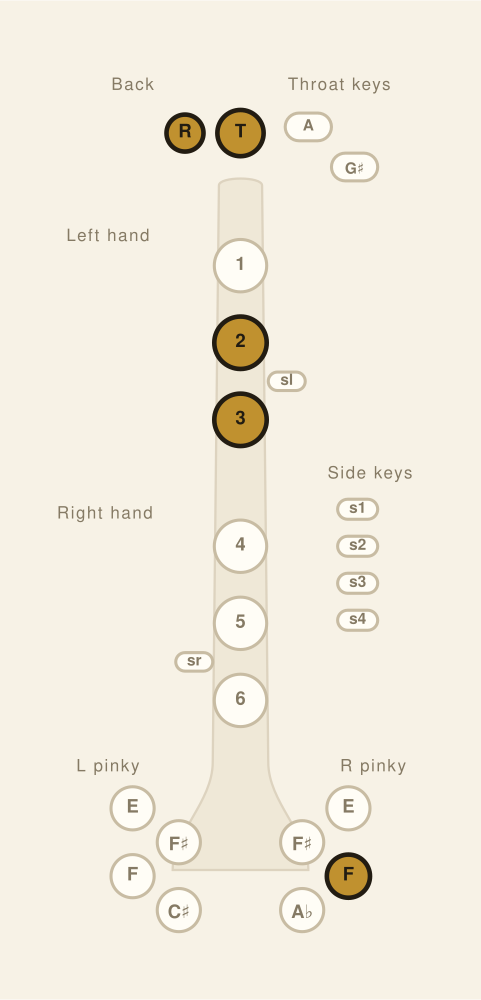
| Altissimo E (E6) | D6 | Register key + Thumb hole + Left middle (hole 2) + Left ring (hole 3) + Right pinky A♭/E♭ key | — |
| Altissimo F (F6) | E♭6 | Register key + Thumb hole + Left middle (hole 2) + Left ring (hole 3) + Left pinky C♯/G♯ key + Right pinky A♭/E♭ key | 1 |
| Altissimo F♯ (F♯6) | E6 | Register key + Thumb hole + Left middle (hole 2) + Right pinky A♭/E♭ key | 2 |
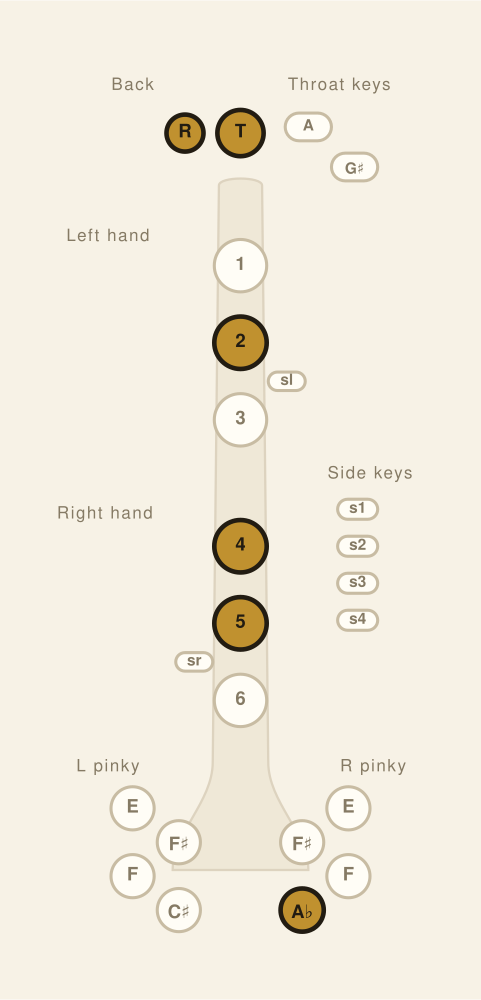
| Altissimo G (G6) | F6 | Register key + Thumb hole + Left middle (hole 2) + Right index (hole 4) + Right middle (hole 5) + Right pinky A♭/E♭ key | 1 |
| Altissimo G♯ (G♯6) | F♯6 | Register key + Thumb hole + Left middle (hole 2) + Left ring (hole 3) + Left pinky F♯/C♯ key + Right index (hole 4) + Right ring (hole 6) + Right pinky F♯/C♯ key | 2 |
| Altissimo A (A6) | G6 | Register key + Thumb hole + Left middle (hole 2) + Left ring (hole 3) + Right pinky F/C key | 2 |
| Altissimo B♭ (B♭6) | A♭6 | Register key + Thumb hole + G♯ key + Left middle (hole 2) + Left ring (hole 3) + Left pinky C♯/G♯ key + Right pinky A♭/E♭ key | 1 |
| Altissimo B (B6) | A6 | Register key + Thumb hole + G♯ key + Left index (hole 1) + Left middle (hole 2) + Right index (hole 4) + Right middle (hole 5) | 1 |
| Altissimo C (C7) | B♭6 | Register key + Thumb hole + G♯ key + Left index (hole 1) + Right index (hole 4) + Right pinky F♯/C♯ key | 1 |
What actually makes altissimo work
Below C♯6 the clarinet is predictable: the register key turns any low-register fingering into a note a twelfth higher. The altissimo does not work like that. These fingerings vent the tube — usually by lifting the left index finger and adding a little-finger key — so the instrument locks onto a higher harmonic instead of the fundamental. That is why the shapes stop looking logical: altissimo C♯6, D6 and E6 all share the same vented left hand, and only the right-hand keys change.
But the fingering is the easy half. The register is produced by voicing and air speed: tongue high as if saying “ee”, throat open, a little more mouthpiece, and fast, focused air. What it is not is jaw pressure. Biting stops the reed vibrating, so a bitten altissimo note comes out as a squeal, sharp and thin, or not at all. When a note misfires, check the voicing before you question the fingering — and check that the vented hole is genuinely open, because a finger resting lightly on it will silence the whole note.
Altissimo fingerings genuinely vary by set-up
This is the honest caveat that belongs on every altissimo chart. From about B♭6 upward, which fingering works depends on your instrument, mouthpiece and reed as much as on the note. B♭6 varies between set-ups more than anything below it. G♯6 has widely differing published fingerings, and one of the simplest — register, thumb, right index and the A♭/E♭ key — tunes well on many instruments while looking nothing like its neighbours. Altissimo C tops most charts and again exists in several versions.
So the alternates in the table above are not decoration. F♯6 has a sparse basic fingering plus two heavier ones that pitch more accurately and speak at any dynamic — worth having for an exposed entry. F6 has a fully covered version that slurs far better out of the clarion register and holds together quietly. Try them on your own horn and keep whichever centres: that is normal practice for this register, not a sign you are doing something wrong.
A practice progression that works
Build the register from below rather than jumping at it. Slur up from a clarion note into the altissimo note that shares its shape and let the voicing travel — clarion G5 into altissimo D6, B5 into E6, F♯6 and G6 into B6. Slurring back down matters just as much, because it teaches you how far the voicing has to relax between registers.
A workable order: start with altissimo G, which is usually the first note above F♯6 that a student can rely on and the ceiling of many school-band parts. Add F♯6 next, since it sits just below and has stable alternates. Then altissimo A, the practical top of most band writing. C♯6, D6 and E6 are worth drilling alongside as a group, because they share one hand shape. Keep sessions short: the register rewards a focused reed and a settled embouchure, and both go once you are tired.
Frequently asked questions
Where does the clarinet altissimo register start?
At written C♯6, the note above the top of the clarion register. Below that, the register key turns each low-register fingering into a note a twelfth higher; from C♯6 up, the fingerings instead vent the tube to bring out higher harmonics, which is why they stop following an obvious pattern.
Why do my altissimo notes squeak instead of sounding?
It is nearly always voicing rather than a wrong finger. Keep the tongue high — think an "ee" vowel — take a little more mouthpiece, keep the throat open and the air fast. Biting to force the note up produces the classic altissimo squeal instead of the pitch, because a clamped reed cannot vibrate. Also check that any vented hole is genuinely uncovered: a fingertip resting lightly on it kills the note.
Which altissimo notes should I learn first?
Altissimo G (written G6) is the note most students get reliably first, and it tops out many school-band parts, so it is a sensible target. Altissimo A follows, and between them they cover most of the high writing you will meet. Both have their own detail pages here.
Clarinet fingering data last updated . Every diagram here, in the printable PDF and in the chart image comes from one dataset, so the paper and the screen cannot disagree.