Euphonium Fingering Chart (Bass Clef)
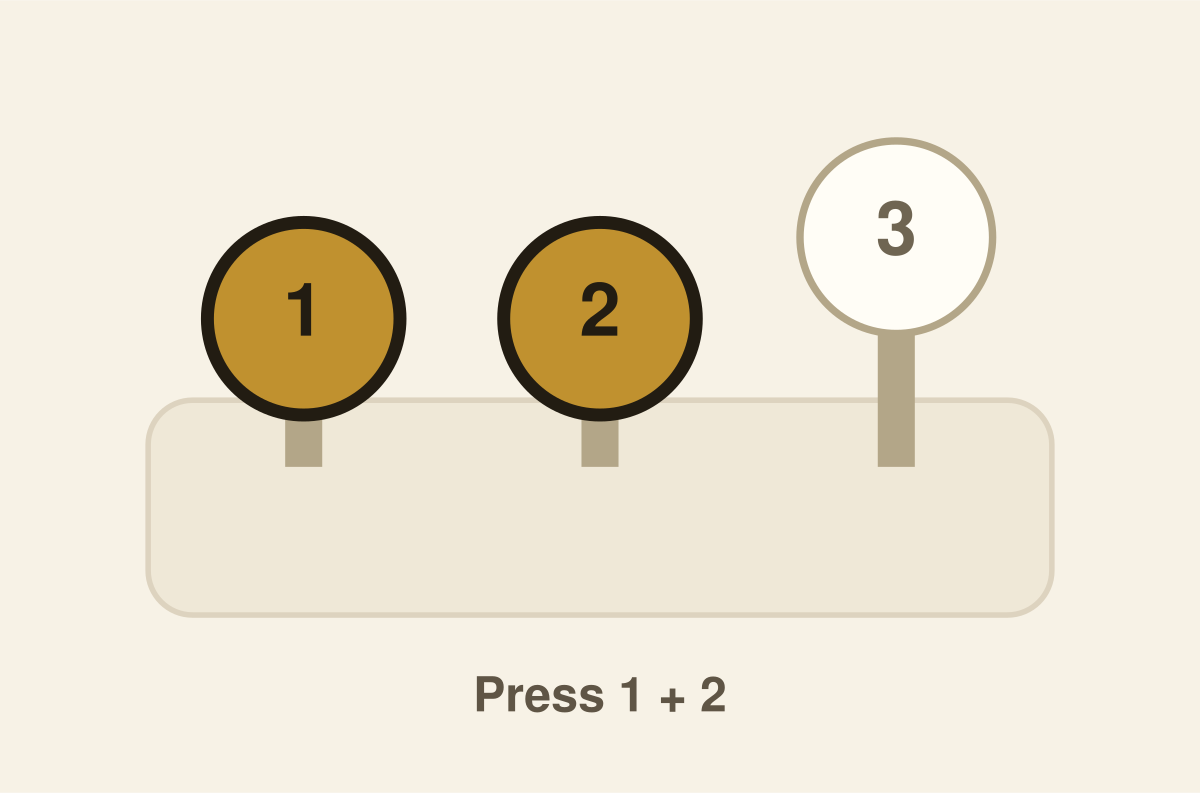
Tap a note to see which valves to press and hear it. Gold (filled) = press it down. 31 notes from Low E (E2) to High B♭ (B♭4).
What’s a partial?
With the same valves down your lips can buzz several notes. Each one is a partial, counted from the lowest. B♭2 is the 2nd.
Play along: hear the note for 2 beats, then you play it for 2.
No valves: this open B♭ is the band's tuning note. Drop your jaw a little, keep your lips loose and blow slow, warm air. It should feel easy, not forced. More about B♭2
No valves: this open B♭ is the band's tuning note. Drop your jaw a little, keep your lips loose and blow slow, warm air. It should feel easy, not forced. More about B♭2
Sound and display
Next moves
Teaching a class? Class mode keeps Stand mode and Test me on the notes your class is learning.
Full euphonium fingering chart — all notes
Concert pitch in bass clef, low E2 to B♭4, chromatically. The euphonium is half the length of the BB♭ tuba, so every fingering here is the tuba's, one octave higher.
Gold (filled): pressed or coveredOpenHas an alternate fingering
Every note has its own page
The same chart, written out
Every fingering in words: handy for copying into lesson notes, and it reads aloud properly on a screen reader.
| Written note | Fingering | Beginner |
|---|---|---|
| E2 | Valves 1 + 2 + 3 | — |
| F2 | Valves 1 + 3 | — |
| G♭2 | Valves 2 + 3 | — |
| G2 | Valves 1 + 2 | Yes |
| A♭2 | Valves 1 | Yes |
| A2 | Valves 2 | Yes |
| B♭2 | Open (no valves) | Yes |
| B2 | Valves 1 + 2 + 3 | — |
| C3 | Valves 1 + 3 | Yes |
| D♭3 | Valves 2 + 3 | Yes |
| D3 | Valves 1 + 2 | Yes |
| E♭3 | Valves 1 | Yes |
| E3 | Valves 2 | Yes |
| F3 | Open (no valves) | Yes |
| G♭3 | Valves 2 + 3 | Yes |
| G3 | Valves 1 + 2 | Yes |
| A♭3 | Valves 1 | Yes |
| A3 | Valves 2 | Yes |
| B♭3 | Open (no valves) | Yes |
| B3 | Valves 1 + 2 | — |
| C4 | Valves 1 | Yes |
| D♭4 | Valves 2 | Yes |
| D4 | Open (no valves) | Yes |
| E♭4 | Valves 1 | Yes |
| E4 | Valves 2 | — |
| F4 | Open (no valves) | — |
| G♭4 | Valves 2 + 3 | — |
| G4 | Valves 1 + 2 | — |
| A♭4 | Valves 1 | — |
| A4 | Valves 2 | — |
| B♭4 | Open (no valves) | — |
Tap any note to see which valves to press and hear the pitch, from low E to the B♭ above middle C. Bass-clef baritone players use exactly the same chart.
How to read this chart
The three valves are numbered 1 for the one under your index finger, then 2 under the middle finger and 3 under the ring finger — on the euphonium they are played with the right hand. A filled, dropped cap means press that valve; a pale, raised cap means leave it up. No caps down is an open note.
The same fingering appears at several pitches, and that is not a mistake. Valves only choose how long the tube is; which note of that tube sounds is set by the harmonic partial your air and lips find. Every note on this chart is tagged with its partial as well as its valves.
Bass clef at concert pitch
Bass-clef euphonium and baritone parts are written at concert pitch: written B♭ sounds B♭, so a concert B♭ scale is simply a B♭ scale. That is the same as trombone and tuba parts, and different from treble-clef baritone parts, which are transposed — see the treble-clef baritone chart for those.
Three valves or four?
The chart shows the three main valves, which every euphonium has. Many euphoniums add a fourth valve, which lowers the pitch a perfect fourth — the same as 1-3, but tuned to be correct. So any note fingered 1-3 here can be played with 4 alone, and any note fingered 1-2-3 with 2-4, and both will sit better in tune.
The fourth valve also fills the gap below low E: with it you can play E♭2, D2, D♭2 and C2 and on down to the pedal B♭, which a three-valve instrument cannot reach chromatically. Compensating euphoniums route the air through extra tubing to correct the low notes automatically.
Why the same valves play different notes
A three-valve euphonium has seven valve combinations — open, 2, 1, 1-2 (or 3), 2-3, 1-3 and 1-2-3 — and each one is a complete harmonic series. With no valves down it plays B♭2, F3, B♭3, D4, F4 and B♭4: one fingering, several notes, chosen by air speed and lip aperture.
From any open note, valve 2 lowers it a semitone, valve 1 a whole step, 1-2 or 3 a minor third, 2-3 a major third, 1-3 a fourth and 1-2-3 a tritone. The 5th partial sits flat on every valved brass instrument, and 1-3 and 1-2-3 run sharp because each valve's tubing is cut to be right on its own, not in combination.
So when a note will not come out, ask which is wrong: the valves, or the slot your lips are aiming for. It is usually the slot, and the fix is hearing the pitch before you play it — not pressing harder.
How brass works
What partials are
A brass instrument with no valves pressed can still play many notes: the partials (also called harmonics or the overtone series). Your lips and air choose the partial; the valves lower it by adding tubing. Tap a note in the ladder to show it at the top. Highlighted chips are the open notes.
For when the standard one is awkward
Alternate euphonium fingerings
Alternates aren’t “better” fingerings: each one earns its place in a specific musical situation, like tuning or a fast passage. The standard fingering is always shown first. Tap one to show it on the chart above; each alternate has its own link to send.
- StandardValves 1 + 2
3 — Valve 3 alone lowers the same minor third as 1-2 and often sits truer in tune this low. Show it big
- StandardValves 1 + 2
3 — Valve 3 alone is the standard substitute for 1-2 and is often smoother in a slurred line. Show it big
- StandardValves 2
1-2-3 — Reaches the same pitch from the 4th partial; much sharper, so it is kept for trills and awkward slurs. Show it big
- StandardOpen
1-3 — A 4th-partial fingering for the same pitch, used for lip-flexibility work; it inherits the sharpness of 1-3. Show it big
- StandardValves 1 + 2
3 — The usual alternate — same minor third, same slot; it saves a finger move in a chromatic run. Show it big
- StandardValves 1
1-2-3 — Reaches the same pitch from the 5th partial; sharp and unwieldy, so a trill fingering only. Show it big
- StandardValves 2
1-3 — The same pitch off the 5th partial, used for trills; sharp like every 1-3 fingering. Show it big
- StandardOpen
2-3 — A 5th-partial fingering for the same pitch, useful where an open note would break a slur. Show it big
- StandardValves 1 + 2
3 — The common substitute for 1-2 in this register; often easier to slur into and out of. Show it big
- StandardValves 1
1-3 — Reaches C3 from the 6th partial instead of the 5th; useful for avoiding a flat 5th-partial slot. Show it big
- StandardValves 2
2-3 — A 6th-partial fingering for the same note, a standard substitute when it is approached from above. Show it big
- StandardOpen
1-2 — Places D3 on the 6th partial rather than the flat 5th — a trill and flexibility fingering. Show it big
- StandardOpen
1-3 — The same pitch off the 8th partial; a flexibility fingering, sharp like all 1-3 combinations. Show it big
- StandardValves 1 + 2
3 — The standard 1-2 substitute; many players prefer its security this high. Show it big
Fingerings to avoid
These sound roughly the right note but badly out of tune. They are listed so you can recognize them, not so you can use them.
- StandardValves 1
Avoid: Open (7th partial) — The open 7th partial sounds roughly this pitch but about a third of a semitone flat; listed for reference only, not as a usable fingering. Show it big
Common euphonium fingering mistakes
- Accepting sharp 1-3 and 1-2-3 notes. Low F, E, C and B run sharp on three valves. Use the fourth valve if you have one; otherwise lip them down.
- Choking the low register. Low notes need a relaxed, dropped jaw and slow, warm air. Tightening up to find them makes them thin and sharp.
- Reading a treble-clef part with this chart. If your part is in treble clef it is transposed for B♭, and every note will come out a whole step (plus an octave) off. Use the treble-clef baritone chart for those parts.
Frequently asked questions
Is euphonium fingering the same as baritone?
Yes. Euphonium and baritone are both pitched in B♭ and use the same valve combinations. Read this chart for bass-clef parts on either instrument, and the treble-clef baritone chart for treble-clef parts.
Is euphonium fingering the same as tuba?
The same as the BB♭ tuba, one octave up. The euphonium's tube is half the tuba's length, so its whole harmonic series sits an octave higher and each valve combination lowers it by the same intervals.
What does the fourth valve do on a euphonium?
It lowers the pitch a perfect fourth, replacing the sharp 1-3 combination, and 2-4 replaces 1-2-3. It also lets you play the chromatic notes between low E and the pedal B♭ that three valves cannot reach.
Can I print this chart free?
Yes — Letter and A4 PDFs generated from this chart, one click, no email.
Euphonium fingering data last updated . Every diagram here, in the printable PDF and in the chart image comes from one dataset, so the paper and the screen cannot disagree.