French Horn Fingering Chart (Double Horn)
Tap a note to see which valves to press and hear it. Gold (filled) = press it down. 31 notes from Low F♯ (F♯3) to High C (C6).
What’s a partial?
With the same valves down your lips can buzz several notes. Each one is a partial, counted from the lowest. F4 is the 6th.
Play along: hear the note for 2 beats, then you play it for 2.
Valve 1, with your thumb off the thumb valve. This is the band's tuning note on horn. Horn notes sit close together, so sing or hum the note first, then buzz it with steady air. More about F4
Valve 1, with your thumb off the thumb valve. This is the band's tuning note on horn. Horn notes sit close together, so sing or hum the note first, then buzz it with steady air. More about F4
Sound and display
Next moves
Teaching a class? Class mode keeps Stand mode and Test me on the notes your class is learning.
Full double horn fingering chart — all notes
Written F♯3 to C6, chromatically. Read the T on each diagram to see which side of the horn the note is on; the alternate below the chart gives the other side.
Gold (filled): pressed or coveredOpenHas an alternate fingering
Every note has its own page
The same chart, written out
Every fingering in words: handy for copying into lesson notes, and it reads aloud properly on a screen reader.
| Written note | Sounds (concert) | Fingering | Beginner |
|---|---|---|---|
| F♯3 | B2 | F side + valves 2 | — |
| G3 | C3 | F side, open | — |
| A♭3 | D♭3 | F side + valves 2 + 3 | — |
| A3 | D3 | F side + valves 1 + 2 | — |
| B♭3 | E♭3 | F side + valves 1 | — |
| B3 | E3 | F side + valves 2 | — |
| C4 | F3 | F side, open | Yes |
| C♯4 | F♯3 | F side + valves 1 + 2 | Yes |
| D4 | G3 | F side + valves 1 | Yes |
| E♭4 | A♭3 | F side + valves 2 | Yes |
| E4 | A3 | F side, open | Yes |
| F4 | B♭3 | F side + valves 1 | Yes |
| F♯4 | B3 | F side + valves 2 | Yes |
| G4 | C4 | F side, open | Yes |
| A♭4 | D♭4 | Thumb (B♭ side) + valves 2 | Yes |
| A4 | D4 | Thumb (B♭ side), open | Yes |
| B♭4 | E♭4 | Thumb (B♭ side) + valves 1 | Yes |
| B4 | E4 | Thumb (B♭ side) + valves 2 | Yes |
| C5 | F4 | Thumb (B♭ side), open | Yes |
| C♯5 | F♯4 | Thumb (B♭ side) + valves 2 + 3 | — |
| D5 | G4 | Thumb (B♭ side) + valves 1 + 2 | — |
| E♭5 | A♭4 | Thumb (B♭ side) + valves 1 | — |
| E5 | A4 | Thumb (B♭ side) + valves 2 | — |
| F5 | B♭4 | Thumb (B♭ side), open | — |
| F♯5 | B4 | Thumb (B♭ side) + valves 2 | — |
| G5 | C5 | Thumb (B♭ side), open | — |
| A♭5 | D♭5 | Thumb (B♭ side) + valves 2 | — |
| A5 | D5 | Thumb (B♭ side), open | — |
| B♭5 | E♭5 | Thumb (B♭ side) + valves 1 | — |
| B5 | E5 | Thumb (B♭ side) + valves 2 | — |
| C6 | F5 | Thumb (B♭ side), open | — |
Tap any note to see the valves — and whether the thumb is down — and hear the pitch. Every note lists both its F-side and its B♭-side fingering.
How to read this chart
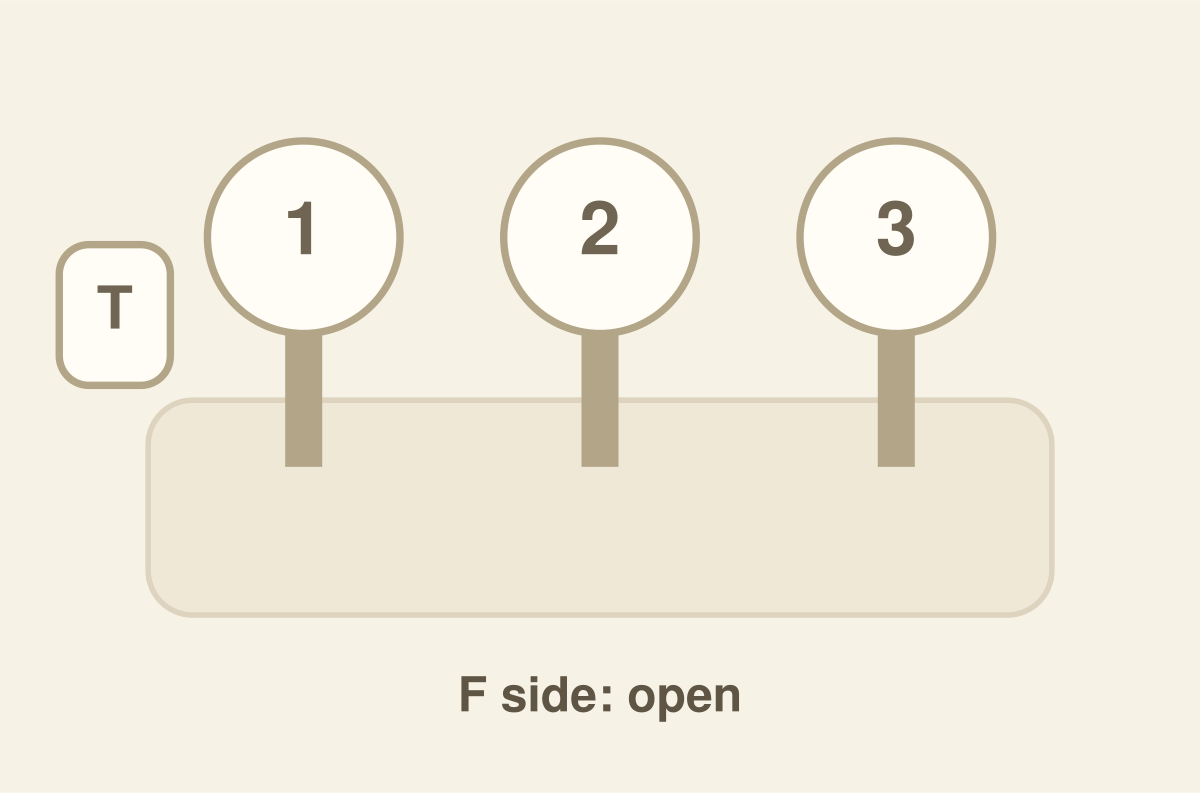
The horn's valves are played with the left hand: valve 1 under the index finger, 2 under the middle, 3 under the ring finger. The lever marked T on the left of the diagram is the thumb valve. Filled and dropped means pressed; pale and raised means up.
Thumb up puts the horn on its F side; thumb down switches to the shorter B♭ side. Each note's diagram shows the side this chart recommends, and the alternate underneath gives the same note on the other side.
F side and B♭ side
A double horn is two horns sharing one bell and mouthpipe. The F horn is longer, with a warm sound, but high up its partials crowd together and notes are easy to miss. The B♭ horn is a fourth shorter, so in the upper register its partials are farther apart and notes are easier to hit.
This chart uses the F side up to written G4 and the B♭ side from G♯4 up, the switch point many band methods teach. Teachers differ — some stay on F higher, some switch earlier — so if your teacher's chart switches somewhere else, follow it; the alternate on each note shows you the other side.
Playing a single F horn? Use the F-side fingering for every note: it is the alternate wherever the chart shows the thumb down.
Written vs concert pitch on horn
Horn parts are written in F: every note sounds a perfect fifth lower than written. Written C sounds concert F, so when the band tunes to concert B♭ you play a written F. The chart shows both pitches, and the play button sounds the concert pitch.
The right hand changes the pitch
The right hand sits in the bell, and how much of the bell it covers moves the pitch and the tone. Covering more darkens the sound and lowers the pitch; opening the hand brightens it and raises it. That is why the explanations below suggest hand adjustments for sharp and flat partials, and why a note that is out of tune with correct fingers is often a hand-position problem.
How brass works
What partials are
A brass instrument with no valves pressed can still play many notes: the partials (also called harmonics or the overtone series). Your lips and air choose the partial; the valves lower it by adding tubing. Tap a note in the ladder to show it at the top. Highlighted chips are the open notes.
For when the standard one is awkward
Alternate french horn fingerings
Alternates aren’t “better” fingerings: each one earns its place in a specific musical situation, like tuning or a fast passage. The standard fingering is always shown first. Tap one to show it on the chart above; each alternate has its own link to send.
- StandardF side + valves 2
B♭ side (thumb): valves 1-2-3 — The same note on the B♭ horn (3rd partial). Safer to hit in fast or loud passages; check the tuning against the F side. Show it big
- StandardF side, open
B♭ side (thumb): valves 1-3 — The same note on the B♭ horn (3rd partial). Safer to hit in fast or loud passages; check the tuning against the F side. Show it big
- StandardF side + valves 2 + 3
B♭ side (thumb): valves 2-3 — The same note on the B♭ horn (3rd partial). Safer to hit in fast or loud passages; check the tuning against the F side. Show it big
- StandardF side + valves 1 + 2
B♭ side (thumb): valves 1-2 — The same note on the B♭ horn (3rd partial). Safer to hit in fast or loud passages; check the tuning against the F side. Show it big
- StandardF side + valves 1
B♭ side (thumb): valves 1 — The same note on the B♭ horn (3rd partial). Safer to hit in fast or loud passages; check the tuning against the F side. Show it big
- StandardF side + valves 2
B♭ side (thumb): valves 2 — The same note on the B♭ horn (3rd partial). Safer to hit in fast or loud passages; check the tuning against the F side. Show it big
- StandardF side, open
B♭ side (thumb): open — The same note on the B♭ horn (3rd partial). Safer to hit in fast or loud passages; check the tuning against the F side. Show it big
- StandardF side + valves 1 + 2
B♭ side (thumb): valves 2-3 — The same note on the B♭ horn (4th partial). Safer to hit in fast or loud passages; check the tuning against the F side. Show it big
- StandardF side + valves 1
B♭ side (thumb): valves 1-2 — The same note on the B♭ horn (4th partial). Safer to hit in fast or loud passages; check the tuning against the F side. Show it big
- StandardF side + valves 2
B♭ side (thumb): valves 1 — The same note on the B♭ horn (4th partial). Safer to hit in fast or loud passages; check the tuning against the F side. Show it big
- StandardF side, open
B♭ side (thumb): valves 2 — The same note on the B♭ horn (4th partial). Safer to hit in fast or loud passages; check the tuning against the F side. Show it big
- StandardF side + valves 1
B♭ side (thumb): open — The same note on the B♭ horn (4th partial). Safer to hit in fast or loud passages; check the tuning against the F side. Show it big
- StandardF side + valves 2
B♭ side (thumb): valves 1-2 — The same note on the B♭ horn (5th partial). Safer to hit in fast or loud passages; check the tuning against the F side. Show it big
- StandardF side, open
B♭ side (thumb): valves 1 — The same note on the B♭ horn (5th partial). Safer to hit in fast or loud passages; check the tuning against the F side. Show it big
- StandardThumb (B♭ side) + valves 2
F side: valves 2-3 — The same note on the F horn (8th partial). Often the better sound in this range; use it when the passage around it stays on the F side. Show it big
- StandardThumb (B♭ side), open
F side: valves 1-2 — The same note on the F horn (8th partial). Often the better sound in this range; use it when the passage around it stays on the F side. Show it big
- StandardThumb (B♭ side) + valves 1
F side: valves 1 — The same note on the F horn (8th partial). Often the better sound in this range; use it when the passage around it stays on the F side. Show it big
- StandardThumb (B♭ side) + valves 2
F side: valves 2 — The same note on the F horn (8th partial). Often the better sound in this range; use it when the passage around it stays on the F side. Show it big
- StandardThumb (B♭ side), open
F side: open — The same note on the F horn (8th partial). Often the better sound in this range; use it when the passage around it stays on the F side. Show it big
- StandardThumb (B♭ side) + valves 2 + 3
F side: valves 2 — The same note on the F horn (9th partial). Often the better sound in this range; use it when the passage around it stays on the F side. Show it big
- StandardThumb (B♭ side) + valves 1 + 2
F side: open — The same note on the F horn (9th partial). Often the better sound in this range; use it when the passage around it stays on the F side. Show it big
- StandardThumb (B♭ side) + valves 1
F side: valves 2 — The same note on the F horn (10th partial). Often the better sound in this range; use it when the passage around it stays on the F side. Show it big
- StandardThumb (B♭ side) + valves 2
F side: open — The same note on the F horn (10th partial). Often the better sound in this range; use it when the passage around it stays on the F side. Show it big
- StandardThumb (B♭ side), open
F side: valves 1 — The same note on the F horn (12th partial). Often the better sound in this range; use it when the passage around it stays on the F side. Show it big
- StandardThumb (B♭ side) + valves 2
F side: valves 2 — The same note on the F horn (12th partial). Often the better sound in this range; use it when the passage around it stays on the F side. Show it big
- StandardThumb (B♭ side), open
F side: open — The same note on the F horn (12th partial). Often the better sound in this range; use it when the passage around it stays on the F side. Show it big
- StandardThumb (B♭ side) + valves 2
F side: valves 1-2 — The same note on the F horn (15th partial). Often the better sound in this range; use it when the passage around it stays on the F side. Show it big
- StandardThumb (B♭ side), open
F side: valves 1 — The same note on the F horn (15th partial). Often the better sound in this range; use it when the passage around it stays on the F side. Show it big
- StandardThumb (B♭ side) + valves 1
F side: valves 2 — The same note on the F horn (15th partial). Often the better sound in this range; use it when the passage around it stays on the F side. Show it big
- StandardThumb (B♭ side) + valves 2
F side: open — The same note on the F horn (15th partial). Often the better sound in this range; use it when the passage around it stays on the F side. Show it big
- StandardThumb (B♭ side), open
F side: open — The same note on the F horn (16th partial). Often the better sound in this range; use it when the passage around it stays on the F side. Show it big
Common french horn fingering mistakes
- Forgetting the thumb. Switching sides mid-phrase is the most common wrong note on double horn. Mark the thumb changes in your music until they are automatic.
- Aiming at the wrong partial. On the horn, partials sit close together, so a correct fingering can still crack onto a neighbor. Hear the pitch before you play it.
- A closed-up right hand. Too much hand in the bell makes the sound muffled and flat. Keep the hand cupped, fingers together, covering roughly half the bell opening.
Frequently asked questions
Why is the French horn played with the left hand?
Because the right hand belongs in the bell, where it shapes the tone and adjusts the pitch. The valves were added to the instrument later, on the side the free hand could reach.
What is a double horn?
A horn with both an F and a B♭ set of tubing, selected by a thumb valve. Thumb up is the F side; thumb down is the B♭ side. Most students move to a double horn after starting on a single F or single B♭ horn.
What key is the French horn in?
Horn parts are written in F, sounding a perfect fifth lower. The double horn itself combines an F horn and a B♭ horn.
Can I print this chart free?
Yes — Letter and A4 PDFs generated from this chart, with the thumb valve marked on every note. One click, no email.
French Horn fingering data last updated . Every diagram here, in the printable PDF and in the chart image comes from one dataset, so the paper and the screen cannot disagree.