Sousaphone Fingering Chart (BB♭)
Tap a note to see which valves to press and hear it. Gold (filled) = press it down. 31 notes from Low E (E1) to High B♭ (B♭3).
What’s a partial?
With the same valves down your lips can buzz several notes. Each one is a partial, counted from the lowest. B♭1 is the 2nd.
Play along: hear the note for 2 beats, then you play it for 2.
No valves: this open B♭ is the band's tuning note. Take a big breath, keep your lips loose and blow slow, warm air. When you march, breathe before the tune starts, not in the middle of a phrase. More about B♭1
No valves: this open B♭ is the band's tuning note. Take a big breath, keep your lips loose and blow slow, warm air. When you march, breathe before the tune starts, not in the middle of a phrase. More about B♭1
Sound and display
Next moves
Teaching a class? Class mode keeps Stand mode and Test me on the notes your class is learning.
Full sousaphone fingering chart — all notes
Concert pitch in bass clef, low E1 to B♭3, chromatically — the range most marching parts use. Every fingering matches the BB♭ tuba chart.
Gold (filled): pressed or coveredOpenHas an alternate fingering
Every note has its own page
The same chart, written out
Every fingering in words: handy for copying into lesson notes, and it reads aloud properly on a screen reader.
| Written note | Fingering | Beginner |
|---|---|---|
| E1 | Valves 1 + 2 + 3 | — |
| F1 | Valves 1 + 3 | — |
| G♭1 | Valves 2 + 3 | — |
| G1 | Valves 1 + 2 | Yes |
| A♭1 | Valves 1 | Yes |
| A1 | Valves 2 | Yes |
| B♭1 | Open (no valves) | Yes |
| B1 | Valves 1 + 2 + 3 | — |
| C2 | Valves 1 + 3 | Yes |
| D♭2 | Valves 2 + 3 | Yes |
| D2 | Valves 1 + 2 | Yes |
| E♭2 | Valves 1 | Yes |
| E2 | Valves 2 | Yes |
| F2 | Open (no valves) | Yes |
| G♭2 | Valves 2 + 3 | Yes |
| G2 | Valves 1 + 2 | Yes |
| A♭2 | Valves 1 | Yes |
| A2 | Valves 2 | Yes |
| B♭2 | Open (no valves) | Yes |
| B2 | Valves 1 + 2 | — |
| C3 | Valves 1 | Yes |
| D♭3 | Valves 2 | Yes |
| D3 | Open (no valves) | Yes |
| E♭3 | Valves 1 | Yes |
| E3 | Valves 2 | — |
| F3 | Open (no valves) | — |
| G♭3 | Valves 2 + 3 | — |
| G3 | Valves 1 + 2 | — |
| A♭3 | Valves 1 | — |
| A3 | Valves 2 | — |
| B♭3 | Open (no valves) | — |
Tap any note to see which valves to press and hear the pitch, from low E up to the B♭ below middle C. A sousaphone is a BB♭ tuba built to be marched, so its fingerings are the tuba's.
How to read this chart
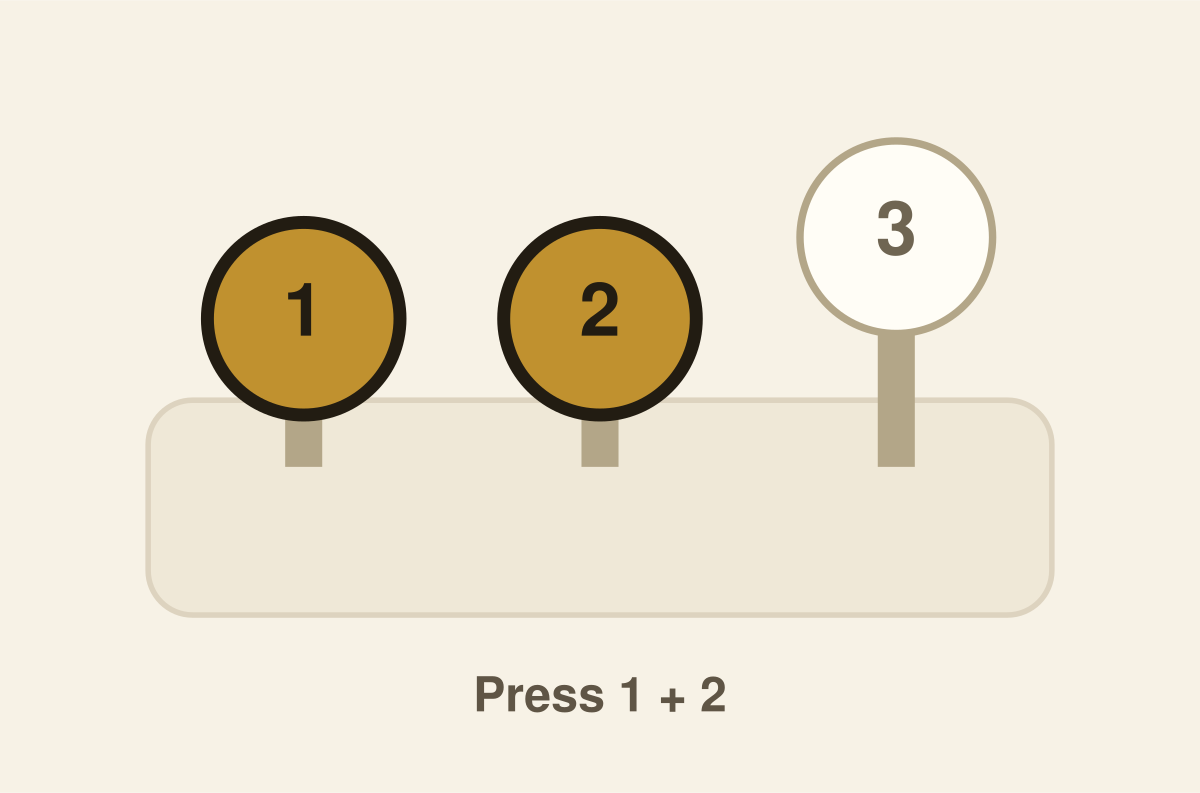
The three valves are numbered 1 for the one under your index finger, then 2 under the middle finger and 3 under the ring finger — on the sousaphone they are played with the right hand. A filled, dropped cap means press that valve; a pale, raised cap means leave it up. No caps down is an open note.
The same fingering appears at several pitches, and that is not a mistake. Valves only choose how long the tube is; which note of that tube sounds is set by the harmonic partial your air and lips find. Every note on this chart is tagged with its partial as well as its valves.
Concert pitch in bass clef
Sousaphone parts are written in bass clef at concert pitch: written B♭ sounds B♭, so the band's concert B♭ scale is your B♭ scale. There is nothing to transpose, which is why the chart shows a single pitch for every note.
Playing it on the move
The notes and fingerings are the tuba's, but marching changes how you get them. Breathe before the phrase rather than during it, because a step can knock a breath short. Keep the mouthpiece angle set so you are not chasing it with your head, and let the instrument's weight sit on your shoulder rather than your left hand, so the right hand stays loose on the valves.
Why the same valves play different notes
A three-valve sousaphone has seven valve combinations — open, 2, 1, 1-2 (or 3), 2-3, 1-3 and 1-2-3 — and each one is a complete harmonic series. With no valves down it plays B♭1, F2, B♭2, D3, F3 and B♭3: one fingering, several notes, chosen by air speed and lip aperture.
From any open note, valve 2 lowers it a semitone, valve 1 a whole step, 1-2 or 3 a minor third, 2-3 a major third, 1-3 a fourth and 1-2-3 a tritone. The 5th partial sits flat on every valved brass instrument, and 1-3 and 1-2-3 run sharp because each valve's tubing is cut to be right on its own, not in combination.
So when a note will not come out, ask which is wrong: the valves, or the slot your lips are aiming for. It is usually the slot, and the fix is hearing the pitch before you play it — not pressing harder.
How brass works
What partials are
A brass instrument with no valves pressed can still play many notes: the partials (also called harmonics or the overtone series). Your lips and air choose the partial; the valves lower it by adding tubing. Tap a note in the ladder to show it at the top. Highlighted chips are the open notes.
For when the standard one is awkward
Alternate BB♭ sousaphone fingerings
Alternates aren’t “better” fingerings: each one earns its place in a specific musical situation, like tuning or a fast passage. The standard fingering is always shown first. Tap one to show it on the chart above; each alternate has its own link to send.
- StandardValves 1 + 2
3 — Valve 3 alone lowers the same minor third as 1-2 and often sits truer in tune this low. Show it big
- StandardValves 1 + 2
3 — Valve 3 alone is the standard substitute for 1-2 and is often smoother in a slurred line. Show it big
- StandardValves 2
1-2-3 — Reaches the same pitch from the 4th partial; much sharper, so it is kept for trills and awkward slurs. Show it big
- StandardOpen
1-3 — A 4th-partial fingering for the same pitch, used for lip-flexibility work; it inherits the sharpness of 1-3. Show it big
- StandardValves 1 + 2
3 — The usual alternate — same minor third, same slot; it saves a finger move in a chromatic run. Show it big
- StandardValves 1
1-2-3 — Reaches the same pitch from the 5th partial; sharp and unwieldy, so a trill fingering only. Show it big
- StandardValves 2
1-3 — The same pitch off the 5th partial, used for trills; sharp like every 1-3 fingering. Show it big
- StandardOpen
2-3 — A 5th-partial fingering for the same pitch, useful where an open note would break a slur. Show it big
- StandardValves 1 + 2
3 — The common substitute for 1-2 in this register; often easier to slur into and out of. Show it big
- StandardValves 1
1-3 — Reaches C3 from the 6th partial instead of the 5th; useful for avoiding a flat 5th-partial slot. Show it big
- StandardValves 2
2-3 — A 6th-partial fingering for the same note, a standard substitute when it is approached from above. Show it big
- StandardOpen
1-2 — Places D3 on the 6th partial rather than the flat 5th — a trill and flexibility fingering. Show it big
- StandardOpen
1-3 — The same pitch off the 8th partial; a flexibility fingering, sharp like all 1-3 combinations. Show it big
- StandardValves 1 + 2
3 — The standard 1-2 substitute; many players prefer its security this high. Show it big
Fingerings to avoid
These sound roughly the right note but badly out of tune. They are listed so you can recognize them, not so you can use them.
- StandardValves 1
Avoid: Open (7th partial) — The open 7th partial sounds roughly this pitch but about a third of a semitone flat; listed for reference only, not as a usable fingering. Show it big
Common sousaphone fingering mistakes
- Breathing on the step. A breath taken mid-step is shallow. Plan breaths into the music and take them before the phrase starts.
- Letting the mouthpiece angle drift. If the horn shifts on your shoulder you end up playing off-center; set the angle before you step off and check it at every halt.
- Not hearing sharp low notes. 1-3 and 1-2-3 run sharp, and sousaphones have no slide triggers, so lip those notes down.
Frequently asked questions
Is sousaphone fingering the same as tuba?
Yes, for a BB♭ sousaphone and a BB♭ tuba. They have the same length of tubing, the same harmonic series and the same three-valve fingerings; the sousaphone is just wrapped to be carried.
What key is a sousaphone in?
Almost all school and marching sousaphones are in BB♭. A few older or specialist ones are in E♭; on those the fingering for a given note is different, so check the key stamped on the bell or valve casing.
Do sousaphones have a fourth valve?
Nearly all have three valves. The low notes this chart lists as 1-3 and 1-2-3 are therefore the ones to lip down, since there is no fourth valve or trigger to correct them.
Can I print this chart free?
Yes — Letter and A4 PDFs generated from this chart, one click, no email.
BB♭ Sousaphone fingering data last updated . Every diagram here, in the printable PDF and in the chart image comes from one dataset, so the paper and the screen cannot disagree.