Trombone Slide Position Chart
Tap a note to see its slide position and hear it. Gold = where the slide goes. 38 notes from Low E (E2) to High F (F5), seven positions.
What’s a partial?
With the slide in one position your lips can buzz several notes. Each one is a partial, counted from the lowest. B♭2 is the 2nd.
Play along: hear the note for 2 beats, then you play it for 2.
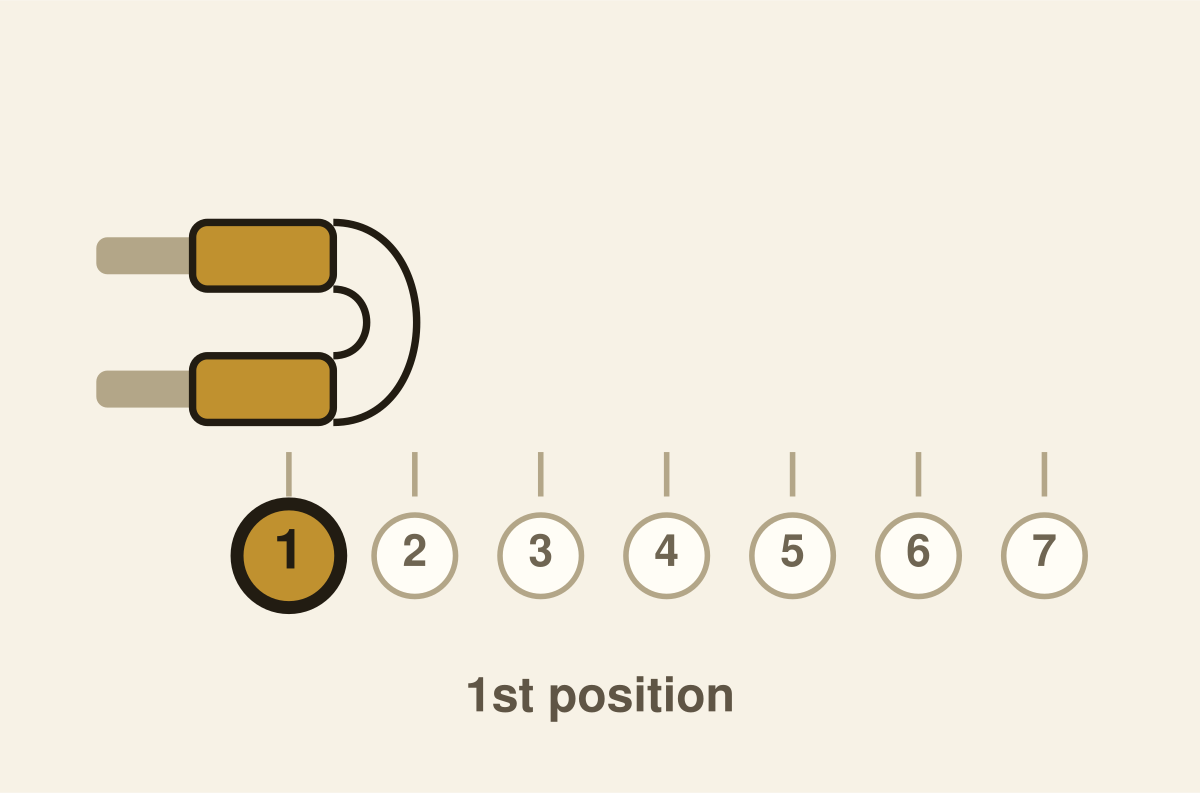
First position: the slide all the way in, resting gently on the stops. This is the band's tuning note. Hold the slide lightly, buzz your lips and blow slow, steady air. More about B♭2
First position: the slide all the way in, resting gently on the stops. This is the band's tuning note. Hold the slide lightly, buzz your lips and blow slow, steady air. More about B♭2
Sound and display
Next moves
Teaching a class? Class mode keeps Stand mode and Test me on the notes your class is learning.
Full trombone slide position chart — all notes
Concert pitch in bass clef, low E2 to high F5, chromatically. Reading up any one position you can see the harmonic series; reading across a partial you can see the slide stepping out a semitone at a time.
Gold (filled): pressed or coveredOpenHas an alternate fingering
Every note has its own page
The same chart, written out
Every fingering in words: handy for copying into lesson notes, and it reads aloud properly on a screen reader.
| Written note | Fingering | Beginner |
|---|---|---|
| E2 | 7th position | — |
| F2 | 6th position | — |
| G♭2 | 5th position | — |
| G2 | 4th position | — |
| A♭2 | 3rd position | — |
| A2 | 2nd position | — |
| B♭2 | 1st position | Yes |
| B2 | 7th position | Yes |
| C3 | 6th position | Yes |
| D♭3 | 5th position | Yes |
| D3 | 4th position | Yes |
| E♭3 | 3rd position | Yes |
| E3 | 2nd position | Yes |
| F3 | 1st position | Yes |
| G♭3 | 5th position | Yes |
| G3 | 4th position | Yes |
| A♭3 | 3rd position | Yes |
| A3 | 2nd position | Yes |
| B♭3 | 1st position | Yes |
| B3 | 4th position | Yes |
| C4 | 3rd position | Yes |
| D♭4 | 2nd position | Yes |
| D4 | 1st position | Yes |
| E♭4 | 3rd position | Yes |
| E4 | 2nd position | Yes |
| F4 | 1st position | Yes |
| G♭4 | 5th position | — |
| G4 | 4th position | — |
| A♭4 | 3rd position | — |
| A4 | 2nd position | — |
| B♭4 | 1st position | — |
| B4 | 2nd position | — |
| C5 | 1st position | — |
| D♭5 | 2nd position | — |
| D5 | 1st position | — |
| E♭5 | 3rd position | — |
| E5 | 2nd position | — |
| F5 | 1st position | — |
Tap any note to see its slide position and hear the pitch, from low E to high F. Every note shows the partial it sits on, and the alternate positions worth knowing.
How to read this chart
The trombone has seven positions. 1st is the slide all the way in; each position after it lengthens the tube by one semitone, so 7th — the slide almost fully out — is six semitones below 1st. The diagram draws the slide out to the position you need, and the filled number underneath is the one to use.
Positions are places you learn by ear, not marks on the slide. As a starting point on a tenor trombone: 3rd is just before the bell, 4th is about level with the edge of the bell, 5th just past it, and 6th and 7th need the arm almost or fully extended.
Why one position plays several notes
Every position is a whole harmonic series. In 1st position the trombone plays B♭2, F3, B♭3, D4, F4 and B♭4 — one slide position, several notes, chosen by air speed and lip aperture. Move to 2nd and every one of those drops a semitone: A2, E3, A3, D♭4, E4, A4.
That is why the chart tags each note with its partial. When a note will not come out, ask whether the slide is in the right place and whether your lips are aiming at the right partial — the second is usually the problem.
Alternate positions and tuning
Many notes can be played in two positions on different partials. The classic alternates are F3 in 6th, B♭3 in 5th and D4 in 4th: each saves a long slide move in a fast passage or makes a slur smoother. Above the staff, B4 (2nd or 4th) and C5 (1st or 3rd) are both standard either way.
Positions also bend with the partial. The 5th partial (D4, D♭4, C4, B3) sits flat, so bring the slide in slightly from the standard spot; the 3rd and 6th partials run a touch sharp. The 7th partial is so flat that its positions move noticeably in — that is why it only appears here as an alternate.
If your trombone has an F attachment (a trigger under the left thumb), pressing it lowers the whole series a fourth: C3 moves from 6th position to 1st with the trigger, and B2 from 7th to 2nd. This chart shows the straight B♭ positions every trombone has.
How brass works
Positions and partials
A brass instrument with no slide moved can still play many notes: the partials (also called harmonics or the overtone series). Your lips and air choose the partial; the slide lowers it, one half step (semitone) per position. Tap a note in the ladder to show it at the top. Highlighted chips are the first-position notes.
For when the standard one is awkward
Alternate trombone fingerings
Alternates aren’t “better” fingerings: each one earns its place in a specific musical situation, like tuning or a fast passage. The standard fingering is always shown first. Tap one to show it on the chart above; each alternate has its own link to send.
- Standard2nd position
7th position (4th partial) — Same pitch on the 4th partial; use it when it keeps the slide close to the notes around it, or for a smoother slur. Both positions are standard. Show it big
- Standard1st position
6th position (4th partial) — Same pitch on the 4th partial; use it when it keeps the slide close to the notes around it, or for a smoother slur. Both positions are standard. Show it big
- Standard3rd position
7th position (5th partial) — Same pitch on the 5th partial; use it when it keeps the slide close to the notes around it, or for a smoother slur. Both positions are standard. Show it big
- Standard2nd position
6th position (5th partial) — Same pitch on the 5th partial; use it when it keeps the slide close to the notes around it, or for a smoother slur. Both positions are standard. Show it big
- Standard1st position
5th position (5th partial) — Same pitch on the 5th partial; use it when it keeps the slide close to the notes around it, or for a smoother slur. Both positions are standard. Show it big
- Standard4th position
7th position (6th partial) — Same pitch on the 6th partial; use it when it keeps the slide close to the notes around it, or for a smoother slur. Both positions are standard. Show it big
- Standard3rd position
6th position (6th partial) — Same pitch on the 6th partial; use it when it keeps the slide close to the notes around it, or for a smoother slur. Both positions are standard. Show it big
- Standard2nd position
5th position (6th partial) — Same pitch on the 6th partial; use it when it keeps the slide close to the notes around it, or for a smoother slur. Both positions are standard. Show it big
- Standard1st position
4th position (6th partial) — Same pitch on the 6th partial; use it when it keeps the slide close to the notes around it, or for a smoother slur. Both positions are standard. Show it big
7th position (7th partial) — On the 7th partial, which sits well flat: bring the slide in noticeably from the normal 7th position. Used for smooth slurs in fast passages. Show it big
- Standard3rd position
6th position (7th partial) — On the 7th partial, which sits well flat: bring the slide in noticeably from the normal 6th position. Used for smooth slurs in fast passages. Show it big
- Standard2nd position
5th position (7th partial) — On the 7th partial, which sits well flat: bring the slide in noticeably from the normal 5th position. Used for smooth slurs in fast passages. Show it big
- Standard1st position
4th position (7th partial) — On the 7th partial, which sits well flat: bring the slide in noticeably from the normal 4th position. Used for smooth slurs in fast passages. Show it big
- Standard5th position
3rd position (7th partial) — On the 7th partial, which sits well flat: bring the slide in noticeably from the normal 3rd position. Used for smooth slurs in fast passages. Show it big
- Standard4th position
2nd position (7th partial) — On the 7th partial, which sits well flat: bring the slide in noticeably from the normal 2nd position. Used for smooth slurs in fast passages. Show it big
- Standard3rd position
1st position (7th partial) — On the 7th partial, which sits well flat: bring the slide in noticeably from the normal 1st position. Used for smooth slurs in fast passages. Show it big
5th position (9th partial) — Same pitch on the 9th partial; use it when it keeps the slide close to the notes around it, or for a smoother slur. Both positions are standard. Show it big
- Standard2nd position
4th position (9th partial) — Same pitch on the 9th partial; use it when it keeps the slide close to the notes around it, or for a smoother slur. Both positions are standard. Show it big
- Standard1st position
3rd position (9th partial) — Same pitch on the 9th partial; use it when it keeps the slide close to the notes around it, or for a smoother slur. Both positions are standard. Show it big
5th position (10th partial) — Same pitch on the 10th partial; use it when it keeps the slide close to the notes around it, or for a smoother slur. Both positions are standard. Show it big
- Standard2nd position
4th position (10th partial) — Same pitch on the 10th partial; use it when it keeps the slide close to the notes around it, or for a smoother slur. Both positions are standard. Show it big
- Standard1st position
3rd position (10th partial) — Same pitch on the 10th partial; use it when it keeps the slide close to the notes around it, or for a smoother slur. Both positions are standard. Show it big
- Standard2nd position
5th position (12th partial) — Same pitch on the 12th partial; use it when it keeps the slide close to the notes around it, or for a smoother slur. Both positions are standard. Show it big
- Standard1st position
4th position (12th partial) — Same pitch on the 12th partial; use it when it keeps the slide close to the notes around it, or for a smoother slur. Both positions are standard. Show it big
Common trombone slide position chart fingering mistakes
- Locking the wrist. A stiff wrist and arm make the slide jerky and positions inaccurate. Hold the slide brace lightly with the fingertips and move from the elbow.
- Finding positions by sight. The bell is a guide, not a ruler. Use it to get close, then listen and adjust — especially on 5th-partial notes, which sit flat.
- Moving the slide too slowly in legato. A slow slide smears the pitch between notes. Move it quickly and at the exact moment the note changes, with a soft legato tongue to cover the move.
- Ignoring the alternates. F3 in 6th and B♭3 in 5th exist to save long moves. Using 1st every time makes fast passages between low C and those notes much harder.
Frequently asked questions
How many positions does a trombone have?
Seven. 1st is the slide closed, 7th is nearly fully extended, and each position in between lowers the pitch by one semitone.
Where is 4th position on a trombone?
On most tenor trombones 4th position is about level with the edge of the bell, with 3rd just before it and 5th just past it. Use that as a starting point and adjust by ear.
What is an F attachment?
A valve, worked by the left thumb, that adds tubing and lowers the trombone a perfect fourth. It replaces long positions with short ones — C3 in 1st position with the trigger instead of 6th — and fills in the low notes below E2.
Is trombone music at concert pitch?
Yes, in bass and tenor clef: written B♭ sounds B♭. (British brass band trombone parts in treble clef are the exception — they are written in B♭ like a baritone part.)
Can I print this chart free?
Yes — Letter and A4 PDFs generated from this chart, one click, no email.
Trombone fingering data last updated . Every diagram here, in the printable PDF and in the chart image comes from one dataset, so the paper and the screen cannot disagree.