trap · 4/4 · intermediate · 140 BPM
Trap Drum Pattern
One bar in standard notation, then a sequencer you can play, slow down and rebuild. Original groove — nothing here is transcribed from a record.
1 e & a 2 e & a 3 e & a 4 e & a
What makes this pattern tick
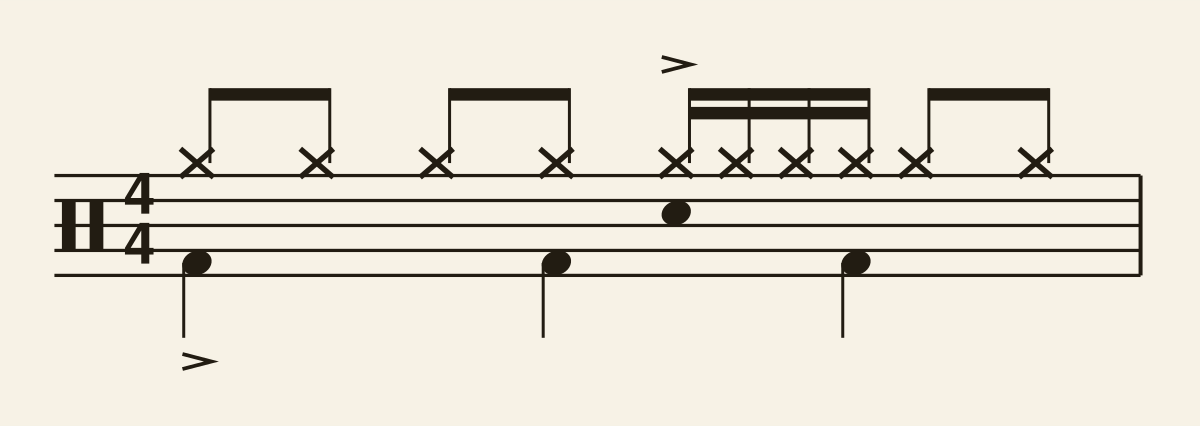
Trap is a half-time feel: the snare waits until beat 3, which makes the bar feel twice as long as its tempo suggests. The kick then works against that space with off-grid sixteenths instead of a steady pulse. The signature is the hi-hat — mostly eighths, then a burst of sixteenths (here on beat 3) that on a record would be a stuttering roll.
What each drum plays
Read the notation from the top down: cymbals above the staff, drums inside it, feet underneath. Full details in the drum notation guide.
| Voice | Hits | Where in the bar |
|---|---|---|
| Closed hi-hat | 10 | 1, the "&" of 1, 2, the "&" of 2, 3, the "e" of 3, the "&" of 3, the "a" of 3, 4, the "&" of 4 |
| Snare drum | 1 | 3 |
| Bass drum (kick) | 3 | 1, the "&" of 2, the "a" of 3 |
How to count it
Count 1 e & a 2 e & a 3 e & a 4 e & a out loud, one syllable per grid step. The numbers are the 4 beats, “&” is halfway through a beat, and “e” and “a” are the sixteenths either side of it. Every note in this pattern lands on one of those syllables — if you can say the count while you play, you are not guessing.
The count row under the sequencer highlights the syllable you are on as the loop plays, so you can check your counting against the playhead rather than against your ears.
Suggested tempo progression
This pattern is written for 140 BPM and rated intermediate. Work up in stages rather than jumping straight to the target — the sequencer remembers whatever tempo you leave it at.
- 85 BPM — slow enough to watch every limb. Play it until nothing surprises you.
- 110 BPM — where the groove starts to feel like music rather than an exercise.
- 140 BPM — the working tempo. Hold it for two minutes without drifting.
- 160 BPM — faster than you need, so the target tempo feels easy when you come back to it.
Make it your own
The sequencer above is a copy, not the original, so change anything you like — toggle cells on and off, mute a voice to hear what it was holding together, or solo the kick to check your foot. Reset puts the pattern back. If you want the same idea in a different style, the closest neighbours are Techno Drum Pattern and Breakbeat Drum Pattern, or browse all 20 patterns.
Drum pattern data last updated . Every diagram here, in the printable PDF and in the chart image comes from one dataset, so the paper and the screen cannot disagree.