PAS #16 · Diddle rudiments
Single Paradiddle
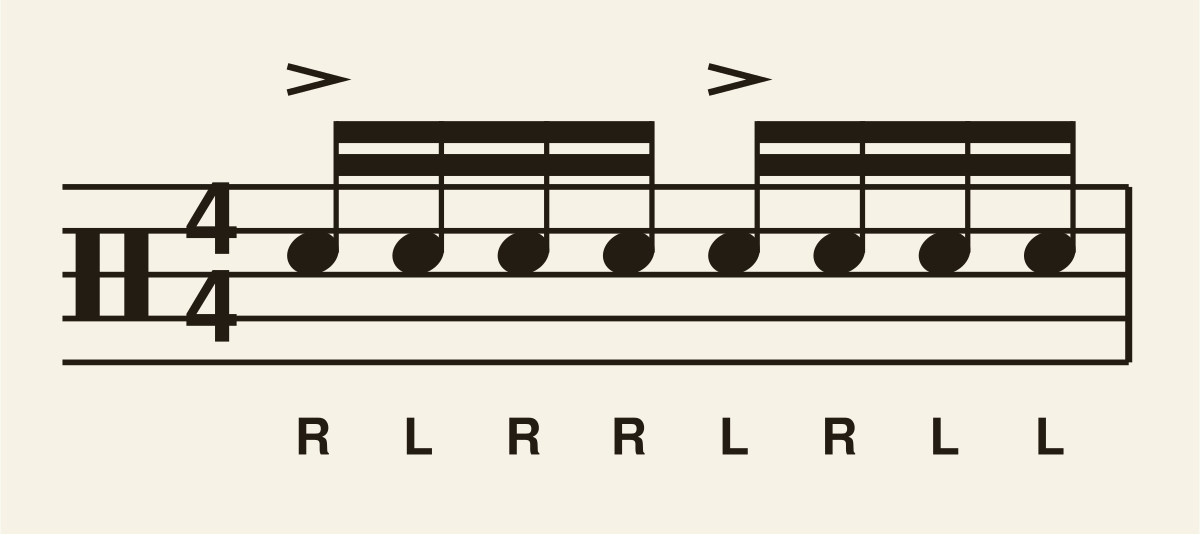
RLRR LRLL — 8 main strokes over 2 beats in sixteenth notes (semiquavers), 2 accents. Loop it from 60 BPM and build to 90.
R = right hand · L = left · small raised letters are grace notes · > = accent. The count runs along the bottom.
Next moves
What the single paradiddle is
Read it, hear it, and slow it down until it is even.
Two single strokes then a double — "pa-ra-did-dle" — which flips the leading hand every group, so it is the rudiment that teaches your hands to swap roles without a gap. That is why it turns up constantly in fills and hi-hat patterns: it lets you start a figure with either hand. Accent the first note of each group so the sticking has an audible shape, and keep the two diddle strokes exactly level with each other.
How to practice it
- Say it out loud while you play — "pa-ra-did-dle" maps exactly onto RLRR, and the mouth keeps the hands honest.
- Accent only the first note of each group. If the diddle gets louder as the tempo rises you are letting the rebound run away with you.
- Once it is even, move the accented note to the floor tom and leave the other three on the snare. That single change turns the rudiment into a usable fill.
- Practice it starting left as well. Because the paradiddle swaps leading hand anyway, drummers wrongly assume they don't need to — then find they can only start a fill with the right.
Where it leads
The single paradiddle belongs to the diddle rudiments family, and it feeds directly into the double and triple paradiddles, the paradiddle-diddle, and almost every linear fill on the kit. Get it even at a slow tempo before you move on — every rudiment built on top of it inherits whatever unevenness you leave here.
Reading the notation above
Both hands play the snare drum, so every notehead sits in the third space of the staff and the sticking cells underneath tell you which hand plays which note, with the count under every stroke. Capital letters are full strokes; small raised letters are grace notes. There are no grace notes in this rudiment, so every note is a full stroke. The marks above the staff are accents: hit those notes harder. Full details in the drum notation guide.
Tempo ladder
Tap a rung to set the speed. Play 8 clean loops before moving up.
More diddle rudiments
Questions
What is the sticking for the single paradiddle?
RLRR LRLL. R = right hand, L = left hand.
How fast should I play it?
Start slow enough that every stroke is even — around 60 BPM — then go up 4–5 BPM at a time. 90 BPM is a good first target.
How is the single paradiddle written in notation?
On the snare line: the third space of the drum staff (stave), stems up, as sixteenth notes (semiquavers), with an accent mark (>) over the loud strokes. The count runs under the sticking: 1 e & a.
Rudiment data last updated . Every diagram here, in the printable PDF and in the chart image comes from one dataset, so the paper and the screen cannot disagree.