PAS #6 · Roll rudiments
Double Stroke Open Roll
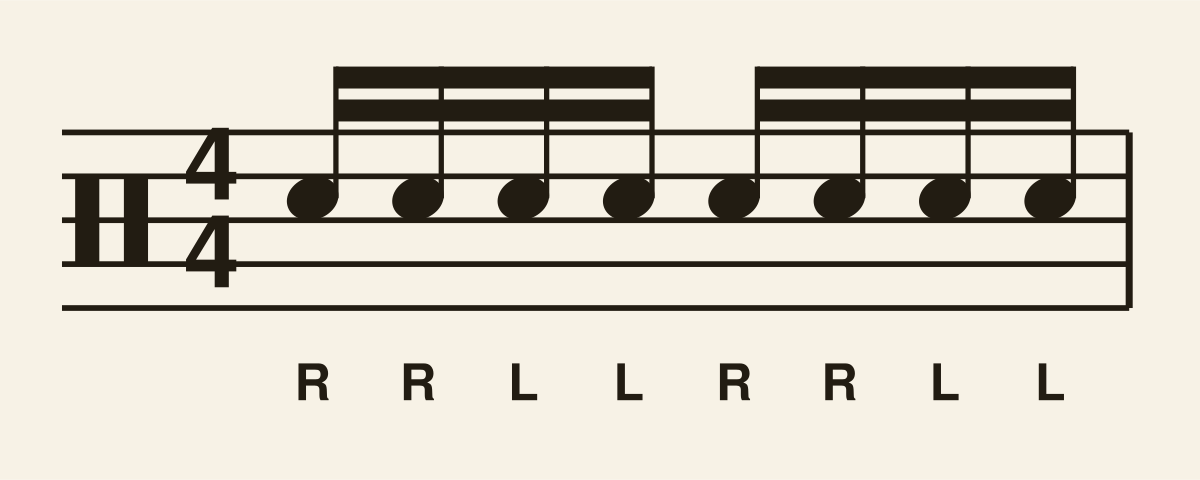
8 main strokes over 2 beats. Read it, hear it, and slow it down until it is even.
RR LL RR LL
Capital letters are full strokes; small letters are the quiet grace notes of a flam or drag.
What the double stroke open roll is
Two strokes per hand, alternating — the foundation of every long roll and of the five, seven, nine and seventeen stroke rolls above it. The first stroke of each pair is played, the second is controlled: at slow tempos you lift and strike twice, and as the tempo rises the rebound does the second stroke for you. Keep both notes of every pair identical in volume; unevenness here is what makes a roll sound lumpy.
How to practise it
- At slow tempos play both strokes deliberately — lift and strike twice. Do not use the rebound yet.
- Speed up gradually until the second stroke starts to come from the rebound on its own. That crossover point is the whole technique; sit at it.
- Check both notes of each pair are the same volume. A quiet second stroke is the single most common fault in a roll.
- Count the sixteenths out loud so the pairs stay in time rather than turning into an accelerating buzz.
Where it leads
The double stroke open roll belongs to the roll rudiments family, and it feeds directly into the five, seven, nine, eleven, thirteen, fifteen and seventeen stroke rolls — all of them are this rudiment cut to length. Get it even at a slow tempo before you move on — every rudiment built on top of it inherits whatever unevenness you leave here.
Reading the notation above
Both hands play the snare drum, so every notehead sits in the third space of the staff and the sticking letters underneath tell you which hand plays which note. Capital letters are full strokes; small letters are grace notes. There are no grace notes in this rudiment, so every note is a full stroke. The marks above the staff are accents: hit those notes harder. Full details in the drum notation guide.
Rudiment data last updated . Every diagram here, in the printable PDF and in the chart image comes from one dataset, so the paper and the screen cannot disagree.