PAS #7 · Roll rudiments
Five Stroke Roll
5 main strokes over 2 beats. Read it, hear it, and slow it down until it is even.
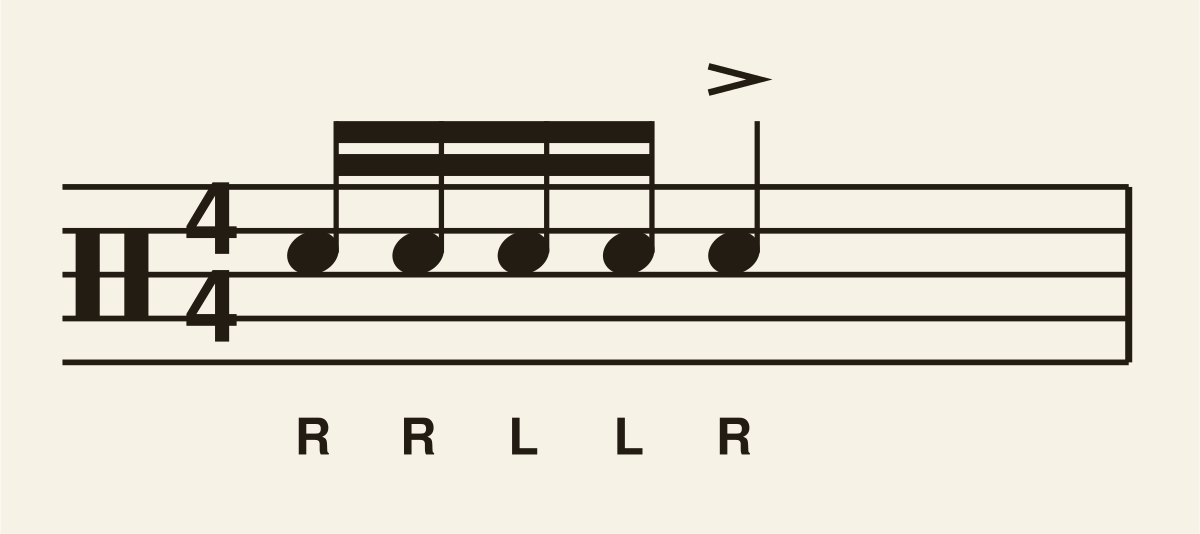
RR LL R
Capital letters are full strokes; small letters are the quiet grace notes of a flam or drag.
What the five stroke roll is
Two double strokes resolving onto a single accented stroke — five strokes in all, and by far the most-used short roll in real playing. It is written as four sixteenth notes landing on an accent on the next beat, so the roll fills the beat and the accent starts the new one. Repeat it leading with the left hand so both sides can start it.
How to practise it
- Count "1 e & a 2" and put the accent exactly on the 2. The roll fills the beat; the accent starts the next one.
- Play the accent first, on its own, with the metronome. Then add the four notes in front of it, so the accent never drifts.
- Alternate the lead: RRLLR then LLRRL. In real playing you need to start it with whichever hand is free.
- Once it is clean, put the accent on a crash and the doubles on the snare — that is a fill you can use tonight.
Where it leads
The five stroke roll belongs to the roll rudiments family, and it feeds directly into the seven and nine stroke rolls, and the standard roll-into-a-downbeat fill. Get it even at a slow tempo before you move on — every rudiment built on top of it inherits whatever unevenness you leave here.
Reading the notation above
Both hands play the snare drum, so every notehead sits in the third space of the staff and the sticking letters underneath tell you which hand plays which note. Capital letters are full strokes; small letters are grace notes. There are no grace notes in this rudiment, so every note is a full stroke. The marks above the staff are accents: hit those notes harder. Full details in the drum notation guide.
Rudiment data last updated . Every diagram here, in the printable PDF and in the chart image comes from one dataset, so the paper and the screen cannot disagree.