Guitar chord · Open shape · Standard tuning
A major guitar chord (A)
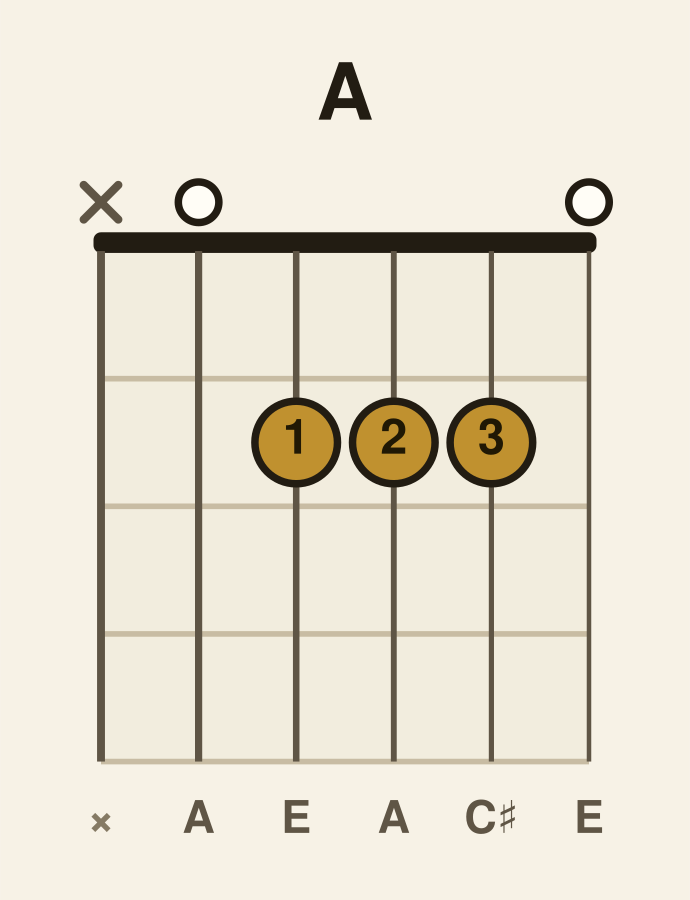
Place finger 1 on the 2nd fret of the D, finger 2 on the 2nd fret of the G, finger 3 on the 2nd fret of the B. Don't play the low E string.
A – C♯ – E
Loop strum: down, down-up, up-down-up on 1 & 2 & 3 & 4 &.
Next moves
3 fingers, 5 strings, chart notation x02220. Tap the chord box to hear it strummed, then play it string by string to check every note is ringing cleanly.
How to play A
Finger numbers run 1 for the index to 4 for the little finger. String names are given as players say them — the low E is the thickest string (the 6th) and the high E is the thinnest (the 1st).
- 1st finger (index) — 2nd fret, D string
- 2nd finger (middle) — 2nd fret, G string
- 3rd finger (ring) — 2nd fret, B string
- Play open: A (5th) and high E (1st) — strum them without fretting anything.
- Leave out: low E (6th) — start the strum below it, or damp it with the side of the thumb.
| String | Fret | Finger | Note it sounds |
|---|---|---|---|
| 6th — low E | Not played | — | × |
| 5th — A | Open | — | A |
| 4th — D | 2nd fret | 1 (index) | E |
| 3rd — G | 2nd fret | 2 (middle) | A |
| 2nd — B | 2nd fret | 3 (ring) | C♯ |
| 1st — high E | Open | — | E |
Notes and intervals in A
A is built from 3 notes: A, C♯ and E.
- A — the root
- C♯ — the major 3rd
- E — the perfect 5th
Across the six strings the shape sounds A · E · A · C♯ · E from low to high, so some notes are doubled in different octaves — that is what gives an open guitar chord its width compared with the same chord on a keyboard.
What A is used for
Three fingers in a row on the 2nd fret make A the tidiest of the open majors. It is the I chord in the key of A and the V that resolves to D, so it turns up in nearly every three-chord progression built on open strings. The root sits on the open 5th string, which is why the shape only asks for five strings.
Common mistakes with A
- Three fingers crammed into one fret. Angle the hand so the fingertips stack up behind the 2nd fret wire instead of piling on top of each other — if the high E chokes, the ring finger is leaning on it.
- Strumming the low E string. A has its root on the open 5th string, so letting the 6th ring puts an E underneath the chord. Start the strum at the A string or damp the 6th with the side of the thumb.
- Fretting in the middle of the fret space. Notes fizz when the fingertip sits too far back — slide the whole hand toward the fret wire, not harder into the fingerboard.
A first strum pattern
Count “1 & 2 & 3 & 4 &” — eighth notes (quavers). Strum down, down-up, up-down-up: down on 1, down on 2, up on the “&” of 2, up on the “&” of 3, down on 4, up on the “&” of 4. Keep your hand moving down and up all the time, and only touch the strings on the marked counts.
Start the strum loop above at 60–70 BPM and change chords on beat 1.
A major FAQ
How do you play A major on guitar?
Place finger 1 on the 2nd fret of the D, finger 2 on the 2nd fret of the G, finger 3 on the 2nd fret of the B. Don't play the low E string. In chart notation it is x02220, low E string first.
What notes are in A major?
A, C♯ and E: the root, the major 3rd and the perfect 5th.
What chord comes after A major?
Common changes from A major: D major and E major. Practice the switch slowly with the strum loop, then speed it up.
Guitar chord data last updated . Every diagram here, in the printable PDF and in the chart image comes from one dataset, so the paper and the screen cannot disagree.