Guitar chord · Barre shape · Standard tuning
F♯ minor guitar chord (F#m)
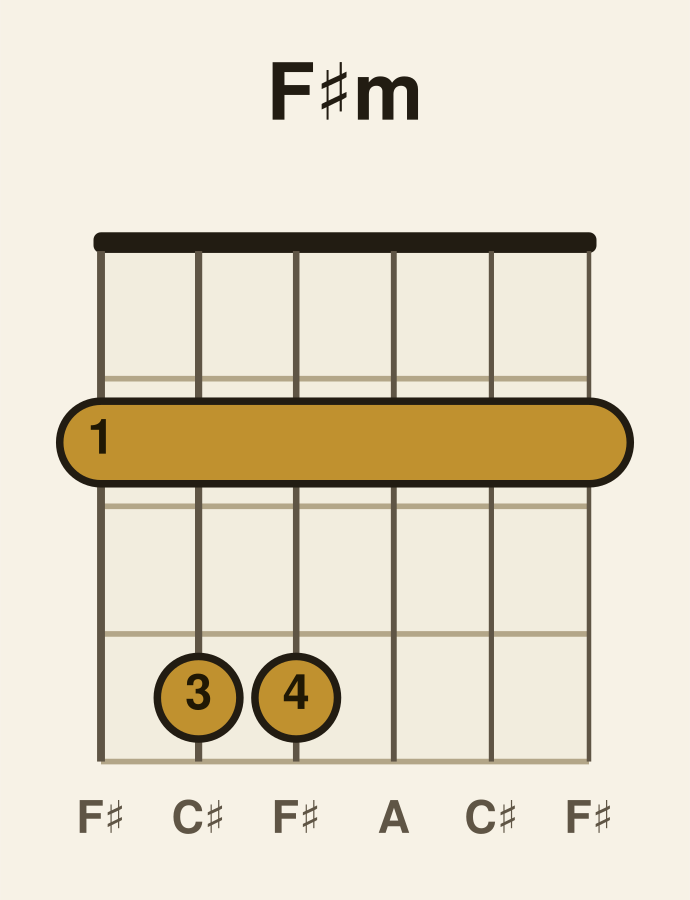
Barre finger 1 across the 2nd fret, then finger 3 on the 4th fret of the A, finger 4 on the 4th fret of the D. Strum all six strings.
F♯ – A – C♯
Loop strum: down, down-up, up-down-up on 1 & 2 & 3 & 4 &.
Next moves
3 fingers, 6 strings, chart notation 244222. Tap the chord box to hear it strummed, then play it string by string to check every note is ringing cleanly.
How to play F#m
Finger numbers run 1 for the index to 4 for the little finger. String names are given as players say them — the low E is the thickest string (the 6th) and the high E is the thinnest (the 1st).
- 1st finger (index) — lies flat across the 2nd fret, covering all six strings
- 3rd finger (ring) — 4th fret, A string
- 4th finger (little) — 4th fret, D string
- Strum all six strings. Nothing is muted in this shape, so the chord should ring from the low E right through to the high E.
- Barre: 2nd fret, strings 6 down to 1. Place the other fingers first and add the barre last.
| String | Fret | Finger | Note it sounds |
|---|---|---|---|
| 6th — low E | 2nd fret | 1 (index) | F♯ |
| 5th — A | 4th fret | 3 (ring) | C♯ |
| 4th — D | 4th fret | 4 (little) | F♯ |
| 3rd — G | 2nd fret | 1 (index) | A |
| 2nd — B | 2nd fret | 1 (index) | C♯ |
| 1st — high E | 2nd fret | 1 (index) | F♯ |
Notes and intervals in F#m
F#m is built from 3 notes: F♯, A and C♯.
- F♯ — the root
- A — the minor 3rd
- C♯ — the perfect 5th
Across the six strings the shape sounds F♯ · C♯ · F♯ · A · C♯ · F♯ from low to high, so some notes are doubled in different octaves — that is what gives an open guitar chord its width compared with the same chord on a keyboard.
What F#m is used for
F♯ minor is the vi chord in A and the ii in E — A, F♯m, D, E is a whole songbook. Barre the E-minor shape at the 2nd fret; it is usually the first full barre that feels manageable, because the 2nd fret is narrower than the 1st.
Common mistakes with F#m
- A barre that misses the G string. In the minor shape the index finger alone frets four strings, including the G — check it rings.
- Squeezing harder instead of rolling the finger. Pressure from the arm, with the elbow in, does more than a tighter grip.
- Placing the barre last but the other fingers in the wrong strings. Ring and little fingers go on the A and D strings, two frets up.
A first strum pattern
Count “1 & 2 & 3 & 4 &” — eighth notes (quavers). Strum down, down-up, up-down-up: down on 1, down on 2, up on the “&” of 2, up on the “&” of 3, down on 4, up on the “&” of 4. Keep your hand moving down and up all the time, and only touch the strings on the marked counts.
Start the strum loop above at 60–70 BPM and change chords on beat 1.
F♯ minor FAQ
How do you play F♯ minor on guitar?
Barre finger 1 across the 2nd fret, then finger 3 on the 4th fret of the A, finger 4 on the 4th fret of the D. Strum all six strings. In chart notation it is 244222, low E string first.
What notes are in F♯ minor?
F♯, A and C♯: the root, the minor 3rd and the perfect 5th.
What chord comes after F♯ minor?
Common changes from F♯ minor: G minor and G♯ minor. Practice the switch slowly with the strum loop, then speed it up.
Guitar chord data last updated . Every diagram here, in the printable PDF and in the chart image comes from one dataset, so the paper and the screen cannot disagree.