Guitar chord · Barre shape · Standard tuning
F♯ major guitar chord (F#)
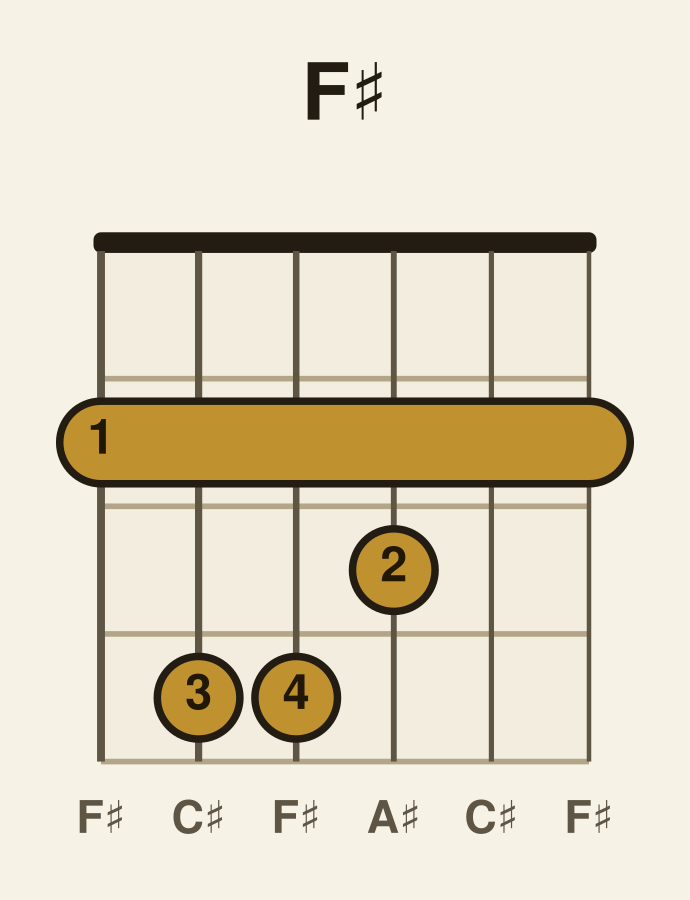
4 fingers, 6 strings, chart notation 244322. Tap the chord chart to hear it strummed, then arpeggio it to check every note is ringing cleanly.
All the strings in one sweep, low to high — how the chord sounds in a song.
- Strings, low to high
- F♯ · C♯ · F♯ · A♯ · C♯ · F♯
- Chord tones
- F♯ R · A♯ 3 · C♯ 5
How to play F#
Finger numbers run 1 for the index to 4 for the little finger. String names are given as players say them — the low E is the thickest string (the 6th) and the high E is the thinnest (the 1st).
- 1st finger (index) — lies flat across the 2nd fret, covering all six strings
- 2nd finger (middle) — 3rd fret, G string
- 3rd finger (ring) — 4th fret, A string
- 4th finger (little) — 4th fret, D string
- Strum all six strings. Nothing is muted in this shape, so the chord should ring from the low E right through to the high E.
- Barre: 2nd fret, strings 6 down to 1. Place the other fingers first and add the barre last.
| String | Fret | Finger | Note it sounds |
|---|---|---|---|
| 6th — low E | 2nd fret | 1 (index) | F♯ |
| 5th — A | 4th fret | 3 (ring) | C♯ |
| 4th — D | 4th fret | 4 (little) | F♯ |
| 3rd — G | 3rd fret | 2 (middle) | A♯ |
| 2nd — B | 2nd fret | 1 (index) | C♯ |
| 1st — high E | 2nd fret | 1 (index) | F♯ |
Notes and intervals in F#
F# is built from 3 notes: F♯, A♯ and C♯.
- F♯ — the root (R)
- A♯ — the major 3rd (3)
- C♯ — the perfect 5th (5)
Across the six strings the shape sounds F♯ · C♯ · F♯ · A♯ · C♯ · F♯ from low to high, so some notes are doubled in different octaves — that is what gives an open guitar chord its width compared with the same chord on a keyboard.
What F# is used for
F♯ is the V chord in B and the chord that resolves a song in B minor home. It is the E-major shape barred at the 2nd fret — exactly the F barre moved up one fret, so if F works, F♯ already does.
Common mistakes with F#
- Barring with the soft crease of the index finger. Roll it onto its bony outside edge so the G, B and high E strings sound clean.
- The thumb hooked over the neck. Put it behind the neck, roughly opposite the middle finger, so the hand squeezes instead of the arm pulling.
- A collapsing ring or little finger. Arch them so they do not lean on the G string, which is the one note the index barre does not cover in this shape.
Guitar chord data last updated . Every diagram here, in the printable PDF and in the chart image comes from one dataset, so the paper and the screen cannot disagree.