Third octave · written D6–C7 · 11 notes
Flute high notes: high D and the third octave
High D (written D6) is where the third octave begins, and it is the note the whole register is built on. Tap it below to see the fingering and hear it, then work up through the rest of the octave.
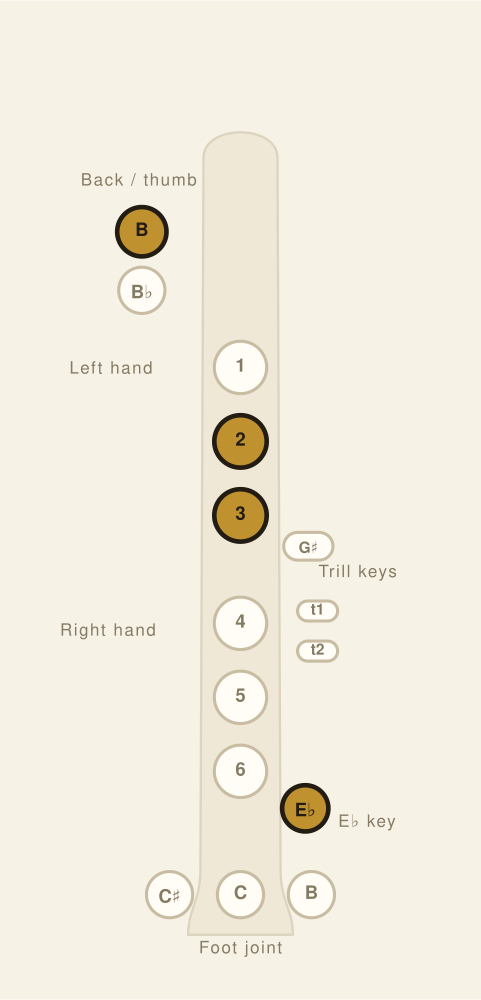
Third-octave D is thumb, left second and third fingers and the E-flat key — the left first finger stays off, venting the tube for the third harmonic of G4. It is the doorway to the high register: much faster air, a smaller aperture and a slightly higher air direction, but no biting. Students who try the second-octave D fingering here get only a squeak.
Everything about D6 on flute →Flute high-note fingerings: high D to high C
The complete third octave of a C-foot flute. The flute is a concert-pitch instrument, so the written note is the note that sounds — start at high D and work upward.
Octave 610 notes
D6
E♭6
E6
F6
F♯6
G6
A♭6
A6
B♭6
B6
Octave 71 note
C7
Pressed or coveredOpenBeginner note
| Written note | Fingering | E♭ key |
|---|---|---|
| High D (D6) | Thumb B key + Left middle (key 2) + Left ring (key 3) + E♭ key (right little finger) | Down |
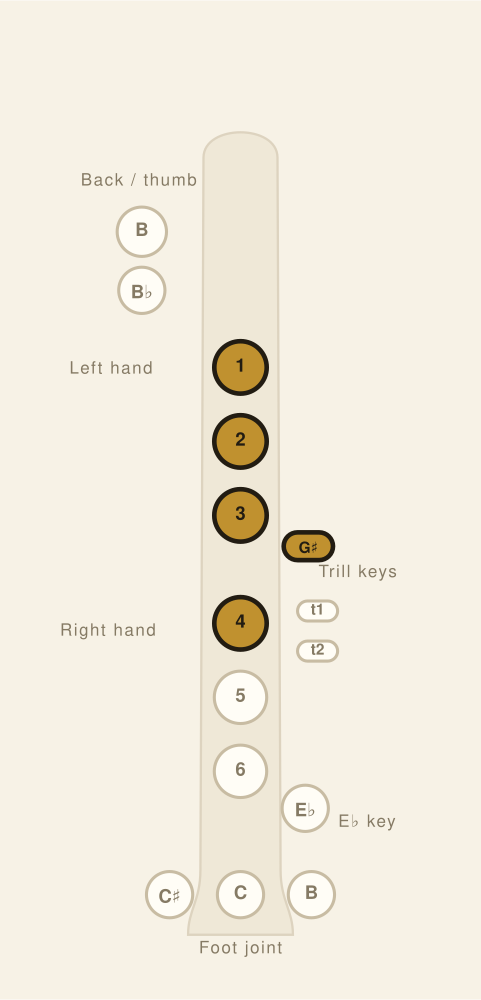
| High E♭ (E♭6) | Thumb B key + Left index (key 1) + Left middle (key 2) + Left ring (key 3) + G♯ key (left little finger) + Right index (key 4) + Right middle (key 5) + Right ring (key 6) + E♭ key (right little finger) | Down |
| High E (E6) | Thumb B key + Left index (key 1) + Left middle (key 2) + Right index (key 4) + Right middle (key 5) + E♭ key (right little finger) | Down |
| High F (F6) | Thumb B key + Left index (key 1) + Left ring (key 3) + Right index (key 4) + E♭ key (right little finger) | Down |
| High F♯ (F♯6) | Thumb B key + Left index (key 1) + Left ring (key 3) + Right ring (key 6) + E♭ key (right little finger) | Down |
| High G (G6) | Left index (key 1) + Left middle (key 2) + Left ring (key 3) + E♭ key (right little finger) | Down |
| High A♭ (A♭6) | Left middle (key 2) + Left ring (key 3) + G♯ key (left little finger) + E♭ key (right little finger) | Down |
| High A (A6) | Thumb B key + Left middle (key 2) + Right index (key 4) + E♭ key (right little finger) | Down |
| High B♭ (B♭6) | Thumb B key + Right index (key 4) + First (D) trill key | Up |
| High B (B6) | Thumb B key + Left index (key 1) + Left ring (key 3) + Second (E♭) trill key | Up |
| High C (C7) | Left index (key 1) + Left middle (key 2) + Left ring (key 3) + G♯ key (left little finger) + Right index (key 4) | Up |
Why third-octave fingerings differ
The first two octaves of the flute share fingerings: from E5 upward the second octave is simply the first octave overblown. The third octave breaks that pattern completely, because these notes are harmonics of lower fingerings, vented. Instead of closing the tube further, you leave a hole open partway along it, and the flute locks onto its third or fourth harmonic.
Once you know that, the strange shapes make sense. High D is the third harmonic of G4 with the left first finger lifted as the vent. High E-flat is the third harmonic of A♭4 — every finger down plus the G♯ key, which looks wrong and is right, because the full fingering is what stops it collapsing. High E is the third harmonic of A4. High F leaves a gap in the middle of the left hand: close left 2 out of habit and you get a muffled note or nothing at all. High A takes thumb, left 2 and right 1 — almost nothing closed, which is exactly the point.
The practical consequence is that you cannot guess up here, and you cannot carry a second-octave fingering into the third. Students who try the D5 fingering for high D get a squeak, every time.
Air speed, not blowing harder
The third octave asks for faster air through a smaller aperture, aimed a little higher across the lip plate. That is a different thing from blowing harder. More force spreads the airstream, and a spread airstream drops the note back an octave or turns it into a hiss — that is what is happening when high A refuses to speak.
Nor does the jaw help. Biting makes high notes sharp, thin and squeak-prone, and it caps how high you can get. Keep the corners of the embouchure firm, the aperture small but not pinched, and let the air do the work. Two useful reference points from the register itself: an airy sound at high G means the aperture has opened too far, while a sharp, pinched C6 or C7 means you are over-blowing.
F♯6 is the most cooperative note up here, which makes it the sensible place to start building the register. Then approach the others from below — slur into them from the second-octave note that shares the harmonic parent, rather than jumping at them cold.
The E♭-key exceptions at the top
Everywhere else on the flute the E♭ key is the right little finger’s home: it opens a tone hole, so pressing it raises the pitch, and it stays down for almost every note from E♭4 upward. The three notes at the very top of the range break that rule, and the table above marks them.
- B♭6 — thumb and right first finger with the first (D) trill key held down, and the E♭ key comes off. This is the first note in the whole range where the right little finger leaves its home position. It is a fourth-harmonic fingering, wants very fast air, and normally sits sharp.
- B6 — thumb, left first and third fingers and the second (E♭) trill key, with the E♭ key released. Holding a trill key while the little finger is off makes the flute feel unsupported, so practise the approach into the note slowly.
- C7 — no thumb, left hand down with the G♯ key, right first finger, and the E♭ key off. On a B-foot flute the gizmo key closes the low-B pad and makes C7 speak far more easily. A C-foot flute has no gizmo, so it depends entirely on very fast, accurately aimed air.
If one of these three arrives a semitone high or refuses to centre, the little finger is the first thing to check — habit keeps it pressed down.
Frequently asked questions
What is the fingering for high D on flute?
High D (written D6) is thumb B, left second and third fingers, and the E♭ key — the left first finger stays off. That raised finger is the vent: high D is the third harmonic of G4, not low D overblown, so the second-octave D fingering produces only a squeak up here.
Why are third-octave flute fingerings so strange?
Because they are harmonic fingerings. Instead of closing the tube progressively, they leave a hole open partway up so the flute locks onto its third or fourth harmonic. That is why high E-flat has every finger down plus the G♯ key, and why high F leaves a gap in the middle of the left hand. The odd-looking hole is doing the work.
Do I need a split-E mechanism for high E?
No, but it helps a great deal. High E6 is the flute's notorious weak note and it wants to slip down to A5. A split-E mechanism closes an extra pad for it and makes the note far more secure. Without one you need fast air aimed slightly higher across the lip plate — more force will not fix it.
Flute fingering data last updated . Every diagram here, in the printable PDF and in the chart image comes from one dataset, so the paper and the screen cannot disagree.