Flute
High D on the Flute
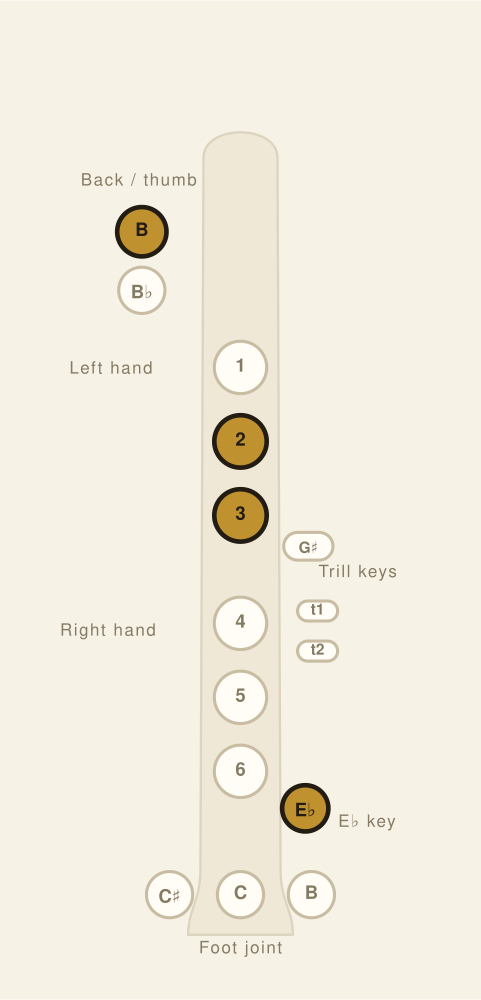
Written D6. Tap the diagram to hear it.
Third-octave D is thumb, left second and third fingers and the E-flat key — the left first finger stays off, venting the tube for the third harmonic of G4. It is the doorway to the high register: much faster air, a smaller aperture and a slightly higher air direction, but no biting. Students who try the second-octave D fingering here get only a squeak.
About this note
Third-octave D is thumb, left second and third fingers and the E-flat key — the left first finger stays off, venting the tube for the third harmonic of G4. It is the doorway to the high register: much faster air, a smaller aperture and a slightly higher air direction, but no biting. Students who try the second-octave D fingering here get only a squeak.
- Primary fingering: Thumb B key + Left middle (key 2) + Left ring (key 3) + E♭ key (right little finger)
- Written pitch: D6
- Sounding frequency: 1174.66 Hz
Trill fingerings
- High D ↔ E♭6 (Hold high D and shake the second (E-flat) trill key): Thumb B key + Left middle (key 2) + Left ring (key 3) + Second (E♭) trill key + E♭ key (right little finger)
Flute fingering data last updated . Every diagram here, in the printable PDF and in the chart image comes from one dataset, so the paper and the screen cannot disagree.