B♭ · above the staff · 6 notes
Trumpet high notes: fingerings above the staff
From written G5 up to high C, the valve combinations you already know come back around — what changes is the harmonic partial. Tap any note to see the valves, hear the pitch and check the slot it lives in.
Eighth partial with 1-2, a minor third under high C. Think the pitch downward from high C rather than upward from G5 — the slot is easier to find from above.
Everything about A5 on B♭ trumpet →Trumpet high-note fingerings: G5 to high C
Every note above the treble staff on a B♭ trumpet, with the valve combination and the harmonic partial it is played on. Written pitches are what you read; the concert column is what sounds.
Octave 55 notes
G5
sounds F5
A♭5
sounds G♭5
A5
sounds G5
B♭5
sounds A♭5
B5
sounds A5
Octave 61 note
C6
sounds B♭5
Pressed or coveredOpenBeginner note
| Written note | Sounds (concert) | Fingering | Harmonic partial |
|---|---|---|---|
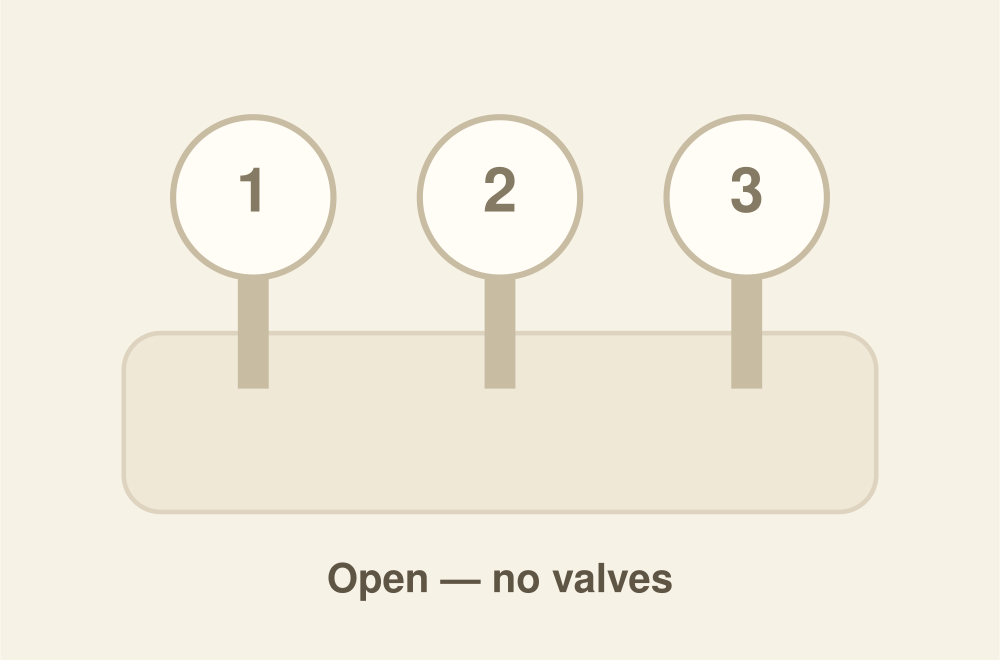
| G5 (G5) | F5 | Open (no valves) | 6 |
| A♭5 (A♭5) | G♭5 | Valves 2 + 3 | 8 |
| A5 (A5) | G5 | Valves 1 + 2 | 8 |
| B♭5 (B♭5) | A♭5 | Valves 1 | 8 |
| B5 (B5) | A5 | Valves 2 | 8 |
| High C (C6) | B♭5 | Open (no valves) | 8 |
Fingerings don’t change much up here — partials do
From about G5 the seven valve combinations simply start over one register higher. Open gives you G5 on the 6th partial and high C on the 8th. Valve 2 gives F♯5, then B5. Valve 1 gives F5, then B♭5. The one that surprises people is A♭5, which takes 2-3 rather than valve 1 — valve 1 would land it on the badly flat 7th partial, so every chart routes around it.
That is the whole story of the high register: the fingers repeat, the partials climb. Low down, neighbouring slots on one fingering are a fifth or a fourth apart and the lip can hardly miss. Above the staff they are a tone, then a semitone apart, so accuracy stops being a fingering problem and becomes a hearing problem. If you can hear the note clearly before the tongue moves, the lip finds the slot; if you cannot, the valves are no help at all.
Building range
- Air speed, not air volume. High notes need faster, more compressed air through a smaller opening — the same amount of blowing, moving quicker. Blowing harder just makes a loud low note.
- An efficient embouchure. Firm corners, a small but unpinched aperture, and the same setting you use in the middle register. Rebuilding your face for each octave is what makes the high notes feel like a different instrument.
- Rest as much as you play. Range is built by recovery as much as by practice. Short bursts with equal rest beat one long session, and the lip repairs between sessions, not during them.
- No pressure. Pushing the mouthpiece into the lip stops the tissue vibrating and caps the range you can reach — often permanently for that session. If a note only comes out with force, work the semitone below it instead: B5 is where high C is actually built.
Above high C
Being honest about the ceiling: high C (written C6) is where this chart stops, because that is the top of the standard written range for the B♭ trumpet and the last note we can publish a verified fingering for. Plenty of players go higher — the pattern does not change, it just gets tighter.
The arithmetic carries straight on. D6 is the open 9th partial, and from there the same seven combinations lower it chromatically exactly as they do lower down, so above high C the valves keep repeating while the slots close up to a semitone and less. In practice that means the fingering chart stops being the useful part: everything above high C is embouchure efficiency, air speed and ear first, valves second.
Frequently asked questions
What are the trumpet fingerings for high notes?
Above the staff: G5 is open, A♭5 is 2-3, A5 is 1-2 (or 3 on its own), B♭5 is valve 1, B5 is valve 2 and high C is open again. They are the same combinations you already use in the middle of the staff — the difference is that you are playing them on the 6th and 8th partials rather than the 3rd and 4th.
Why do high notes crack?
Because the partials are only a semitone or two apart up here, so a lip that lands between two slots gets neither. It is almost always the attack: the air slows down or stops just as the tongue moves, or the mouthpiece gets pressed in to compensate. Hear the pitch before you play it, keep the air moving through the attack, and approach from a note you already own — B5 into high C rather than a jump from nowhere.
Is high C hard on trumpet?
It is the standard ceiling of most school and orchestral parts, and it is genuinely demanding — but not because of the fingering. High C is an open 8th-partial note, the same no-valve fingering as C4, G4 and C5, so the fingers contribute nothing. It comes from air speed, an efficient aperture and knowing the sound you are aiming for. Most players get there with consistent daily work; forcing it with mouthpiece pressure delays it.
Trumpet fingering data last updated . Every diagram here, in the printable PDF and in the chart image comes from one dataset, so the paper and the screen cannot disagree.