PAS #9 · Roll rudiments
Seven Stroke Roll
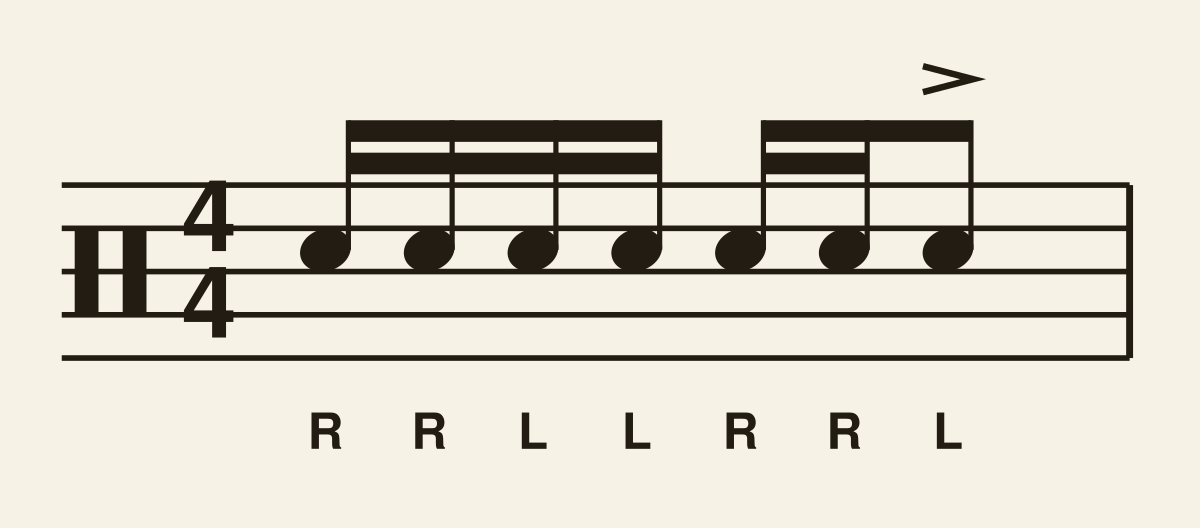
RR LL RR L — 7 main strokes over 2 beats in sixteenth notes (semiquavers), 1 accent. Loop it from 52 BPM and build to 82.
R = right hand · L = left · small raised letters are grace notes · > = accent. The count runs along the bottom.
Next moves
What the seven stroke roll is
Read it, hear it, and slow it down until it is even.
Three double strokes resolving onto one accented single. Longer than the five stroke roll, so it usually spans a beat and a half before the accent lands.
How to practice it
- Three doubles then one accent — think "diddle, diddle, diddle, hit".
- Keep the doubles low so the accent stands out without being forced.
- Start it with either hand: the accent lands on the opposite hand to the one you start with.
Where it leads
The seven stroke roll belongs to the roll rudiments family, and it feeds directly into the nine, eleven and thirteen stroke rolls. Get it even at a slow tempo before you move on — every rudiment built on top of it inherits whatever unevenness you leave here.
Reading the notation above
Both hands play the snare drum, so every notehead sits in the third space of the staff and the sticking cells underneath tell you which hand plays which note, with the count under every stroke. Capital letters are full strokes; small raised letters are grace notes. There are no grace notes in this rudiment, so every note is a full stroke. The marks above the staff are accents: hit those notes harder. Full details in the drum notation guide.
Tempo ladder
Tap a rung to set the speed. Play 8 clean loops before moving up.
More roll rudiments
Questions
What is the sticking for the seven stroke roll?
RR LL RR L. R = right hand, L = left hand.
How fast should I play it?
Start slow enough that every stroke is even — around 52 BPM — then go up 4–5 BPM at a time. 82 BPM is a good first target.
How is the seven stroke roll written in notation?
On the snare line: the third space of the drum staff (stave), stems up, as sixteenth notes (semiquavers), with an accent mark (>) over the loud strokes. The count runs under the sticking: 1 e & a.
Rudiment data last updated . Every diagram here, in the printable PDF and in the chart image comes from one dataset, so the paper and the screen cannot disagree.