Piano chord · Dominant 7th
B dominant 7th piano chord (B7)
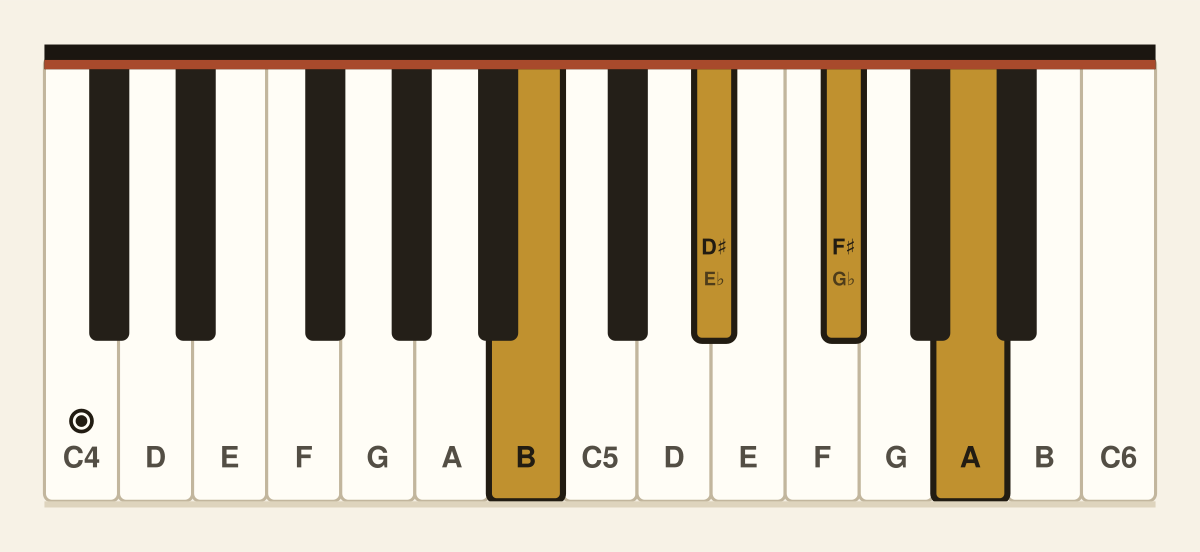
B, D♯, F♯ and A, played together. Root position is highlighted on the keyboard below — press play to hear it.
Notes in B7: B, D♯, F♯ and A
| Note | Interval from the root | Key around middle C |
|---|---|---|
| B | Root | B4 · white key |
| D♯ | Major 3rd | D♯5 · black key |
| F♯ | Perfect 5th | F♯5 · black key |
| A | Minor 7th | A5 · white key |
- Chord symbol: B7 — B dominant 7th
- Formula: R · 3 · 5 · b7 (0 · 4 · 7 · 10 semitones from the root)
- Right hand fingering: 1-2-3-5 — thumb, index, middle and little finger
- Left hand fingering: 5-3-2-1, little finger on the root
How B7 works
B7 is the dominant of both E major and E minor, which makes it a staple of classical minor keys and of blues in E alike. Two black keys sit inside the shape, so the hand tilts forward while the thumb and little finger stay on the white outer notes.
B7 inversions
An inversion keeps the same notes and changes which one is at the bottom. That matters because it lets you move between chords without jumping: the closer the notes of the next chord are to the ones your hand is already holding, the smoother it sounds and the easier it is to play. Root position first, then three inversions.
Root position
B–D♯–F♯–A — the root, B, is at the bottom.
1st inversion — D♯ in the bass
D♯–F♯–A–B — the same four notes, reordered so D♯ is lowest.
2nd inversion — F♯ in the bass
F♯–A–B–D♯ — the same four notes, reordered so F♯ is lowest.
3rd inversion — A in the bass
A–B–D♯–F♯ — the same four notes, reordered so A is lowest.
Common mistakes on B7
- Playing D natural instead of D♯, which gives Bm7.
- Playing A♯ on top out of habit from the B major scale; the seventh of B7 is A natural.
- Squeezing the hand to secure the two black keys, which drags the outer fingers off theirs.
Piano chord data last updated . Every diagram here, in the printable PDF and in the chart image comes from one dataset, so the paper and the screen cannot disagree.